Department of Community & Behavioral Health, Colorado School of Public Health, University of Colorado Anschutz Medical Campus, Aurora, Colorado, USA.
Center for Global Health, Colorado School of Public Health, Aurora, Colorado, USA.
Brain Behav. 2024 Aug;14(8):e3646. doi: 10.1002/brb3.3646.
Having more "autistic traits" is associated with an increased risk of mental health conditions. However, few studies have examined autistic traits in nonclinical samples. This study aims to analyze the relationship between autistic traits and internalizing symptoms among early adolescents and to examine the moderating effect of self-efficacy.
Survey data were collected from early adolescents ages 10-14 living in Darjeeling, India (n = 274) to assess autistic traits, self-efficacy, and internalizing symptoms.
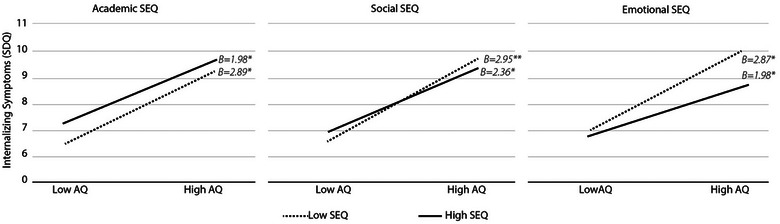
Higher internalizing symptoms were significantly associated with a higher report of autistic traits. Academic, social, and emotional dimensions of self-efficacy moderated the relationship between autistic traits and internalizing symptoms.
The moderation effects between social and emotional self-efficacy among youth with high versus low autism trait scores suggest the need for social-emotional learning interventions designed for and with neurodivergent youth. Such interventions aim to reduce internalizing symptoms during early adolescence and improve future mental health trajectories.
具有更多“自闭症特征”与心理健康状况风险增加相关。然而,很少有研究在非临床样本中检查自闭症特征。本研究旨在分析自闭症特征与青少年早期内化症状之间的关系,并检验自我效能感的调节作用。
从印度大吉岭的 10-14 岁青少年中收集了调查数据(n=274),以评估自闭症特征、自我效能感和内化症状。
更高的内化症状与更高的自闭症特征报告显著相关。自我效能感的学业、社会和情感维度调节了自闭症特征与内化症状之间的关系。
在自闭症特征得分高和低的青少年中,社会和情感自我效能感之间的调节作用表明,需要为和青少年神经多样性一起设计社交情感学习干预措施。这些干预措施旨在减少青少年早期的内化症状,并改善未来的心理健康轨迹。