Zhou Zhuo-Ren, Guo Yong
Department of Health Care, Guangdong Women and Children Hospital, Guangzhou, 511400, People's Republic of China.
Pediatric Health Med Ther. 2024 Aug 8;15:265-272. doi: 10.2147/PHMT.S468778. eCollection 2024.
This study aimed to assess the growth of full-term infants with different sizes at birth and examine catch-up and catch-down growth in their first year.
This retrospective population-based cohort study was based on the Guangdong Provincial Women and Children Health Information System. 194797 full-term singleton live births were extracted. Measurements for weight and length were taken at birth, 6 months, and 12 months. The size-for-gestational age was categorized as small (SGA, <10th centile), appropriate (AGA, 10th-90th centiles), or large (LGA, >90th centile) based on the international newborn size for gestational age and sex INTERGROWTH-21st standards. Catch-up and catch- down growth were defined as a change in standard deviation in z-score greater than 0.67 in the growth curves.
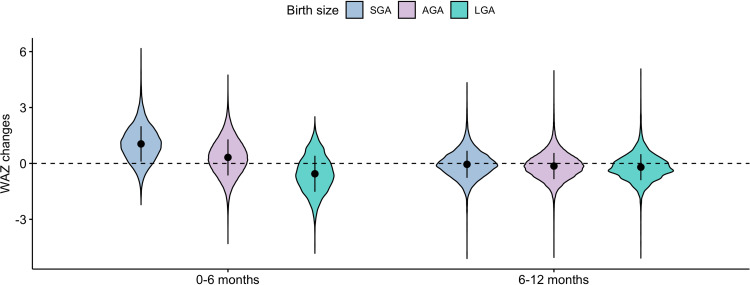
Of the 194797 full-term singletons, the average gestational age was 39.28 ± 1.03 weeks, and the average weight of the newborns was 3205 ± 383 grams. 15632 infants were identified as SGA (8.0%) and 12756 were LGA (6.5%). At 1 year of age, catch-up growth in weight was observed in 63.0% of SGA infants, 29.5% of AGA infants, and 5.4% of LGA infants. Conversely, catch-down growth occurred in 3.3% of SGA infants, 17.8% of AGA infants, and 54.7% of LGA infants. The proportions of catch-up growth in length for SGA, AGA, and LGA infants within the first year were 31.4%, 22.5%, and 17.1%, respectively. Catch-up or catch-down growth predominantly occurred before 6 months of age. However, from 6 to 12 months, there was no significant variation in WAZ among children with different birth sizes.
In their first year of life, full-term singleton live births tend towards regression to the mean in their postnatal weight and length. The average delay in the growth of LGA is compensated by an increase in it of the SGA. Early monitoring and intervention are crucial for optimizing growth in infants with different birth sizes.
本研究旨在评估不同出生大小的足月儿的生长情况,并观察其出生后第一年的追赶生长和生长减缓情况。
本项基于人群的回顾性队列研究以广东省妇幼健康信息系统为基础。提取了194797例足月儿单胎活产病例。在出生时、6个月和12个月时测量体重和身长。根据国际胎儿生长发育标准(INTERGROWTH-21st标准),将出生体重与胎龄的关系分为小于胎龄儿(SGA,<第10百分位数)、适于胎龄儿(AGA,第10-90百分位数)或大于胎龄儿(LGA,>第90百分位数)。追赶生长和生长减缓定义为生长曲线中z评分的标准差变化大于0.67。
在194797例足月儿单胎活产病例中,平均胎龄为39.28±1.03周,新生儿平均体重为3205±383克。15632例婴儿被确定为小于胎龄儿(8.0%),12756例为大于胎龄儿(6.5%)。在1岁时,63.0%的小于胎龄儿、29.5%的适于胎龄儿和5.4%的大于胎龄儿出现体重追赶生长。相反,3.3%的小于胎龄儿、17.8%的适于胎龄儿和54.7%的大于胎龄儿出现生长减缓。小于胎龄儿、适于胎龄儿和大于胎龄儿在出生后第一年内身长追赶生长的比例分别为31.4%、22.5%和17.1%。追赶生长或生长减缓主要发生在6个月之前。然而,在6至12个月期间,不同出生大小的儿童之间的体重别身高(WAZ)没有显著差异。
在出生后的第一年,足月儿单胎活产儿在出生后的体重和身长倾向于向均值回归。大于胎龄儿生长的平均延迟通过小于胎龄儿生长的增加得到补偿。早期监测和干预对于优化不同出生大小婴儿的生长至关重要。