Department of Preventive Medicine, Shantou University Medical College, Shantou, China.
Department of Healthcare, Guangdong Women and Children Hospital, Guangzhou, China.
JAMA Netw Open. 2022 Jun 1;5(6):e2216658. doi: 10.1001/jamanetworkopen.2022.16658.
Many studies have reported an association of interpregnancy interval (IPI) between 2 consecutive births with adverse birth outcomes in low- and middle-income countries. However, most of these studies ignore the implications of some unmeasured confounders.
To explore the association of IPI with adverse perinatal outcomes.
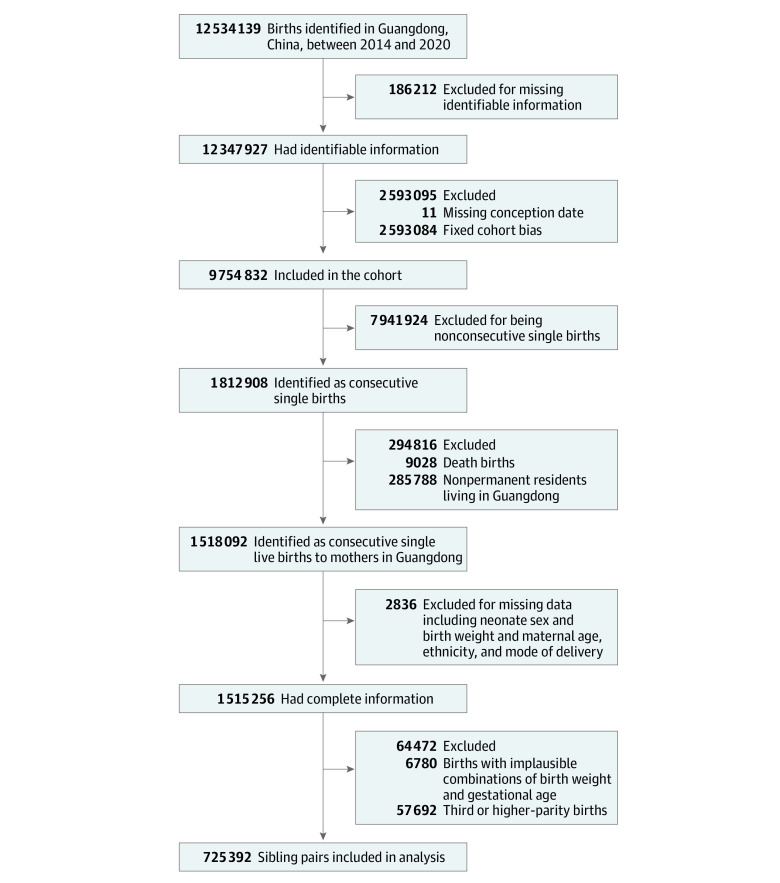
DESIGN, SETTING, AND PARTICIPANTS: This large-scale cohort study used the Guangdong Provincial Women and Children Health Information System in Guangdong Province, China, to obtain birth data recorded between January 1, 2014, and December 31, 2020. Matched-sibling design was used. The final cohort included first-born and second-born sibling pairs delivered by mothers who were permanent residents of Guangdong Province.
The exposure variable was IPI, which was categorized as follows: less than 6, 6 to 11, 12 to 17, 18 to 23, 24 to 29, 30 to 35, and 36 or more months.
The outcome variables were adverse birth outcomes: preterm birth (PTB, gestational age <37 weeks), low birth weight (LBW, <2500 g), and small for gestational age (SGA). Adjusted odds ratio (OR) and interaction odds ratio (IOR) associated with IPI were calculated.
The study consisted of 725 392 sibling pairs of multiparous mothers. Among these mothers, 718 111 (99.0%) were aged 20 to 34 years, and 715 583 (98.7%) were of Han Chinese ethnicity. Unmatched analysis showed that a short IPI of less than 6 months was associated with higher risks of PTB (adjusted OR, 1.96; 95% CI, 1.87-2.06), LBW (adjusted OR, 1.88; 95% CI, 1.79-1.98), and SGA (adjusted OR, 1.34; 95% CI, 1.30-1.38) compared with an IPI of 18 to 23 months. These associations were attenuated in the matched-sibling analysis. An association of short IPI (<6 months) with PTB (adjusted IOR, 1.40; 95% CI, 1.30-1.51), LBW (adjusted IOR, 1.30; 95% CI, 1.21-1.40), and SGA (adjusted IOR, 1.16; 95% CI, 1.11-1.22) remained in the matched analysis. For IPI of 36 months or more, the odds of PTB (adjusted OR, 1.08; 95% CI, 1.03-1.14) and LBW (adjusted OR, 1.13; 95% CI, 1.07-1.19) in the unmatched analysis were also greater than the reference interval (18-23 months), but not for SGA (adjusted OR, 0.96; 95% CI, 0.93-0.99). Associations between a long IPI (≥36 months) and PTB (adjusted IOR, 1.10; 95% CI, 1.02-1.19) and LBW (adjusted IOR, 1.16; 95% CI, 1.07-1.26) remained through the sibling comparisons.
Results of this study indicated that mothers with a short (<6 months) or long (≥36 months) IPI had greater odds of adverse birth outcomes. The findings may inform family planning policies and guide individuals and families who are planning for another pregnancy in China.
许多研究报告称,低中等收入国家连续两次妊娠之间的间隔(IPI)与不良出生结局之间存在关联。然而,这些研究大多忽略了一些未测量混杂因素的影响。
探讨 IPI 与不良围产期结局的关系。
设计、设置和参与者:本大规模队列研究使用了中国广东省的广东省妇女儿童健康信息系统,以获取 2014 年 1 月 1 日至 2020 年 12 月 31 日期间记录的分娩数据。采用匹配的同胞设计。最终队列包括由广东省常住居民母亲所生的第一胎和第二胎同胞对。
暴露变量是 IPI,分为以下几类:少于 6 个月、6 至 11 个月、12 至 17 个月、18 至 23 个月、24 至 29 个月、30 至 35 个月和 36 个月或更长时间。
结局变量是不良出生结局:早产(PTB,<37 周)、低出生体重(LBW,<2500g)和小于胎龄儿(SGA)。计算了与 IPI 相关的调整后比值比(OR)和交互比值比(IOR)。
该研究包括 725392 对多产母亲的同胞对。在这些母亲中,718111 人(99.0%)年龄在 20 至 34 岁之间,715583 人(98.7%)为汉族。未匹配分析显示,IPI 短于 6 个月与 PTB(调整后的 OR,1.96;95%CI,1.87-2.06)、LBW(调整后的 OR,1.88;95%CI,1.79-1.98)和 SGA(调整后的 OR,1.34;95%CI,1.30-1.38)的风险增加相关,与 IPI 为 18 至 23 个月相比。在匹配的同胞分析中,这些关联减弱了。与 IPI 较短(<6 个月)与 PTB(调整后的 IOR,1.40;95%CI,1.30-1.51)、LBW(调整后的 IOR,1.30;95%CI,1.21-1.40)和 SGA(调整后的 IOR,1.16;95%CI,1.11-1.22)仍存在关联。在匹配分析中,IPI 为 36 个月或更长时间的 PTB(调整后的 OR,1.08;95%CI,1.03-1.14)和 LBW(调整后的 OR,1.13;95%CI,1.07-1.19)的几率也高于参考区间(18-23 个月),但 SGA(调整后的 OR,0.96;95%CI,0.93-0.99)除外。在未匹配分析中,较长 IPI(≥36 个月)与 PTB(调整后的 IOR,1.10;95%CI,1.02-1.19)和 LBW(调整后的 IOR,1.16;95%CI,1.07-1.26)之间也存在关联。
本研究结果表明,IPI 短(<6 个月)或长(≥36 个月)的母亲发生不良出生结局的几率更高。这些发现可能为计划生育政策提供信息,并为中国计划再次怀孕的个人和家庭提供指导。

