Moody Louise, Wood Esme, Needham Abigail, Booth Andrew, Tindale Wendy
Centre for Arts, Memory and Communities, Coventry University, UK.
NIHR Devices for Dignity HealthTech Research Centre, Sheffield Teaching Hospitals NHS Foundation Trust, UK.
Digit Health. 2024 Jun 7;10:20552076241247196. doi: 10.1177/20552076241247196. eCollection 2024 Jan-Dec.
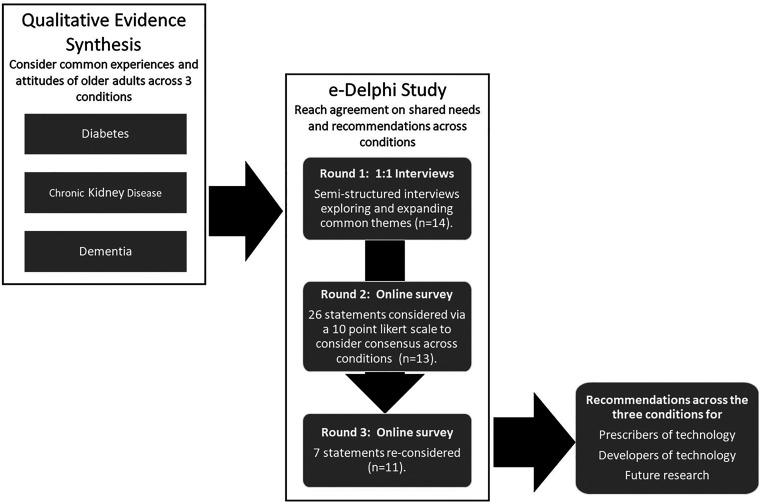
As development and introduction of digital self-management technologies continues to increase, the gap between those who can benefit, and those who cannot correspondingly widens. This research aimed to explore the use of digital self-management technology by older adults with three highly-prevalent long-term conditions (chronic kidney disease, diabetes and dementia), and build expert consensus across the conditions on changes needed to improve effective usage. This qualitative research involved a modified e-Delphi Study. The Delphi panel was comprised of experts with personal, academic or clinical expertise related to one of the long-term conditions and/or the development and use of digital self-management technology. The e-Delphi involved a round of online semi-structured interviews followed by two rounds of a structured online survey. Fourteen experts participated in the study, with eleven of the fourteen completing all three rounds. Analysis of the interviews (round 1 of the Delphi) led to 7 main themes and 29 sub-themes. These were translated into 26 statements that formed the basis of the online survey questions. In the first administration of the survey (round 2) 19 statements reached consensus. After the second administration a further 6 statements reach consensus. The findings reflect expert consensus on barriers to the use of digital self-management by older adults with 3 different, but inter-related conditions, and identify ways in which the design and provision of such technologies could be improved to facilitate more effective use. It is concluded that both the design and the provision of technologies should consider a combination of individual, condition-specific and age-related requirements. By building a consensus on issues and potential strategies common across the three conditions, we aim to inform future research and practice and facilitate effective self-management by older adults.
随着数字自我管理技术的开发和引入持续增加,能够从中受益的人群与无法受益的人群之间的差距相应地不断扩大。本研究旨在探讨患有三种高发性慢性病(慢性肾病、糖尿病和痴呆症)的老年人对数字自我管理技术的使用情况,并就改善有效使用所需的变化在这三种病症上达成专家共识。这项定性研究采用了改良的电子德尔菲研究法。德尔菲小组由在三种慢性病之一和/或数字自我管理技术的开发与使用方面具备个人、学术或临床专业知识的专家组成。电子德尔菲研究包括一轮在线半结构化访谈,随后是两轮结构化在线调查。14位专家参与了该研究,其中11位完成了全部三轮调查。对访谈(德尔菲研究的第一轮)的分析得出了7个主要主题和29个子主题。这些被转化为26条陈述,构成了在线调查问卷问题的基础。在第一轮调查(第二轮)中,19条陈述达成了共识。在第二轮调查后,又有6条陈述达成了共识。研究结果反映了专家们对患有三种不同但相互关联病症的老年人使用数字自我管理技术的障碍的共识,并确定了可以改进此类技术的设计和提供方式以促进更有效使用的方法。得出的结论是,技术的设计和提供都应考虑个人、病症特定和与年龄相关的需求的综合因素。通过就三种病症共有的问题和潜在策略达成共识,我们旨在为未来的研究和实践提供参考,并促进老年人进行有效的自我管理。