German Center for Neurodegenerative Diseases (DZNE), Tuebingen, Germany.
Department of Neurodegeneration, Hertie Institute for Clinical Brain Research, University of Tuebingen, Tuebingen, Germany.
Mol Brain. 2024 Aug 13;17(1):56. doi: 10.1186/s13041-024-01128-z.
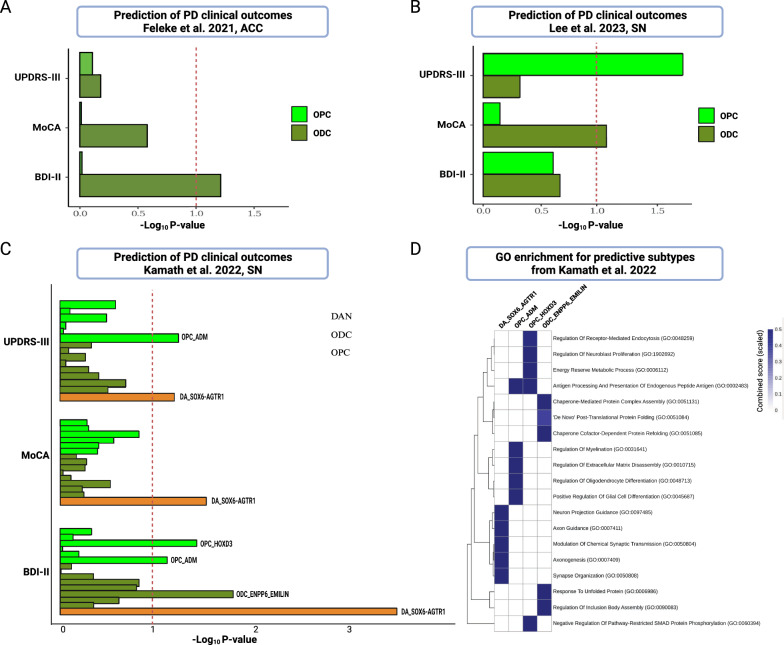
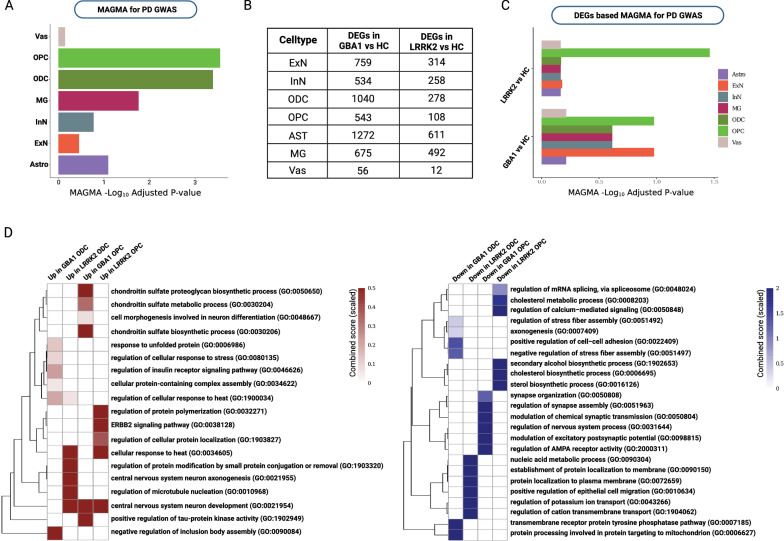
Several prior studies have proposed the involvement of various brain regions and cell types in Parkinson's disease (PD) pathology. Here, we performed snRNA-seq on the prefrontal cortex and anterior cingulate regions from a small cohort of post-mortem control and PD brain tissue. We found a significant association of oligodendrocytes (ODCs) and oligodendrocyte precursor cells (OPCs) with PD-linked risk loci and report several dysregulated genes and pathways, including regulation of tau-protein kinase activity, regulation of inclusion body assembly and protein processing involved in protein targeting to mitochondria. In an independent PD cohort with clinical measures (681 cases and 549 controls), polygenic risk scores derived from the dysregulated genes significantly predicted Montreal Cognitive Assessment (MoCA)-, and Beck Depression Inventory-II (BDI-II)-scores but not motor impairment (UPDRS-III). We extended our analysis of clinical outcome prediction by incorporating differentially expressed genes from three separate datasets that were previously published by different laboratories. In the first dataset from the anterior cingulate cortex, we identified an association between ODCs and BDI-II. In the second dataset obtained from the substantia nigra (SN), OPCs displayed an association with UPDRS-III. In the third dataset from the SN region, a distinct subtype of OPCs, labeled OPC_ADM, exhibited an association with UPDRS-III. Intriguingly, the OPC_ADM cluster also demonstrated a significant increase in PD samples. These results suggest that by expanding our focus to glial cells, we can uncover region-specific molecular pathways associated with PD symptoms.
先前的几项研究提出了各种脑区和细胞类型参与帕金森病(PD)病理。在这里,我们对小队列的尸检对照和 PD 脑组织的前额叶皮层和前扣带回区域进行了 snRNA-seq。我们发现少突胶质细胞(ODCs)和少突胶质前体细胞(OPCs)与 PD 相关风险基因座显著相关,并报告了几个失调的基因和途径,包括tau 蛋白激酶活性的调节、包含体组装的调节以及与线粒体蛋白靶向相关的蛋白加工。在具有临床测量(681 例病例和 549 例对照)的独立 PD 队列中,源自失调基因的多基因风险评分显著预测蒙特利尔认知评估(MoCA)和贝克抑郁量表第二版(BDI-II)评分,但不能预测运动障碍(UPDRS-III)。我们通过纳入先前由不同实验室发表的三个独立数据集的差异表达基因来扩展我们对临床结果预测的分析。在前扣带回皮层的第一个数据集,我们发现 ODCs 与 BDI-II 之间存在关联。在第二个从黑质(SN)获得的数据集,OPCs 与 UPDRS-III 显示出关联。在第三个来自 SN 区域的数据集,一种称为 OPC_ADM 的 OPC 亚型与 UPDRS-III 显示出关联。有趣的是,OPC_ADM 簇在 PD 样本中也表现出显著增加。这些结果表明,通过扩大我们对神经胶质细胞的关注,我们可以发现与 PD 症状相关的特定区域分子途径。