Gu Yingzhen, Li Zuozhi, Han Xiaorong, Liu Jinxing, Li Yifan, Zhang Wei, Lv Naqiang, Dang Aimin
Fuwai Hospital, National Center for Cardiovascular Diseases, Chinese Academy of Medical Science and Peking Union Medical College, 100037 Beijing, China.
Rev Cardiovasc Med. 2024 Jul 9;25(7):255. doi: 10.31083/j.rcm2507255. eCollection 2024 Jul.
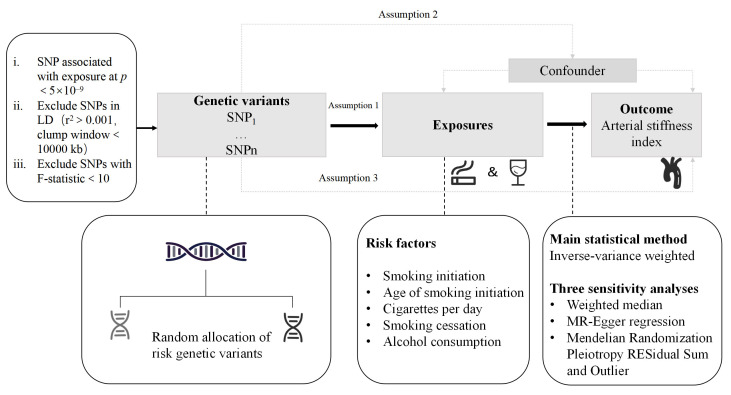
While observational studies have demonstrated connections between cigarette smoking, alcohol consumption, and arterial stiffness, establishing a causal relationship has proven challenging because of potential confounding factors. To address this problem, we employed a two-sample Mendelian randomization approach.
We selected genetic instruments for these risk factors from genome-wide association studies encompassing 3,383,199 individuals at the genome-wide significance level ( 5 ). Arterial stiffness data were acquired from the UK Biobank, which included 127,121 participants. Our primary analysis utilized the inverse variance-weighted method to explore causality. To confirm our results' robustness, we conducted sensitivity analyses using Egger regression, the weighted median method, and Mendelian Randomization Pleiotropy RESidual Sum and Outlier (MR-PRESSO).
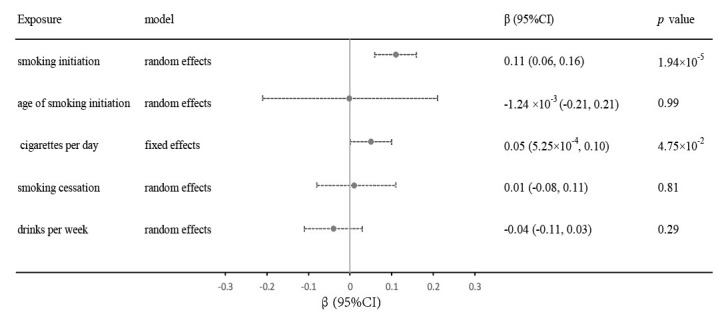
Our analysis revealed a significant association between genetic inclination to smoking initiation and an increase in the arterial stiffness index ( = 0.11; 95% confidence interval [CI], 0.06 to 0.16; = 1.95 ). Additionally, there was a suggestive connection between genetically predicted number of cigarettes per day and the arterial stiffness index ( = 0.05; 95% CI, 5.25 to 0.10; = 4.75 ). No causal relationships were observed between the genetically predicted age of smoking initiation, smoking cessation, or alcohol consumption and the risk of arterial stiffness index.
This Mendelian randomization study indicates that smoking initiation is likely a causative risk factor for arterial stiffness. However, further research is needed to determine if the quantity of daily cigarettes directly contributes to arterial stiffness development. Regarding alcohol consumption, age of smoking initiation, and smoking cessation, there was insufficient evidence to establish causality.
虽然观察性研究已证明吸烟、饮酒与动脉僵硬度之间存在关联,但由于潜在的混杂因素,确立因果关系颇具挑战性。为解决这一问题,我们采用了两样本孟德尔随机化方法。
我们从全基因组关联研究中为这些风险因素选择了基因工具,该研究涵盖了3383199名达到全基因组显著性水平(P<5×10⁻⁸)的个体。动脉僵硬度数据来自英国生物银行,其中包括127121名参与者。我们的主要分析采用逆方差加权法来探究因果关系。为证实结果的稳健性,我们使用Egger回归、加权中位数法以及孟德尔随机化多效性残差和离群值法(MR-PRESSO)进行了敏感性分析。
我们的分析显示,开始吸烟的遗传倾向与动脉僵硬度指数升高之间存在显著关联(β = 0.11;95%置信区间[CI],0.06至0.16;P = 1.95×10⁻²)。此外,基因预测的每日吸烟量与动脉僵硬度指数之间存在提示性关联(β = 0.05;95%CI,5.25×10⁻³至0.10;P = 4.75×10⁻⁶)。在基因预测的开始吸烟年龄、戒烟或饮酒与动脉僵硬度指数风险之间未观察到因果关系。
这项孟德尔随机化研究表明,开始吸烟可能是动脉僵硬度的一个致病风险因素。然而,需要进一步研究以确定每日吸烟量是否直接导致动脉僵硬度的发展。关于饮酒、开始吸烟年龄和戒烟,没有足够的证据确立因果关系。