Fortin-Hamel Liana, Chapman Lauren J
Department of Biology, McGill University, 1205 avenue du Docteur-Penfield, Montreal, Quebec, Canada, H3A 1B1.
Conserv Physiol. 2024 Aug 13;12(1):coae053. doi: 10.1093/conphys/coae053. eCollection 2024.
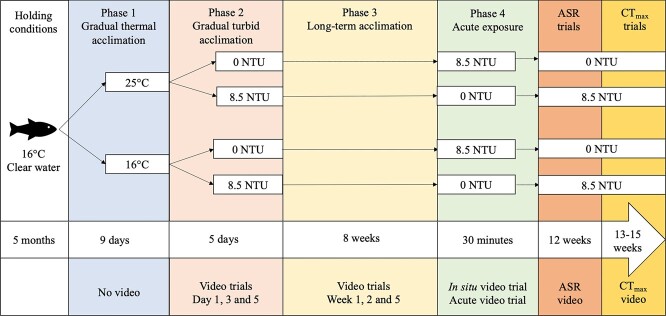
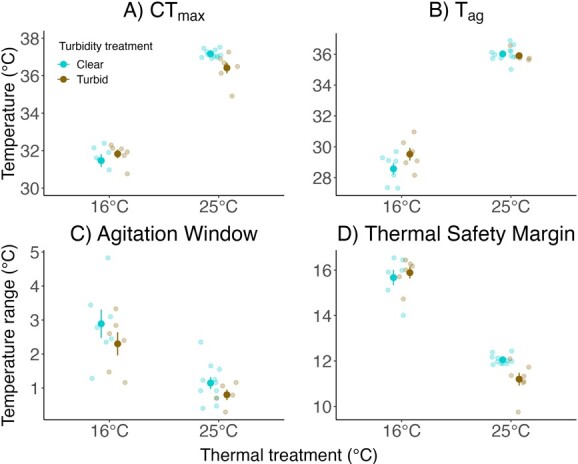
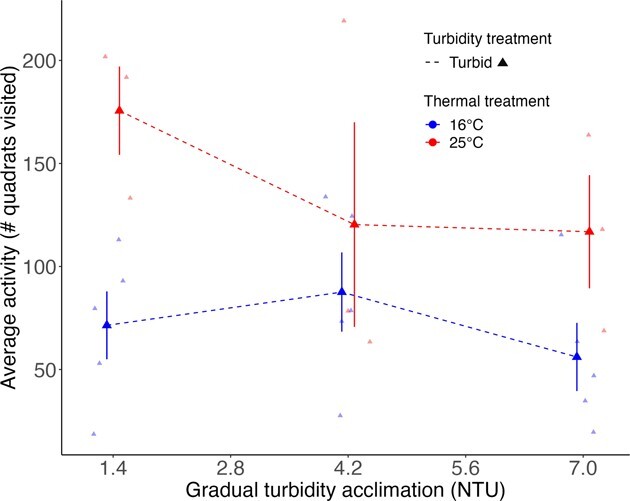
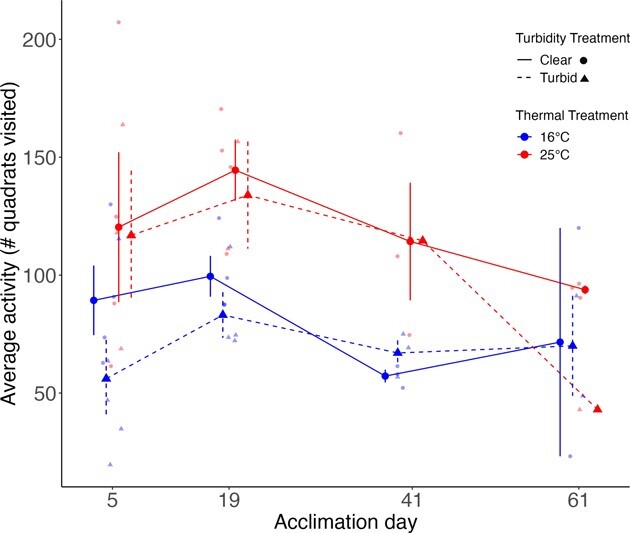
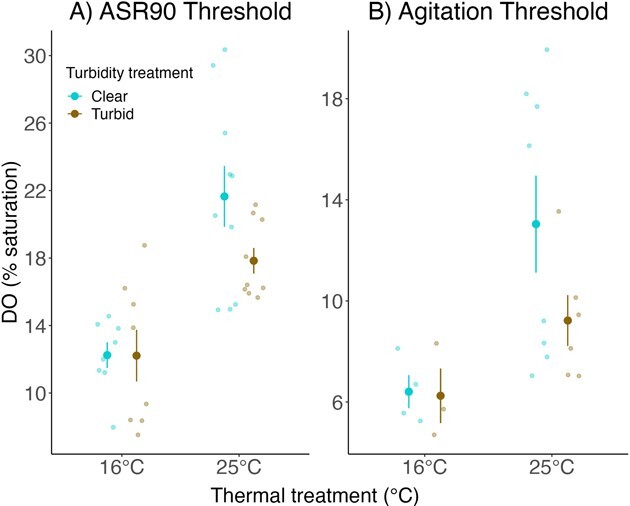
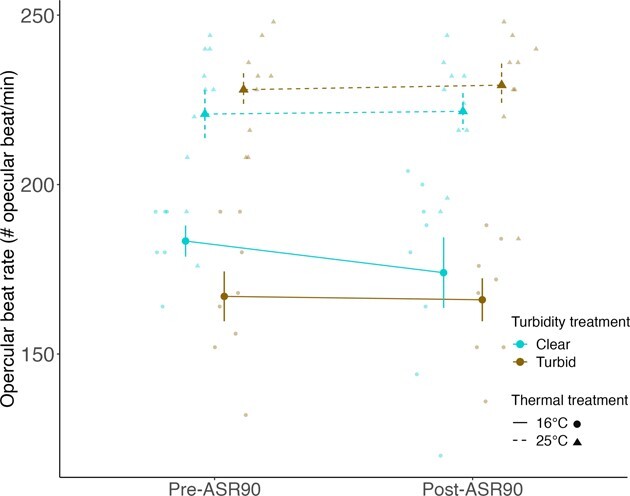
High turbidity and elevated water temperature are environmental stressors that can co-occur in freshwater ecosystems such as when deforestation increases solar radiation and sedimentary runoff. However, we have limited knowledge about their combined impacts on fish behaviour and physiology. We explored independent and interactive effects of sedimentary turbidity and temperature on the swimming activity and both thermal and hypoxia tolerance of the Pugnose Shiner (, formerly ), a small leuciscid fish listed as Threatened under Canada's Species at Risk Act (SARA). Fish underwent a 15-week acclimation to two temperatures (16°C or 25°C) crossed with two turbidities (~0 NTU or 8.5 NTU). Swimming activity was measured during the first 8 weeks of acclimation. Fish in warm water were more active compared to those in cold water, but turbidity had no effect on activity. Behavioural response to hypoxia was measured after 12 weeks of acclimation, as the oxygen level at which fish used aquatic surface respiration (ASR). Fish in warm water engaged in ASR behaviour at higher oxygen thresholds, indicating less tolerance to hypoxia. Turbidity had no effect on ASR thresholds. Finally, thermal tolerance was measured as the critical thermal maximum (CT) after 13-15 weeks of acclimation. Acclimation to warm water increased fish CT and T (agitation temperature) but reduced the agitation window (°C difference between T and CT) and thermal safety margin (°C difference between the acclimation temperature and CT). Furthermore, fish in warm, turbid water had a lower CT and smaller thermal safety margin than fish in warm, clear water, indicating an interaction between turbidity and temperature. This reduced thermal tolerance observed in Pugnose Shiner in warm, turbid water highlights the importance of quantifying independent and interactive effects of multiple stressors when evaluating habitat suitability and conservation strategies for imperilled species.
高浊度和水温升高是淡水生态系统中可能同时出现的环境压力源,比如森林砍伐增加太阳辐射和沉积径流时就会如此。然而,我们对它们对鱼类行为和生理的综合影响了解有限。我们探究了沉积浊度和温度对 Pugnose Shiner(原名 )游泳活动以及热耐受性和耐缺氧性的独立和交互作用,Pugnose Shiner 是一种小型鲤科鱼类,根据加拿大《濒危物种法》(SARA)被列为受威胁物种。鱼类在两种温度(16°C 或 25°C)与两种浊度(约 0 NTU 或 8.5 NTU)交叉组合的条件下进行了 15 周的驯化。在驯化的前 8 周测量游泳活动。与冷水环境中的鱼相比,温水环境中的鱼更活跃,但浊度对活动没有影响。驯化 12 周后测量鱼类对缺氧的行为反应,即鱼类开始进行水面呼吸(ASR)时的氧气水平。温水环境中的鱼在较高的氧气阈值时开始进行 ASR 行为,表明其对缺氧的耐受性较低。浊度对 ASR 阈值没有影响。最后,在驯化 13 - 15 周后测量热耐受性,以临界热最大值(CT)表示。适应温水环境会提高鱼类的 CT 和 T(兴奋温度),但会缩小兴奋窗口(T 与 CT 之间的°C差值)和热安全边际(驯化温度与 CT 之间的°C差值)。此外,与温暖清澈水中的鱼相比,温暖浑浊水中的鱼 CT 更低,热安全边际更小,这表明浊度和温度之间存在交互作用。在温暖浑浊水中的 Pugnose Shiner 身上观察到的这种热耐受性降低,凸显了在评估濒危物种的栖息地适宜性和保护策略时,量化多种压力源的独立和交互作用非常重要。