Institute of Marine Science, University of Auckland, Leigh, New Zealand.
School of Biological Sciences, University of Auckland, Auckland, New Zealand.
PLoS One. 2020 Apr 2;15(4):e0231091. doi: 10.1371/journal.pone.0231091. eCollection 2020.
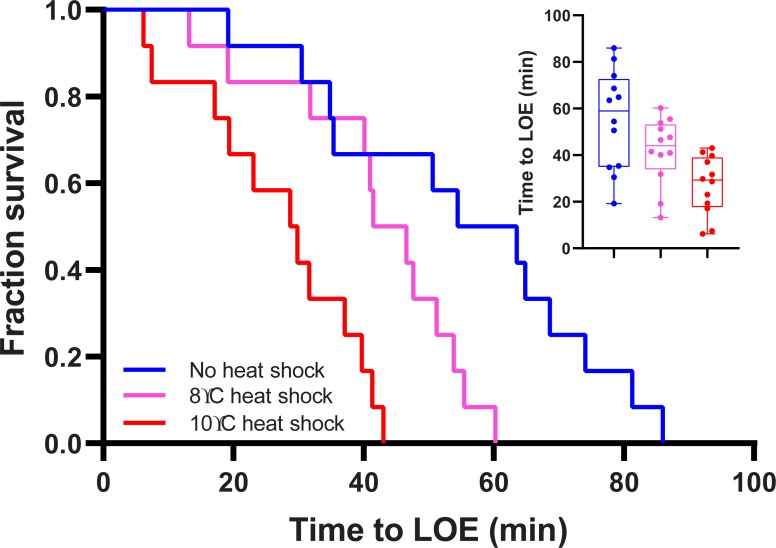
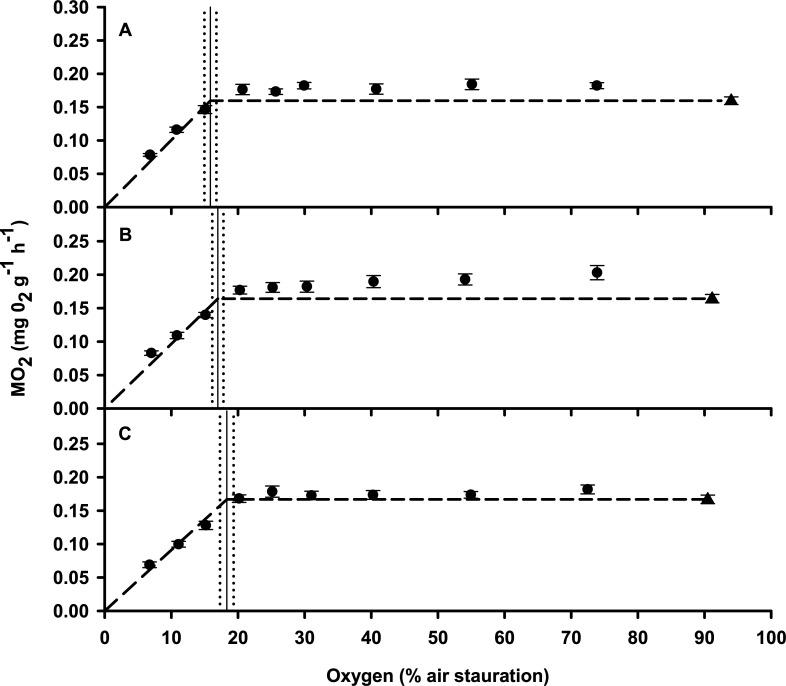
Acute heat shock has previously been shown to improve subsequent low O2 (hypoxia) tolerance in an intertidal fish species, a process known as cross-tolerance, but it is not known whether this is a widespread phenomenon. This study examined whether a rock pool specialist, the triplefin fish Bellapiscis medius, exhibits heat shock induced cross-tolerance to hypoxia, i.e., longer time to loss of equilibrium (LOE) and lower critical O2 saturation (Scrit) after recovering from an acute heat challenge. Non-heat shock controls had a median time to loss of equilibrium (LOE50) of 54.4 min under severe hypoxia (7% of air saturation) and a Scrit of 15.8% air saturation. Contrary to expectations, however, treatments that received an 8 or 10°C heat shock showed a significantly shorter LOE50 in hypoxia (+8°C = 41.5 min; +10°C = 28.7 min) and no significant change in Scrit (+8°C = 17.0% air saturation; +10°C = 18.3% of air saturation). Thus, there was no evidence of heat shock induced cross-tolerance to hypoxia in B. medius because exposure to acute heat shock impaired hypoxia tolerance.
先前的研究表明,急性热休克可提高潮间带鱼类物种对低氧(缺氧)的后续耐受性,这一过程被称为交叉耐受,但目前尚不清楚这是否是一种普遍现象。本研究探讨了岩池特化种三鳍鱼(Bellapiscis medius)是否表现出热休克诱导的对低氧的交叉耐受,即在从急性热应激中恢复后,达到平衡丧失(LOE)的时间更长和更低的临界氧饱和度(Scrit)。在严重缺氧(空气饱和度的 7%)下,非热休克对照的中位数平衡丧失时间(LOE50)为 54.4 分钟,临界氧饱和度(Scrit)为 15.8%空气饱和度。然而,与预期相反的是,接受 8 或 10°C 热休克处理的处理组在低氧条件下的 LOE50 明显缩短(+8°C = 41.5 分钟;+10°C = 28.7 分钟),而 Scrit 没有明显变化(+8°C = 17.0%空气饱和度;+10°C = 18.3%空气饱和度)。因此,三鳍鱼没有表现出对低氧的热休克诱导的交叉耐受,因为暴露于急性热休克会损害其对低氧的耐受性。