Department of Ergonomics, Institute of Industrial Ecological Sciences, University of Occupational and Environmental Health, Japan, 1-1 Iseigaoka, Yahatanishi-ku, Fukuoka, Kitakyushu 807-8555, Japan.
ES Japan, Inc., 5F Dai-3 Kyoritsu Building, 2-50-9 Ikebukuro, Toshima-ku, Tokyo 171-0014, Japan.
J Occup Health. 2024 Jan 4;66(1). doi: 10.1093/joccuh/uiae047.
To verify the effects of organizational interventions on mental health using Layered Voice Analysis (LVA).
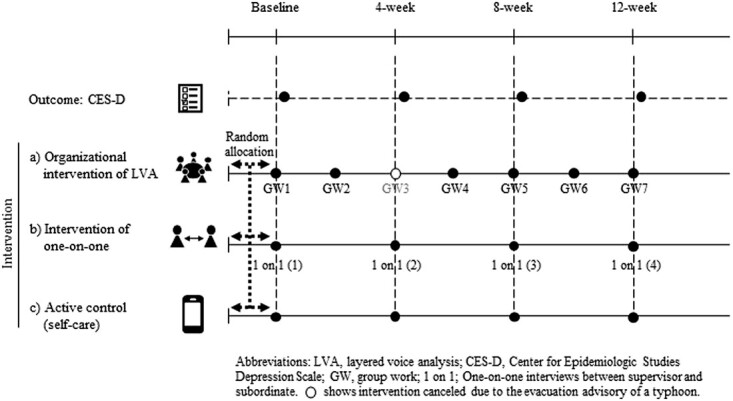
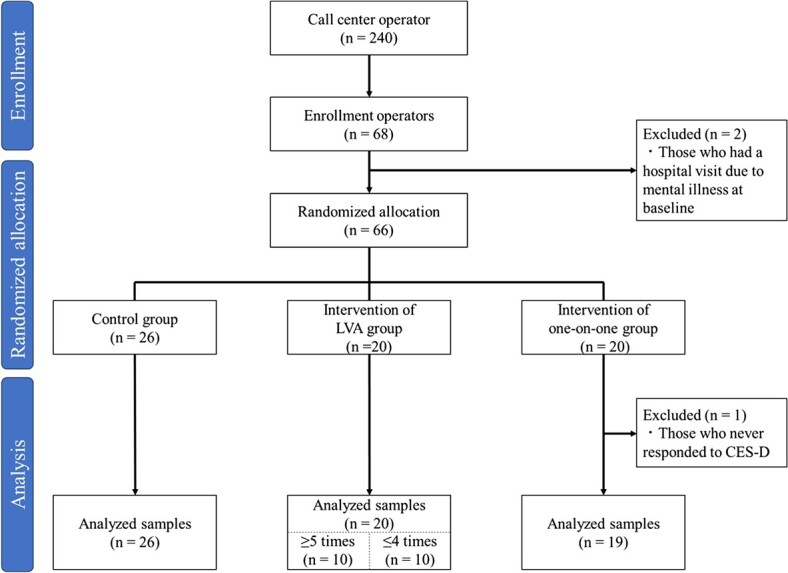
A 12-week single-blind randomized controlled trial was conducted with call center operators. Sixty-six participants were randomly assigned to either a control group (n = 26), an LVA intervention group (n = 20), or a one-on-one intervention group (n = 20). The control group received general self-care information about preventing mental health problems from the Ministry of Health, Labour, and Welfare, Japan website. The organizational LVA intervention involved group sessions using participants' voice calls with customers, whereas the one-on-one intervention consisted of meetings or consultations with participants and their supervisors to discuss preventing mental health issues at work. To verify the effectiveness of the intervention program, the Center for Epidemiologic Studies Depression Scale (CES-D) was administered 4 times (baseline, 4, 8, and 12 weeks) as the primary outcome, and the data were analyzed using a linear mixed model. The intervention of LVA was subdivided and analyzed into LVA ≥5 times and LVA ≤4 times out of the total 6 interventions.
Compared with the control group, a significant CES-D reduction effect was observed at 8/12 weeks for the difference of coefficients (DOC; [βint - βctrl]) for the intervention of LVA ≥5 times (DOC -1.86 and -2.36, respectively). Similarly, even intervention LVA ≤4 times also showed a significant decrease of CES-D scores at 8/12 weeks (DOC -2.20 and -2.38, respectively).
An organizational intervention using LVA has the potential to reduce the risk of depression among call center operators.
使用分层语音分析(LVA)验证组织干预对心理健康的影响。
这是一项为期 12 周的单盲随机对照试验,对象为呼叫中心运营商。共有 66 名参与者被随机分配至对照组(n=26)、LVA 干预组(n=20)或一对一干预组(n=20)。对照组从日本厚生劳动省的网站上获取有关预防心理健康问题的一般自我保健信息。组织层面的 LVA 干预涉及使用参与者与客户的语音通话进行小组会议,而一对一干预则包括与参与者及其主管讨论工作场所心理健康问题的会议或咨询。为了验证干预计划的有效性,采用流行病学研究中心抑郁量表(CES-D)作为主要结局指标,在 4 个时间点(基线、4 周、8 周和 12 周)进行了 4 次评估,并使用线性混合模型进行数据分析。将 LVA 干预细分为 6 次干预中的 LVA≥5 次和 LVA≤4 次,并分别分析这两种干预方式的效果。
与对照组相比,LVA≥5 次的干预在 8/12 周时 CES-D 评分的系数差异(DOC;[βint-βctrl])有显著降低(DOC-1.86 和-2.36)。同样,即使是 LVA≤4 次的干预在 8/12 周时也显示出 CES-D 评分的显著降低(DOC-2.20 和-2.38)。
使用 LVA 的组织干预有可能降低呼叫中心运营商的抑郁风险。