Long Hannah, Bartlett Yvonne K, Farmer Andrew J, French David P
Manchester Centre for Health Psychology, School of Health Sciences, University of Manchester, Manchester, United Kingdom.
Nuffield Department of Primary Care Health Sciences, University of Oxford, Oxford, United Kingdom.
J Med Internet Res. 2019 Jan 9;21(1):e10421. doi: 10.2196/10421.
Current interventions to support medication adherence in people with type 2 diabetes are generally resource-intensive and ineffective. Brief messages, such as those delivered via short message service (SMS) systems, are increasingly used in digital health interventions to support adherence because they can be delivered on a wide scale and at low cost. The content of SMS text messages is a crucial intervention feature for promoting behavior change, but it is often unclear what the rationale is for chosen wording or any underlying mechanisms targeted for behavioral change. There is little guidance for developing and optimizing brief message content for use in mobile device-delivered interventions.
This review aimed to (1) identify theoretical constructs (ie, the targets that interventions aim to change) and behavioral strategies (ie, features of intervention content) found to be associated with medication adherence in patients with type 2 diabetes and (2) map these onto a standard taxonomy for behavior change techniques (BCTs, that is, active ingredients of interventions used to promote behavioral change, to produce an evidence-based set of approaches that have shown promise of improving adherence in previous studies and which could be further tested in digital health interventions.
A rapid systematic review of existing relevant systematic reviews was conducted. MEDLINE and PsycINFO databases were searched from inception to April 10, 2017. Inclusion criteria were (1) systematic reviews of quantitative data if the studies reviewed identified predictors of or correlates with medication adherence or evaluated medication adherence-enhancing interventions and included adult participants taking medication to manage a chronic physical health condition, and (2) systematic reviews of qualitative studies of experiences of medication adherence for adult participants with type 2 diabetes. Data were extracted on review characteristics and BCTs, theoretical constructs, or behavioral strategies associated with improved adherence. Constructs and strategies were mapped onto the BCT version 1 taxonomy.
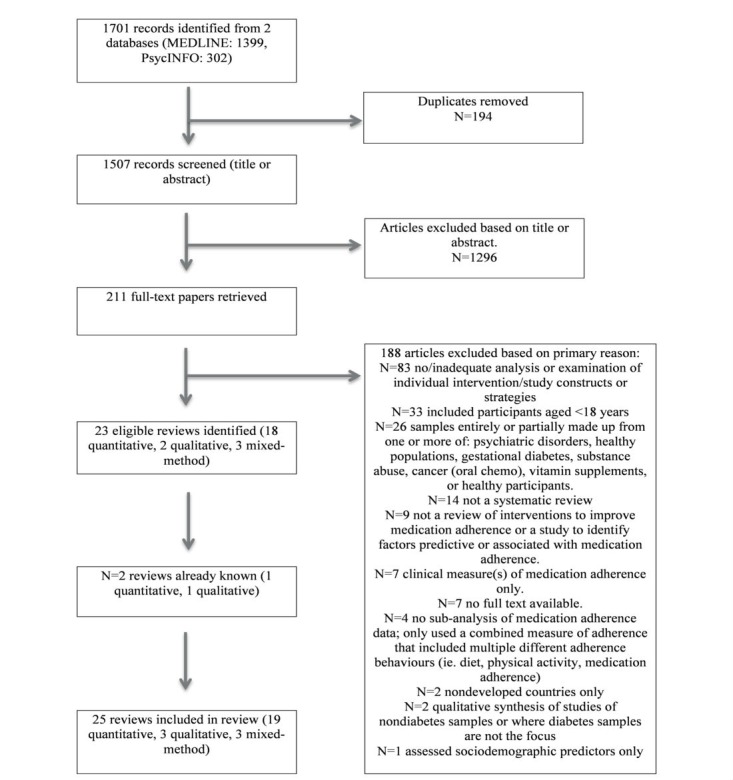
A total of 1701 references were identified; 25 systematic reviews (19 quantitative reviews, 3 qualitative reviews, and 3 mixed-method reviews) were included. Moreover, 20 theoretical constructs (eg, self-efficacy) and 19 behavioral strategies (eg, habit analysis) were identified in the included reviews. In total, 46 BCTs were identified as being related to medication adherence in type 2 diabetes (eg, habit formation, prompts or cues, and information about health consequences).
We identified 46 promising BCTs related to medication adherence in type 2 diabetes on which the content of brief messages delivered through mobile devices to improve adherence could be based. By using explicit systematic review methods and linking our findings to a standardized taxonomy of BCTs, we have described a novel approach for the development of digital message content. Future brief message interventions that aim to support medication adherence could incorporate the identified BCTs.
目前用于支持2型糖尿病患者药物依从性的干预措施通常资源密集且效果不佳。简短信息,如通过短信服务(SMS)系统发送的信息,在数字健康干预中越来越多地用于支持依从性,因为它们可以大规模且低成本地发送。短信内容是促进行为改变的关键干预特征,但所选措辞的基本原理或针对行为改变的任何潜在机制往往不明确。在开发和优化用于移动设备干预的简短信息内容方面几乎没有指导。
本综述旨在(1)识别与2型糖尿病患者药物依从性相关的理论构建(即干预旨在改变的目标)和行为策略(即干预内容的特征),以及(2)将这些映射到行为改变技术(BCTs)的标准分类法上,即用于促进行为改变的干预措施的有效成分,以产生一组基于证据的方法,这些方法在先前的研究中已显示出改善依从性的前景,并且可以在数字健康干预中进一步测试。
对现有的相关系统评价进行快速系统评价。检索MEDLINE和PsycINFO数据库,检索时间从建库至2017年4月10日。纳入标准为:(1)对定量数据的系统评价,如果所审查的研究确定了药物依从性的预测因素或相关因素,或评估了增强药物依从性的干预措施,且纳入的成年参与者正在服用药物来管理慢性身体健康状况;(2)对2型糖尿病成年参与者药物依从性体验的定性研究的系统评价。提取有关综述特征以及与改善依从性相关的BCTs、理论构建或行为策略的数据。将构建和策略映射到BCT版本1分类法上。
共识别出1701篇参考文献;纳入了25篇系统评价(19篇定量评价、3篇定性评价和3篇混合方法评价)。此外,在所纳入的综述中识别出20种理论构建(例如自我效能感)和19种行为策略(例如习惯分析)。总共识别出46种与2型糖尿病药物依从性相关的BCTs(例如习惯形成、提示或线索以及关于健康后果的信息)。
我们识别出46种与2型糖尿病药物依从性相关的有前景的BCTs,通过移动设备发送的旨在改善依从性简短信息的内容可以基于这些BCTs。通过使用明确的系统评价方法并将我们的发现与BCTs的标准化分类法相联系,我们描述了一种开发数字信息内容的新方法。未来旨在支持药物依从性的简短信息干预可以纳入所识别出的BCTs。
