Department of Neurology and Clinical Research Center of Neurological Disease, the Second Affiliated Hospital of Soochow University, Suzhou, Jiangsu, 215021, China.
Institute of Neuroscience & Jiangsu Key Laboratory of Translational Research and Therapy for Neuro-psycho-Diseases, Soochow University, Suzhou, Jiangsu, 215021, China.
Cell Death Dis. 2024 Aug 15;15(8):591. doi: 10.1038/s41419-024-06978-y.
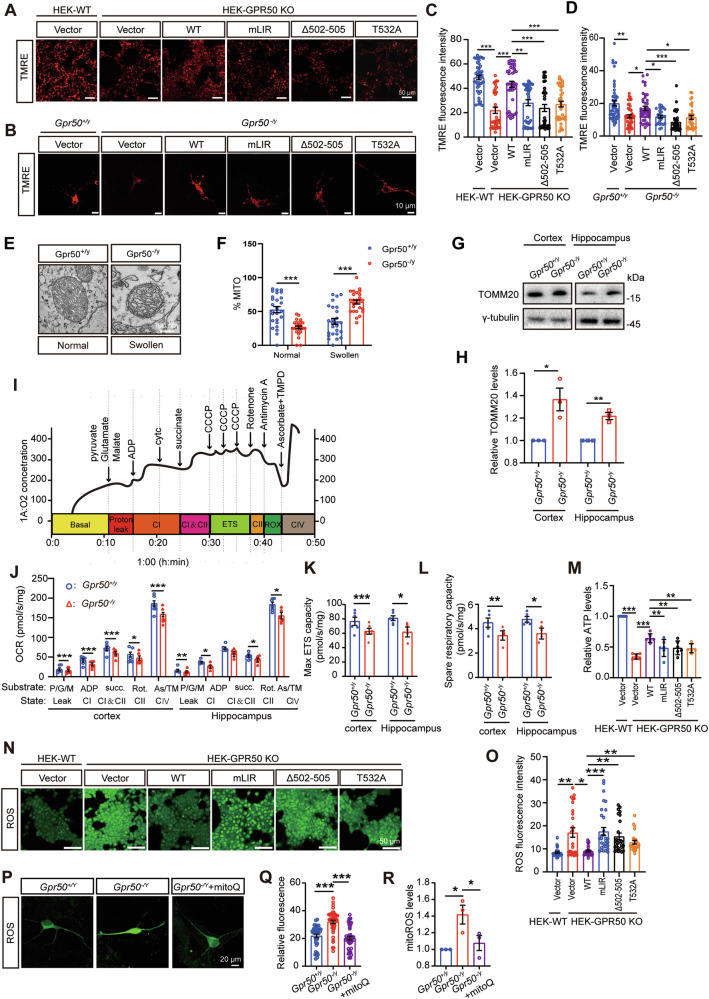
Neurons rely heavily on high mitochondrial metabolism to provide sufficient energy for proper development. However, it remains unclear how neurons maintain high oxidative phosphorylation (OXPHOS) during development. Mitophagy plays a pivotal role in maintaining mitochondrial quality and quantity. We herein describe that G protein-coupled receptor 50 (GPR50) is a novel mitophagy receptor, which harbors the LC3-interacting region (LIR) and is required in mitophagy under stress conditions. Although it does not localize in mitochondria under normal culturing conditions, GPR50 is recruited to the depolarized mitochondrial membrane upon mitophagy stress, which marks the mitochondrial portion and recruits the assembling autophagosomes, eventually facilitating the mitochondrial fragments to be engulfed by the autophagosomes. Mutations Δ502-505 and T532A attenuate GPR50-mediated mitophagy by disrupting the binding of GPR50 to LC3 and the mitochondrial recruitment of GPR50. Deficiency of GPR50 causes the accumulation of damaged mitochondria and disrupts OXPHOS, resulting in insufficient ATP production and excessive ROS generation, eventually impairing neuronal development. GPR50-deficient mice exhibit impaired social recognition, which is rescued by prenatal treatment with mitoQ, a mitochondrially antioxidant. The present study identifies GPR50 as a novel mitophagy receptor that is required to maintain mitochondrial OXPHOS in developing neurons.
神经元高度依赖高线粒体代谢来提供足够的能量以促进其正常发育。然而,神经元在发育过程中如何维持高氧化磷酸化(OXPHOS)仍不清楚。线粒体自噬在维持线粒体质量和数量方面起着关键作用。本文描述了 G 蛋白偶联受体 50(GPR50)是一种新的线粒体自噬受体,它含有 LC3 相互作用区域(LIR),并且在应激条件下的线粒体自噬中是必需的。尽管在正常培养条件下 GPR50 不在线粒体中定位,但在线粒体自噬应激下,GPR50 被募集到去极化的线粒体膜上,这标志着线粒体部分并招募正在组装的自噬体,最终促进线粒体片段被自噬体吞噬。缺失 502-505 位和 T532A 位的突变通过破坏 GPR50 与 LC3 的结合和 GPR50 向线粒体的募集,减弱了 GPR50 介导的线粒体自噬。GPR50 的缺失导致受损线粒体的积累和 OXPHOS 的破坏,导致产生的 ATP 不足和 ROS 过度生成,最终损害神经元的发育。GPR50 缺失的小鼠表现出社交识别受损,这种损伤可通过产前给予线粒体抗氧化剂 mitoQ 来挽救。本研究确定 GPR50 是一种新的线粒体自噬受体,它对于维持发育中的神经元中线粒体 OXPHOS 是必需的。