College of Forestry and Prataculture, Ningxia University, Yinchuan, 750021, China.
College of Enology and Horticulture, Ningxia University, Yinchuan, Ningxia, 750021, China.
BMC Plant Biol. 2024 Aug 15;24(1):776. doi: 10.1186/s12870-024-05494-7.
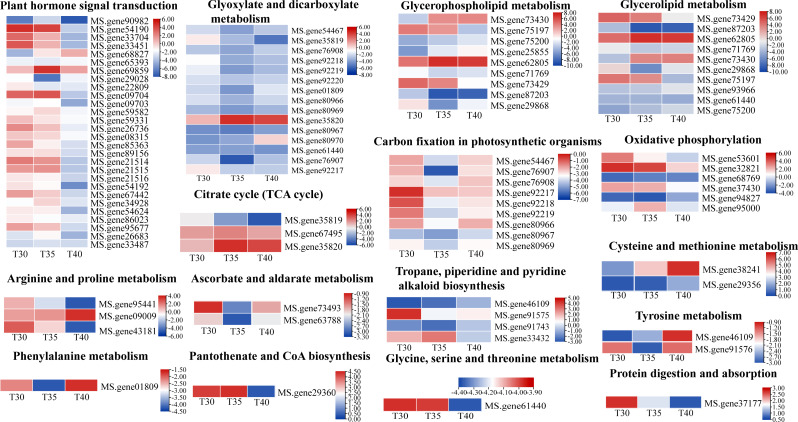
High temperature stress is one of the most severe forms of abiotic stress in alfalfa. With the intensification of climate change, the frequency of high temperature stress will further increase in the future, which will bring challenges to the growth and development of alfalfa. Therefore, untargeted metabolomic and RNA-Seq profiling were implemented to unravel the possible alteration in alfalfa seedlings subjected to different temperature stress (25 ℃, 30 ℃, 35 ℃, 40 ℃) in this study. Results revealed that High temperature stress significantly altered some pivotal transcripts and metabolites. The number of differentially expressed genes (DEGs) markedly up and down-regulated was 1876 and 1524 in T30_vs_CK, 2, 815 and 2667 in T35_vs_CK, and 2115 and 2, 226 in T40_vs_CK, respectively. The number for significantly up-regulated and down-regulated differential metabolites was 173 and 73 in T30_vs_CK, 188 and 57 in T35_vs_CK, and 220 and 66 in T40_vs_CK, respectively. It is worth noting that metabolomics and transcriptomics co-analysis characterized enriched in plant hormone signal transduction (ko04705), glyoxylate and dicarboxylate metabolism (ko00630), from which some differentially expressed genes and differential metabolites participated. In particular, the content of hormone changed significantly under T40 stress, suggesting that maintaining normal hormone synthesis and metabolism may be an important way to improve the HTS tolerance of alfalfa. The qRT-PCR further showed that the expression pattern was similar to the expression abundance in the transcriptome. This study provides a practical and in-depth perspective from transcriptomics and metabolomics in investigating the effects conferred by temperature on plant growth and development, which provided the theoretical basis for breeding heat-resistant alfalfa.
高温胁迫是紫花苜蓿面临的最严重非生物胁迫之一。随着气候变化的加剧,未来高温胁迫的频率将会进一步增加,这将给紫花苜蓿的生长和发育带来挑战。因此,本研究采用无靶向代谢组学和 RNA-Seq 分析方法,揭示了不同温度胁迫(25℃、30℃、35℃、40℃)下紫花苜蓿幼苗可能发生的变化。结果表明,高温胁迫显著改变了一些关键的转录本和代谢物。T30_vs_CK、T35_vs_CK 和 T40_vs_CK 中差异表达基因(DEGs)的上调和下调数量分别为 1876 和 1524、2815 和 2667、2115 和 2226。T30_vs_CK、T35_vs_CK 和 T40_vs_CK 中差异代谢物的上调和下调数量分别为 173 和 73、188 和 57、220 和 66。值得注意的是,代谢组学和转录组学联合分析表明,植物激素信号转导(ko04705)、乙醛酸和二羧酸代谢(ko00630)途径显著富集,其中一些差异表达基因和差异代谢物参与其中。特别是在 T40 胁迫下,激素含量发生了显著变化,这表明维持正常的激素合成和代谢可能是提高紫花苜蓿高温胁迫耐受性的重要途径。qRT-PCR 进一步表明,表达模式与转录组中的表达丰度相似。本研究从转录组学和代谢组学的角度,为研究温度对植物生长发育的影响提供了一种实用且深入的方法,为培育耐热紫花苜蓿提供了理论依据。