Li Fu-Jia, Zhang Ru-Yu, Li Jin-Yu, Liu Yu-Ning, Zhang Zi-Xuan, Du Li, Li Yang-Dan-Yu, Liu Xu, Zhang Wei, Cui Gui-Yun, Xu Chuan-Ying
Department of Neurology, The Affiliated Hospital of Xuzhou Medical University, Xuzhou, China.
Department of Pulmonary and Critical Care Medicine, First People's Hospital of Zigong, Zigong, Sichuan, China.
Front Microbiol. 2024 Jul 31;15:1413218. doi: 10.3389/fmicb.2024.1413218. eCollection 2024.
The objective of this study is to investigate the indirect causalities between gut microbiota and sleep disorders.
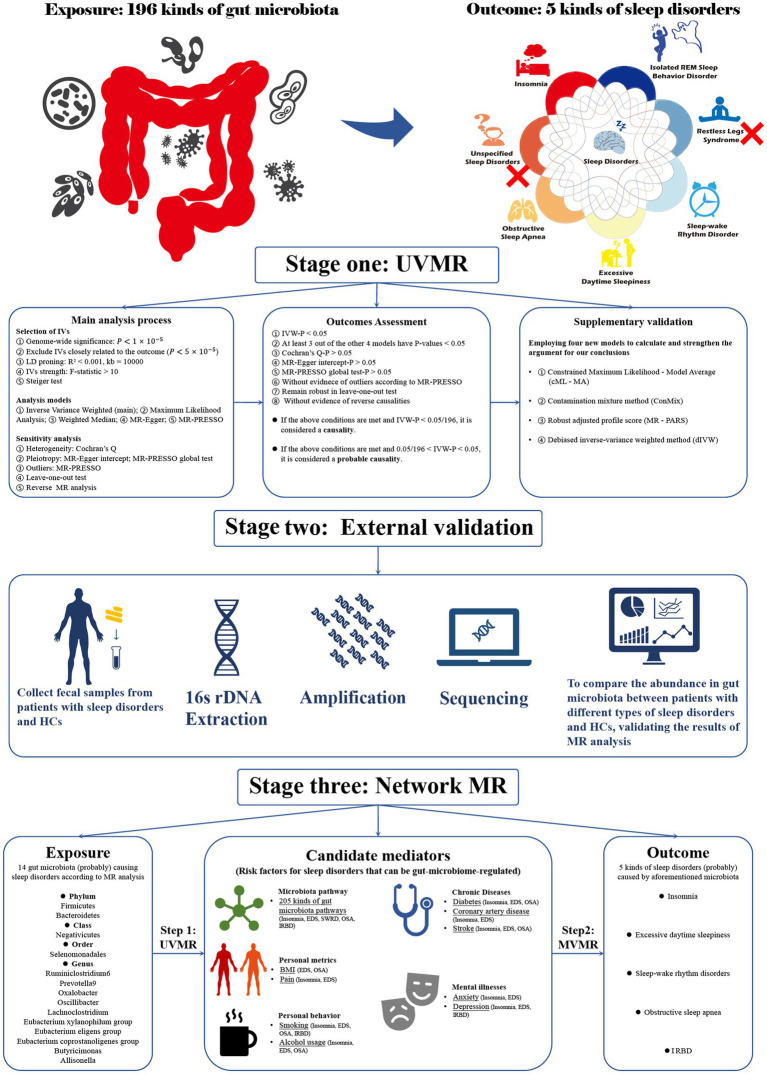
In stage 1, we utilized 196 gut microbiota as the exposure factor and conducted a two-sample univariable Mendelian randomization (MR) analysis on five sleep disorders: insomnia, excessive daytime sleepiness (EDS), sleep-wake rhythm disorders (SWRD), obstructive sleep apnea (OSA), and isolated REM sleep behavior disorder (iRBD). In stage 2, we validated the MR findings by comparing fecal microbiota abundance between patients and healthy controls through 16S rDNA sequencing. In stage 3, we explored the indirect pathways by which the microbiota affects sleep, using 205 gut microbiota metabolic pathways and 9 common risk factors for sleep disorders as candidate mediators in a network MR analysis.
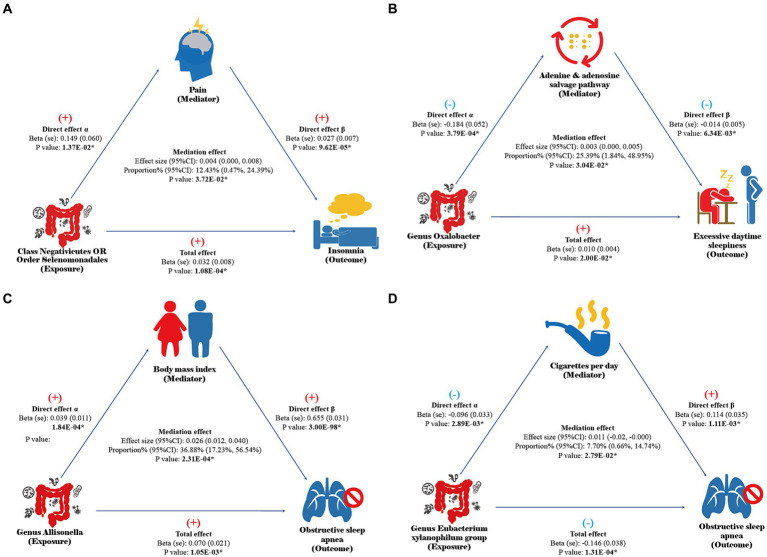
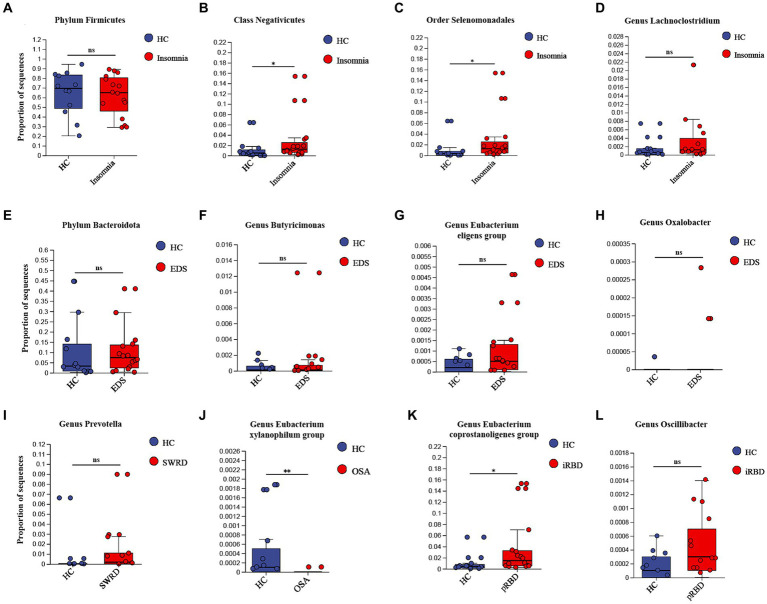
In stage 1, the univariable MR analysis identified 14 microbiota potentially influencing five different sleep disorders. In stage 2, the results from our observational study validated four of these associations. In stage 3, the network MR analysis revealed that the Negativicutes class and Selenomonadales order might worsen insomnia by increasing pain [mediation: 12.43% (95% CI: 0.47, 24.39%)]. could raise EDS by disrupting adenosine reuptake [25.39% (1.84, 48.95%)]. may elevate OSA risk via obesity promotion [36.88% (17.23, 56.54%)], while the group may lower OSA risk by decreasing smoking behavior [7.70% (0.66, 14.74%)].
Triangulation of evidence from the MR and observational study revealed indirect causal relationships between the microbiota and sleep disorders, offering fresh perspectives on how gut microbiota modulate sleep.
本研究旨在探讨肠道微生物群与睡眠障碍之间的间接因果关系。
在第一阶段,我们将196种肠道微生物群作为暴露因素,对五种睡眠障碍进行两样本单变量孟德尔随机化(MR)分析,这五种睡眠障碍分别为:失眠、日间过度嗜睡(EDS)、睡眠-觉醒节律障碍(SWRD)、阻塞性睡眠呼吸暂停(OSA)和孤立性快速眼动睡眠行为障碍(iRBD)。在第二阶段,我们通过16S rDNA测序比较患者与健康对照之间的粪便微生物群丰度,对MR结果进行验证。在第三阶段,我们在网络MR分析中使用205种肠道微生物群代谢途径和9种常见睡眠障碍风险因素作为候选中介,探索微生物群影响睡眠的间接途径。
在第一阶段,单变量MR分析确定了14种可能影响五种不同睡眠障碍的微生物群。在第二阶段,我们观察性研究的结果验证了其中四种关联。在第三阶段,网络MR分析显示,Negativicutes菌纲和Selenomonadales目可能通过增加疼痛而加重失眠[中介作用:12.43%(95%CI:0.47,24.39%)]。 可能通过破坏腺苷再摄取而增加日间过度嗜睡[25.39%(1.84,48.95%)]。 可能通过促进肥胖而增加阻塞性睡眠呼吸暂停风险[36.88%(17.23,56.54%)],而 组可能通过减少吸烟行为而降低阻塞性睡眠呼吸暂停风险[7.70%(0.66,14.74%)]。
MR和观察性研究的证据三角揭示了微生物群与睡眠障碍之间的间接因果关系,为肠道微生物群如何调节睡眠提供了新的视角。