Anderson Berkley N, Black Gabrielle P, Young Thomas M
Department of Civil and Environmental Engineering, University of California, Davis, One Shields Avenue, Davis, California 95616, United States.
ACS ES T Water. 2024 Jul 22;4(8):3532-3539. doi: 10.1021/acsestwater.4c00392. eCollection 2024 Aug 9.
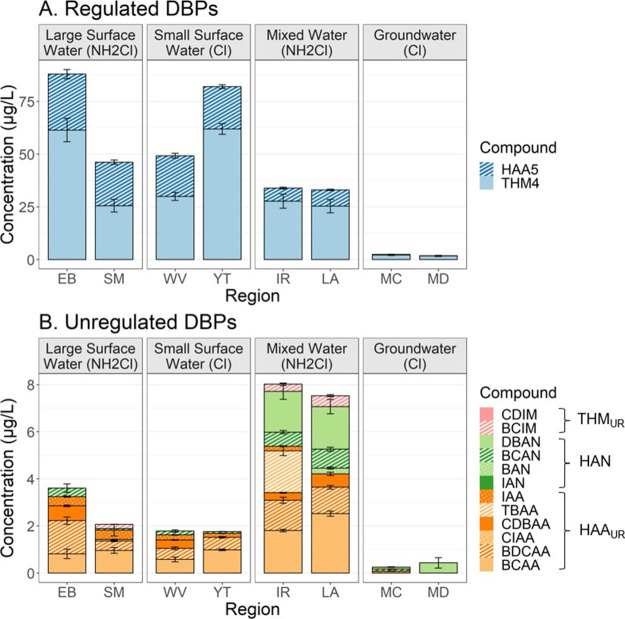
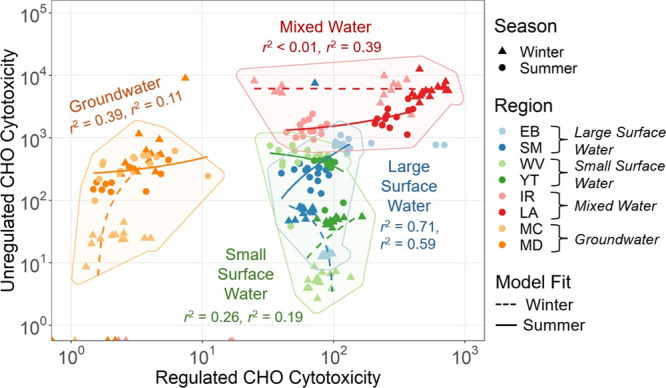
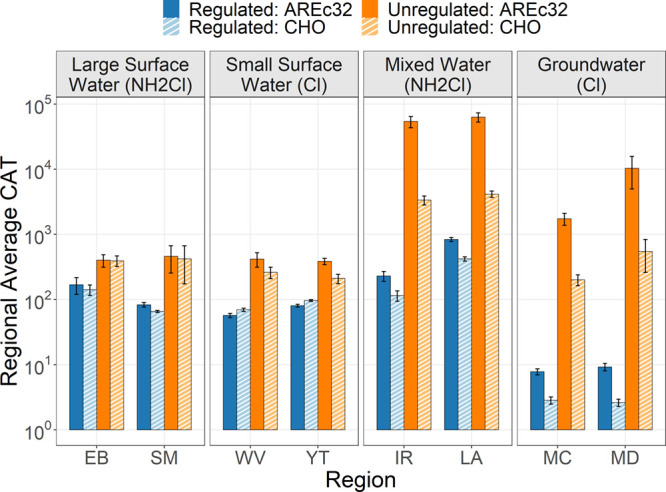
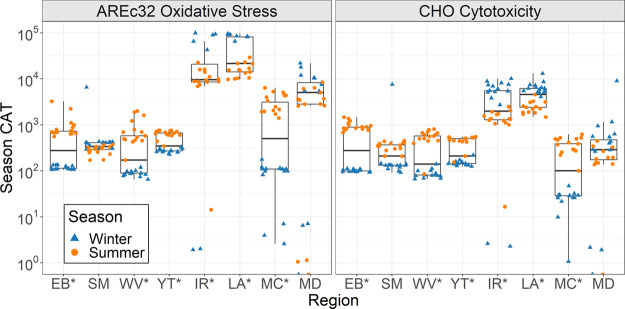
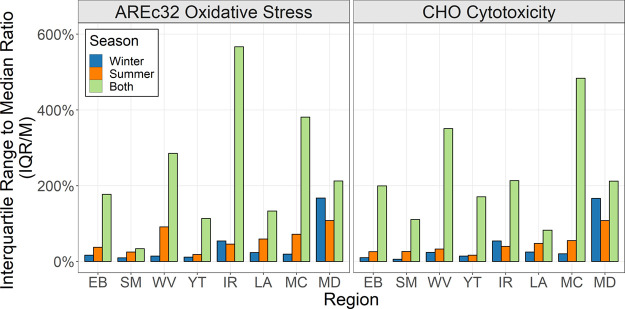
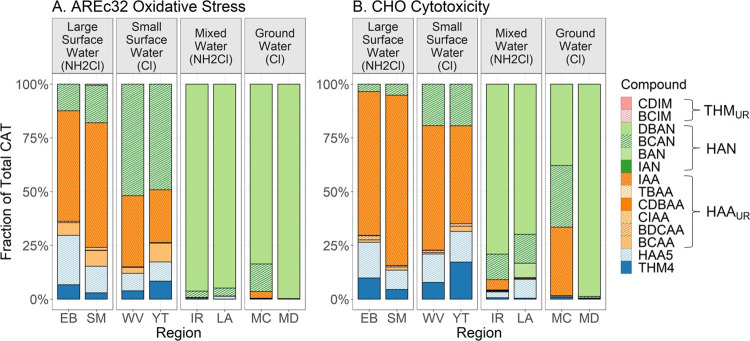
Recent studies have implemented a calculated additive toxicity (CAT) approach that sums measured disinfection byproduct (DBP) concentrations weighted by their respective in vitro bioassay potencies to estimate their associated risk in disinfected waters. In this study, the CAT approach was used to systematically investigate 21 regulated and unregulated DBPs measured in drinking water at the household level. Water samples from the tap were collected from over 120 randomly selected participants supplied by eight public water systems using four distinct source water types, two types of disinfection processes, and across two seasons. The purpose of this study was to compare CAT using multiple biological end points, examine household variability, identify DBPs driving toxicity, and assess if current regulated DBPs are adequate predictors of unregulated DBPs. Our results support the significance of unregulated DBPs, particularly haloacetonitriles and iodoacetic acid, as drivers of toxicity. Simple linear models between regulated versus unregulated concentrations and CAT were overall weak with 67% considered poor ( < 0.3). These results reveal that current regulatory monitoring approaches may not be adequately capturing true household exposure due to higher contribution of unregulated DBPs to CAT and poor predictability between regulated and unregulated DBP-mediated CAT.
最近的研究采用了一种计算加性毒性(CAT)的方法,该方法将所测消毒副产物(DBP)的浓度与其各自的体外生物测定效力加权后相加,以估计其在消毒水中的相关风险。在本研究中,CAT方法被用于系统地调查家庭层面饮用水中所测的21种受管制和不受管制的消毒副产物。从8个公共供水系统供应的120多名随机选择的参与者家中采集水龙头水样,这些供水系统使用4种不同的水源类型、2种消毒工艺,并跨越两个季节。本研究的目的是比较使用多个生物学终点的CAT,研究家庭变异性,识别导致毒性的消毒副产物,并评估当前受管制的消毒副产物是否是不受管制的消毒副产物的充分预测指标。我们的结果支持不受管制的消毒副产物,特别是卤代乙腈和碘乙酸作为毒性驱动因素的重要性。受管制与不受管制的浓度与CAT之间的简单线性模型总体较弱,67%被认为较差(<0.3)。这些结果表明,由于不受管制的消毒副产物对CAT的贡献较高,以及受管制和不受管制的消毒副产物介导的CAT之间的预测性较差,当前的监管监测方法可能无法充分捕捉真实的家庭暴露情况。