Mishra Shobhna, Jain Ankit, Sharma Prateek, Khan Ghazala, Chhibber Bhumika
Department of Physiotherapy, Amity Institute of Health Allied Sciences, New Delhi, IND.
Department of Physiotherapy, Indian Head Injury Foundation, New Delhi, IND.
Cureus. 2024 Jul 15;16(7):e64554. doi: 10.7759/cureus.64554. eCollection 2024 Jul.
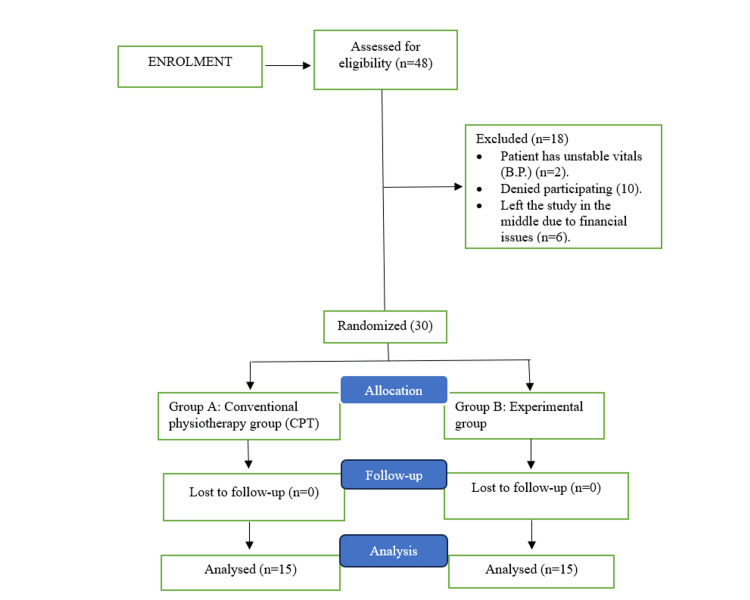
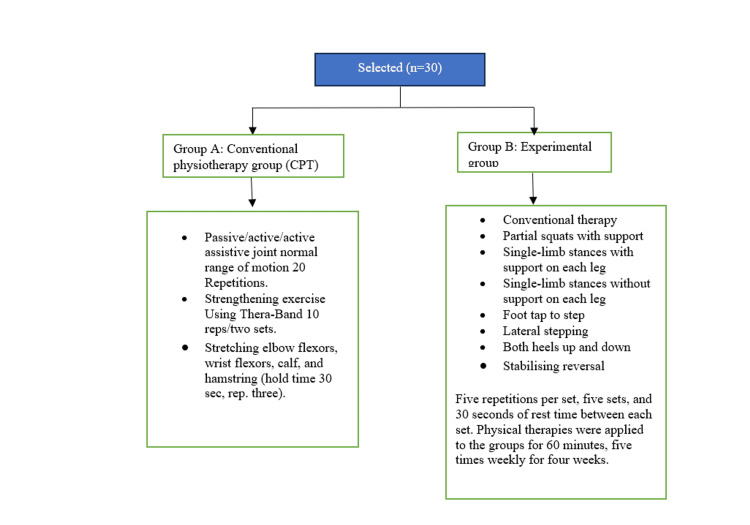
Background and objective Balance and trunk control are major concerns among older adults during stroke rehabilitation. Loss of proprioception in the affected limb has a greater influence on motor learning and reeducation during balance training. Available studies stress the relevance of strength and functional training in regaining balance and trunk control. Proprioception training, in addition to available rehabilitation, can optimize the balance among this population. Our study aimed to find out the effects of proprioceptive training on balance and trunk control among the chronic stroke population. Methodology Out of 45 subjects enrolled at the Indian Head Injury Foundation, New Delhi, India, 30 subjects were selected based on selection criteria and randomized into two groups using the chit method, with 15 subjects in each group. The control group received conventional training, which included a range of motion, stretching, and strengthening exercises, while the intervention group received additional proprioceptive training five days per week for four consecutive weeks. Subjects were assessed on the Berg Balance Scale and Trunk Control Test for balance and trunk control on day one and after four weeks. A paired t-test was used to analyze the difference within the groups, and unpaired t-tests were used between the groups, keeping p < 0.05 as a significance level. Results After four weeks of intervention, statistically significant improvements were seen in the balance and trunk control groups, with p < 0.05 in both groups. However, a significant improvement in balance was observed in the experimental group when compared across groups (p = 0.001), whereas no statistically significant improvement in trunk control was found (p = 0.061). Conclusion We conclude that proprioceptive training and conventional physiotherapy both help to improve balance. Proprioceptive training is better for improving balance, but it has no significant effects on trunk control. It is likely that an extended intervention time or a different form of intervention may be required to achieve substantial gains in these areas. Future research might look at other outcome measures or the impacts of other types of therapies to see which ones are most helpful at increasing trunk control.
背景与目的 平衡和躯干控制是老年人中风康复期间的主要关注点。患侧肢体本体感觉的丧失对平衡训练期间的运动学习和再教育有更大影响。现有研究强调力量和功能训练在恢复平衡和躯干控制方面的相关性。除了现有的康复训练外,本体感觉训练可以优化该人群的平衡能力。我们的研究旨在探讨本体感觉训练对慢性中风患者平衡和躯干控制的影响。
方法 在印度新德里的印度头部损伤基金会登记的45名受试者中,根据入选标准选择了30名受试者,并使用抽签法随机分为两组,每组15名受试者。对照组接受常规训练,包括关节活动度、伸展和强化练习,而干预组连续四周每周五天接受额外的本体感觉训练。在第一天和四周后,对受试者进行伯格平衡量表和躯干控制测试,以评估平衡和躯干控制能力。采用配对t检验分析组内差异,组间采用独立样本t检验,显著性水平设定为p < 0.05。
结果 经过四周的干预,平衡和躯干控制组均有统计学意义的改善,两组p值均< 0.05。然而,与对照组相比,实验组的平衡能力有显著改善(p = 0.001),而躯干控制能力未发现统计学意义的改善(p = 0.061)。
结论 我们得出结论,本体感觉训练和传统物理治疗都有助于改善平衡。本体感觉训练在改善平衡方面效果更好,但对躯干控制没有显著影响。可能需要延长干预时间或采用不同形式的干预才能在这些方面取得实质性进展。未来的研究可以考虑其他结局指标或其他类型治疗的影响,以确定哪些对提高躯干控制最有帮助。