1 School of Physiotherapy, Faculty of Health Sciences, Australian Catholic University, Brisbane, QLD, Australia.
2 Community Rehabilitation Unit, Tasmanian Health Service, Hobart, TAS, Australia.
Clin Rehabil. 2019 Jun;33(6):964-979. doi: 10.1177/0269215519836461. Epub 2019 Mar 22.
This systematic review aimed to investigate the effects of interventions intended for retraining leg somatosensory function on somatosensory impairment, and secondary outcomes of balance and gait, after stroke.
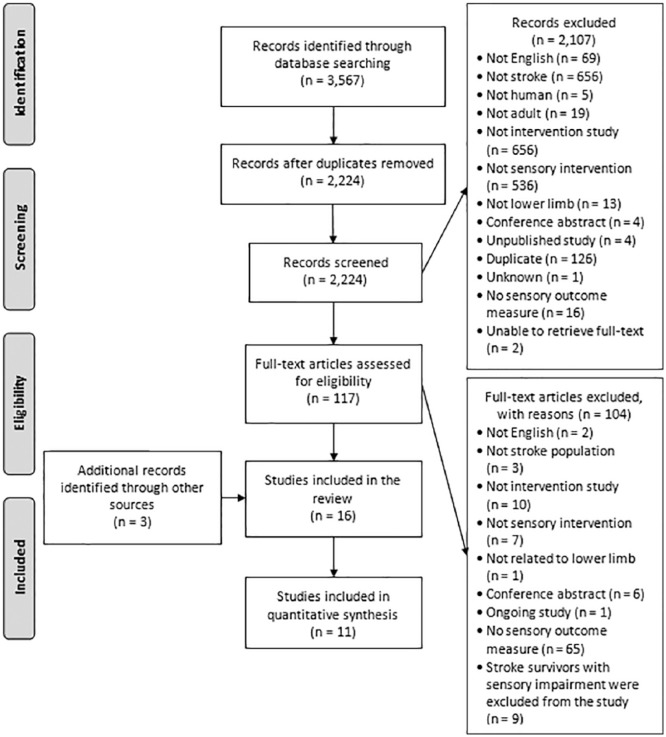
Databases searched from inception to 16 January 2019 included Cochrane Library, PubMed, MEDLINE, CINAHL, EMBASE, PEDro, PsycINFO, and Scopus. Reference lists of relevant publications were also manually searched.
All types of quantitative studies incorporating interventions that intended to improve somatosensory function in the leg post stroke were retrieved. The Quality Assessment Tool for Quantitative Studies was used for quality appraisal. Standardised mean differences were calculated and meta-analyses were performed using preconstructed Microsoft Excel spreadsheets.
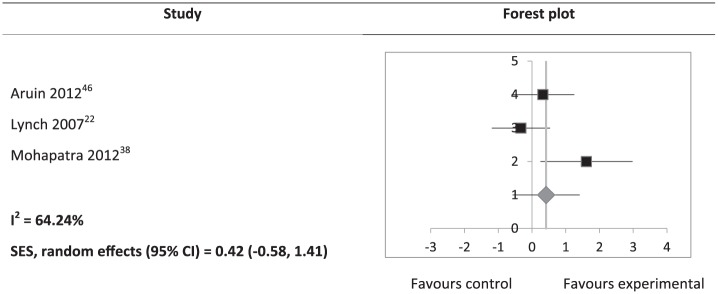
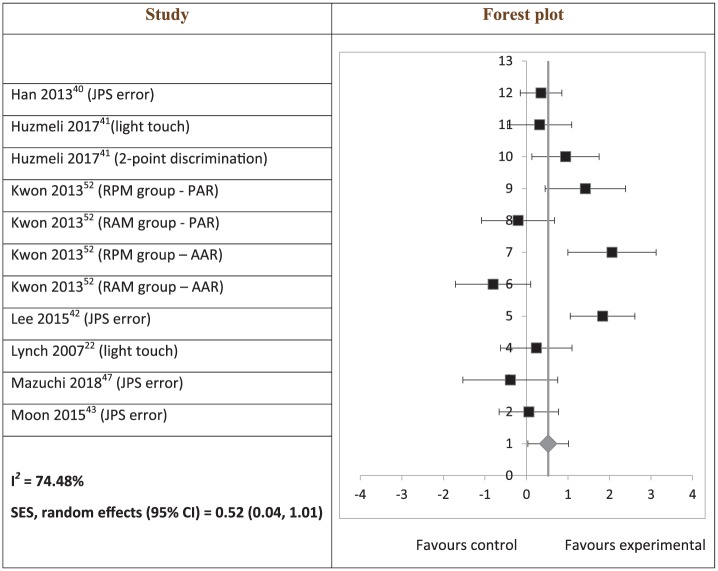
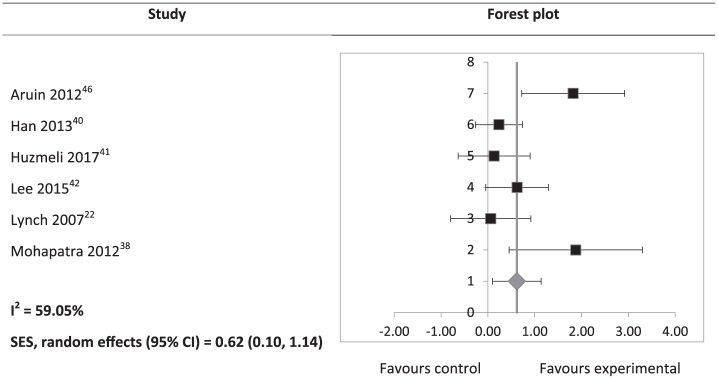
The search yielded 16 studies, comprising 430 participants, using a diverse range of interventions. In total, 10 of the included studies were rated weak in quality, 6 were rated moderate, and none was rated strong. Study quality was predominantly affected by high risk of selection bias, lack of blinding, and the use of somatosensory measures that have not been psychometrically evaluated. A significant heterogeneous positive summary effect size (SES) was found for somatosensory outcomes (SES: 0.52; 95% confidence interval (CI): 0.04 to 1.01; I = 74.48%), which included joint position sense, light touch, and two-point discrimination. There was also a significant heterogeneous positive SES for Berg Balance Scale scores (SES: 0.62; 95% CI: 0.10 to 1.14; I = 59.05%). Gait SES, mainly of gait velocity, was not significant.
This review suggests that interventions used for retraining leg somatosensory impairment after stroke significantly improved somatosensory function and balance but not gait.
本系统评价旨在调查旨在重新训练腿部躯体感觉功能的干预措施对卒中后躯体感觉障碍以及平衡和步态的次要结局的影响。
从成立到 2019 年 1 月 16 日,数据库检索包括 Cochrane Library、PubMed、MEDLINE、CINAHL、EMBASE、PEDro、PsycINFO 和 Scopus。还手动搜索了相关出版物的参考文献列表。
检索了所有包含旨在改善卒中后腿部躯体感觉功能的干预措施的定量研究。使用定量研究质量评估工具评估质量。使用预先构建的 Microsoft Excel 电子表格计算标准化均数差并进行荟萃分析。
搜索结果包括 16 项研究,共纳入 430 名参与者,使用了多种不同的干预措施。总共,纳入的 10 项研究质量较弱,6 项研究质量中等,没有研究质量较强。研究质量主要受到选择偏倚风险高、缺乏盲法以及使用未经心理测量评估的躯体感觉测量的影响。躯体感觉结果的汇总效应大小(SES)存在显著的异质性正效应(SES:0.52;95%置信区间(CI):0.04 至 1.01;I=74.48%),包括关节位置感、轻触和两点辨别。Berg 平衡量表评分的 SES 也存在显著的正异质性(SES:0.62;95%CI:0.10 至 1.14;I=59.05%)。步态 SES 主要是步态速度,没有显著意义。
本综述表明,用于重新训练卒中后腿部躯体感觉障碍的干预措施显著改善了躯体感觉功能和平衡,但对步态没有影响。