Nutrition and Microbiome Laboratory, Centre de recherche du Centre hospitalier de l'Université de Montréal (CRCHUM), Montréal, Québec, Canada.
Department of Surgery, Digestive Surgery Service, Centre hospitalier de l'Université de Montréal (CHUM), Montréal, Québec, Canada.
Oncotarget. 2024 Aug 14;15:562-572. doi: 10.18632/oncotarget.28634.
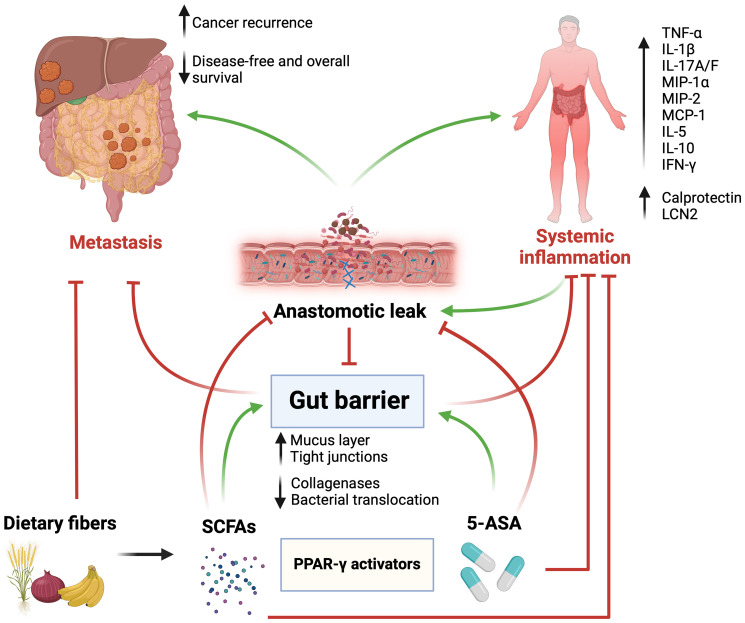
Colorectal cancer (CRC) is highly prevalent and is a major cause of cancer-related deaths worldwide. The incidence rate of CRC remains alarmingly high despite screening measures. The main curative treatment for CRC is a surgical resection of the diseased bowel segment. Postoperative complications usually involve a weakened gut barrier and a dissemination of bacterial proinflammatory lipopolysaccharides. Herein we discuss how gut microbiota and microbial metabolites regulate basal inflammation levels in the gut and the healing process of the bowel after surgery. We further elaborate on the restoration of the gut barrier function in patients with CRC and how this potentially impacts the dissemination and implantation of CRC cells in extracolonic tissues, contributing therefore to worse survival after surgery.
结直肠癌(CRC)的发病率极高,是全球癌症相关死亡的主要原因。尽管采取了筛查措施,但 CRC 的发病率仍然居高不下。CRC 的主要治疗方法是手术切除病变肠段。术后并发症通常涉及肠道屏障减弱和细菌促炎脂多糖的扩散。本文讨论了肠道微生物群和微生物代谢物如何调节肠道的基础炎症水平以及手术后肠道的愈合过程。我们进一步阐述了结直肠癌患者的肠道屏障功能的恢复,以及这如何潜在地影响 CRC 细胞在结外组织中的传播和定植,从而导致手术后生存状况恶化。