Muñoz-Lopetegi Amaia, Baiardi Simone, Balasa Mircea, Mammana Angela, Mayà Gerard, Rossi Marcello, Serradell Mónica, Zenesini Corrado, Ticca Alice, Santamaria Joan, Dellavalle Sofia, Gaig Carles, Iranzo Alex, Parchi Piero
Neurology Service, Sleep Unit, Hospital Clínic Barcelona, Universitat de Barcelona, IDIBAPS, CIBERNED, Barcelona, Spain.
IRCCS, Istituto delle Scienze Neurologiche di Bologna (ISNB), Bologna, Italy.
NPJ Parkinsons Dis. 2024 Aug 15;10(1):157. doi: 10.1038/s41531-024-00770-7.
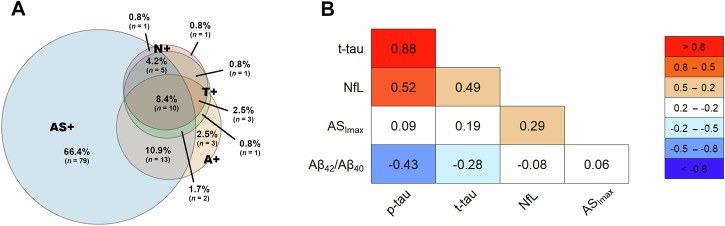
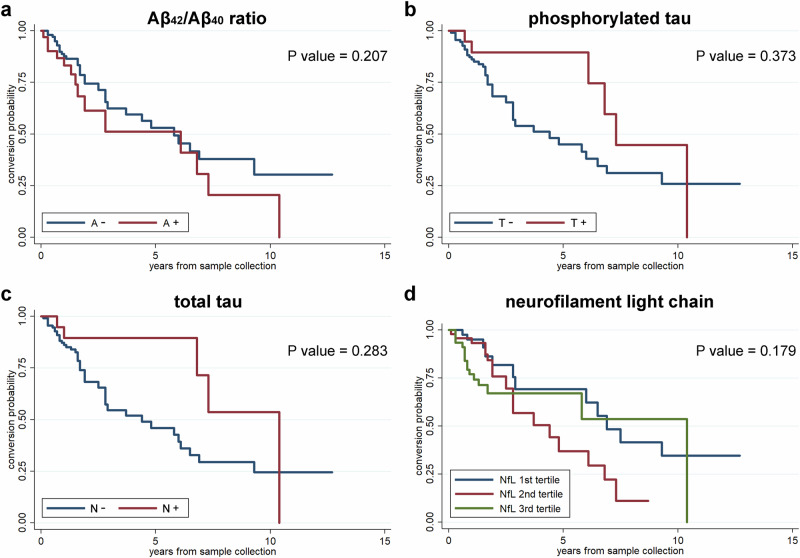
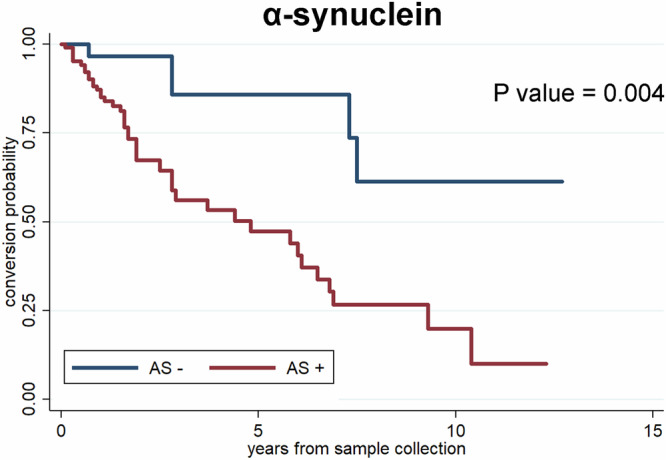
We investigated the biomarker profile of neurodegeneration, Alzheimer's and Lewy body pathology in the CSF of 148 polysomnography-confirmed patients with isolated REM sleep behavior disorder (IRBD), a condition that precedes Parkinson's disease (PD) and dementia with Lewy bodies (DLB). We assessed misfolded α-synuclein (AS) by RT-QuIC assay, amyloid-beta peptides (Aβ and Aβ), phosphorylated tau (p-tau), and total tau (t-tau) by CLEIA and neurofilament light chain (NfL) by ELISA. We detected AS in 75.3% of patients, pathologically decreased Aβ/Aβ ratio in 22.5%, increased p-tau in 15.5%, increased t-tau in 14.9%, and elevated NfL in 14.7%. After a mean follow-up of 2.48 ± 2.75 years, 47 (38.1%) patients developed PD (n = 24) or DLB (n = 23). At CSF collection, AS positivity [HR 4.05 (1.26-12.99), p = 0.019], mild cognitive impairment [3.86 (1.96-7.61), p < 0.001], and abnormal DAT-SPECT [2.31 (1.09-4.91), p < 0.030] were independent predictors of conversion to PD and DLB. Among the other CSF markers, only elevated p-tau/Aβ was predictive of conversion, although only to DLB and not as an independent variable. In IRBD, CSF AS assessment by RT-QuIC provides an added value in defining the risk of short-term conversion to PD and DLB independent of clinical and instrumental investigations. Positive Alzheimer's disease (AD) pathology markers and elevated NfL occur in a subgroup of patients, but p-tau/Aβ is the only marker that predicts short-term conversion to DLB. Longer follow-up is needed to assess if AD biomarkers predict the later development of PD and DLB in IRBD.
我们研究了148例经多导睡眠图确诊的孤立快速眼动睡眠行为障碍(IRBD)患者脑脊液中神经退行性变、阿尔茨海默病和路易体病理的生物标志物谱,IRBD是帕金森病(PD)和路易体痴呆(DLB)之前的一种病症。我们通过实时无细胞免疫反应(RT-QuIC)检测法评估错误折叠的α-突触核蛋白(AS),通过化学发光酶免疫分析(CLEIA)评估淀粉样β肽(Aβ和Aβ)、磷酸化tau蛋白(p-tau)和总tau蛋白(t-tau),并通过酶联免疫吸附测定(ELISA)评估神经丝轻链(NfL)。我们在75.3%的患者中检测到AS,22.5%的患者病理上Aβ/Aβ比值降低,15.5%的患者p-tau升高,14.9%的患者t-tau升高,14.7%的患者NfL升高。平均随访2.48±2.75年后,47例(38.1%)患者发展为PD(n = 24)或DLB(n = 23)。在采集脑脊液时,AS阳性[风险比(HR)4.05(1.26 - 12.99),p = 0.019]、轻度认知障碍[3.86(1.96 - 7.61),p < 0.001]和异常多巴胺转运体单光子发射计算机断层扫描(DAT-SPECT)[2.31(1.09 - 4.91),p < 0.030]是转化为PD和DLB的独立预测因素。在其他脑脊液标志物中,只有p-tau/Aβ升高可预测转化,尽管仅针对DLB且不是作为独立变量。在IRBD中,通过RT-QuIC进行脑脊液AS评估在定义短期转化为PD和DLB的风险方面具有附加价值,独立于临床和仪器检查。阿尔茨海默病(AD)病理阳性标志物和NfL升高出现在一部分患者中,但p-tau/Aβ是唯一预测短期转化为DLB的标志物。需要更长时间的随访来评估AD生物标志物是否能预测IRBD中PD和DLB的后期发展。