Zhang Xuan, Zhou Ziying, Cai Yilu, Grzybowski Andrzej, Ye Juan, Lou Lixia
Eye Center, The Second Affiliated Hospital, School of Medicine, Zhejiang University, Zhejiang Provincial Key Laboratory of Ophthalmology, Zhejiang Provincial Clinical Research Center for Eye Diseases, Zhejiang Provincial Engineering Institute on Eye Diseases, Hangzhou, China.
Institute for Research in Ophthalmology, Foundation for Ophthalmology Development, 60-836, Poznan, Poland.
Heliyon. 2024 Jul 20;10(14):e34979. doi: 10.1016/j.heliyon.2024.e34979. eCollection 2024 Jul 30.
To generate an overview of global research on artificial intelligence (AI) in eyelid diseases using a bibliometric approach.
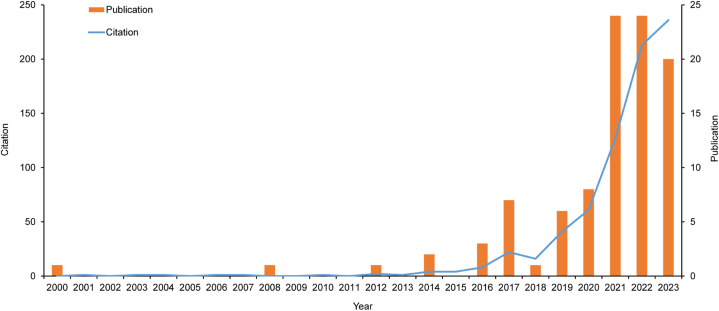
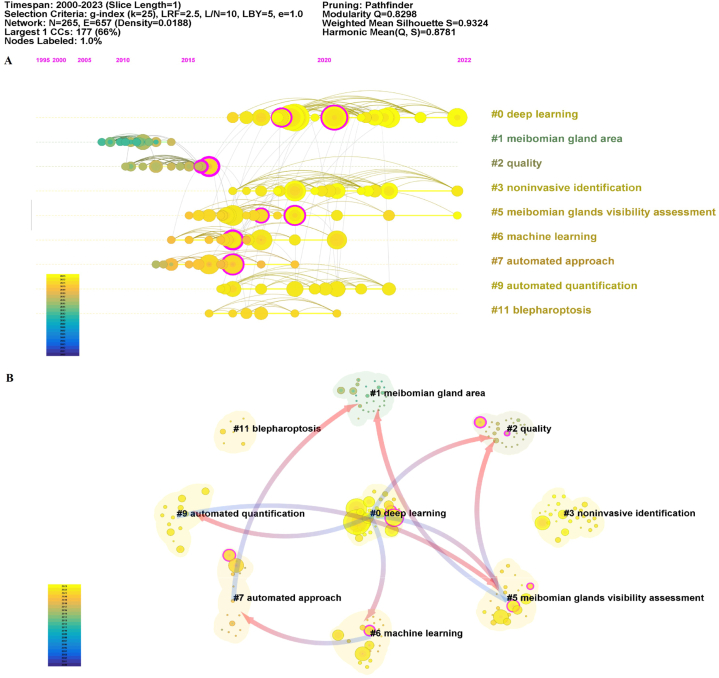
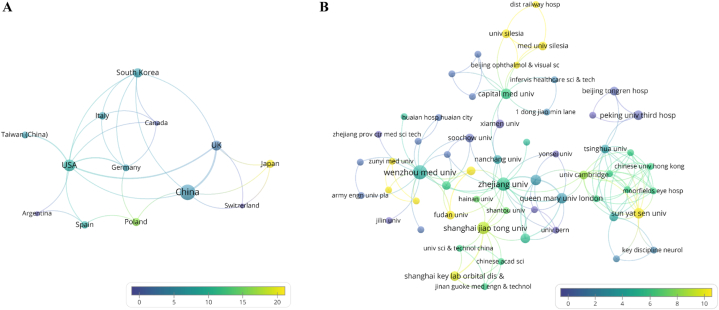
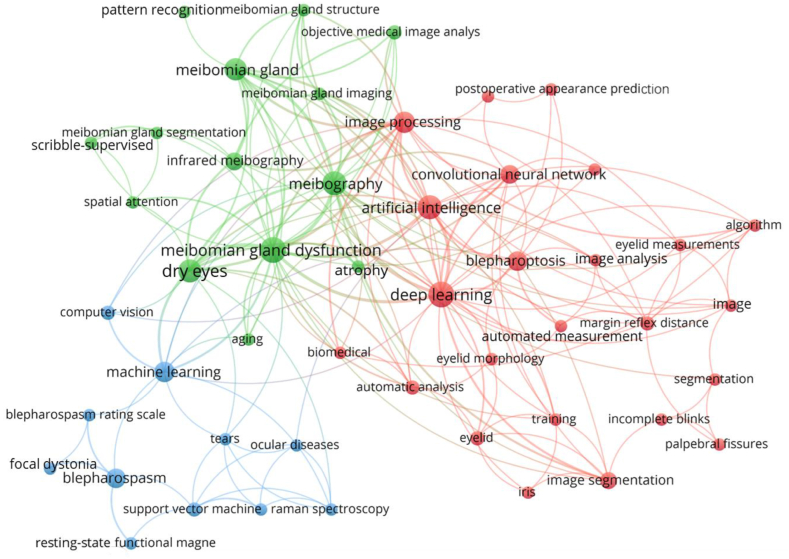
All publications related to AI in eyelid diseases from 1900 to 2023 were retrieved from the Web of Science (WoS) Core Collection database. After manual screening, 98 publications published between 2000 and 2023 were finally included. We analyzed the annual trend of publication and citation count, productivity and co-authorship of countries/territories and institutions, research domain, source journal, co-occurrence and evolution of the keywords and co-citation and clustering of the references, using the analytic tool of the WoS, VOSviewer, Wordcloud Python package and CiteSpace.
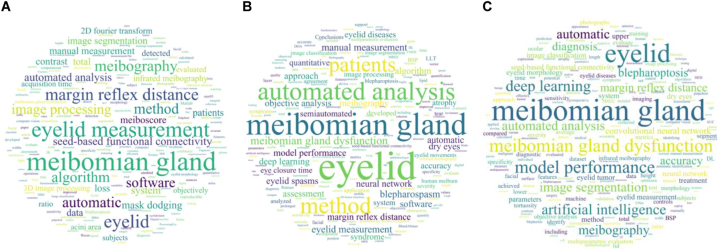
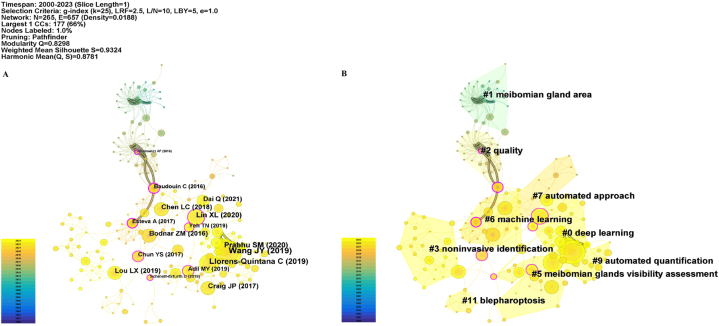
By analyzing a total of 98 relevant publications, we detected that this field had continuously developed over the past two decades and had entered a phase of rapid development in the last three years. Among these countries/territories and institutions contributing to this field, China was the most productive country and had the most institutions with high productivity, while USA was the most active in collaborating with others. The most popular research domains was Ophthalmology and the most productive journals were Ocular Surface. The co-occurrence network of keywords could be classified into 3 clusters respectively concerned about blepharoptosis, meibomian gland dysfunction and blepharospasm. The evolution of research hotspots is from clinical features to clinical scenarios and from image processing to deep learning. In the clustering analysis of co-cited reference network, cluster "0# deep learning" was the largest and latest, and cluster "#5 meibomian glands visibility assessment" existed for the longest time.
Although the research of AI in eyelid diseases has rapidly developed in the last three years, there are still gaps in this area. Our findings provide researchers with a better understanding of the development of the field and a reference for future research directions.
采用文献计量学方法对全球眼睑疾病人工智能(AI)研究进行概述。
从科学网(WoS)核心合集数据库中检索1900年至2023年所有与眼睑疾病AI相关的出版物。经过人工筛选,最终纳入2000年至2023年发表的98篇出版物。我们使用WoS分析工具、VOSviewer、Wordcloud Python包和CiteSpace,分析了出版物和被引频次的年度趋势、国家/地区和机构的生产力与合作情况、研究领域、来源期刊、关键词共现与演变以及参考文献共被引与聚类。
通过分析总共98篇相关出版物,我们发现该领域在过去二十年中持续发展,并在过去三年进入快速发展阶段。在为该领域做出贡献的这些国家/地区和机构中,中国是产出最多的国家,拥有最多高生产力机构,而美国在与其他国家合作方面最为活跃。最热门的研究领域是眼科,产出最多的期刊是《眼表》。关键词共现网络可分为分别关注上睑下垂、睑板腺功能障碍和眼睑痉挛的3个聚类。研究热点的演变是从临床特征到临床场景,从图像处理到深度学习。在共被引参考文献网络的聚类分析中,聚类“0#深度学习”最大且最新,聚类“#5睑板腺可见度评估”存在时间最长。
尽管眼睑疾病AI研究在过去三年中迅速发展,但该领域仍存在差距。我们的研究结果为研究人员更好地了解该领域的发展以及未来研究方向提供了参考。