Gil J, Navarrete E, Rosin L F, Chowdhury N, Abraham S, Cornilleau G, Lei E P, Mozziconacci J, Mirny L A, Muller H, Drinnenberg I A
Institut Curie, PSL University, Sorbonne Université, CNRS, Nuclear Dynamics, 75005 Paris, France.
Department of Biology, Massachusetts Institute of Technology, Cambridge, MA 02139, USA.
Res Sq. 2024 Jul 31:rs.3.rs-4732646. doi: 10.21203/rs.3.rs-4732646/v1.
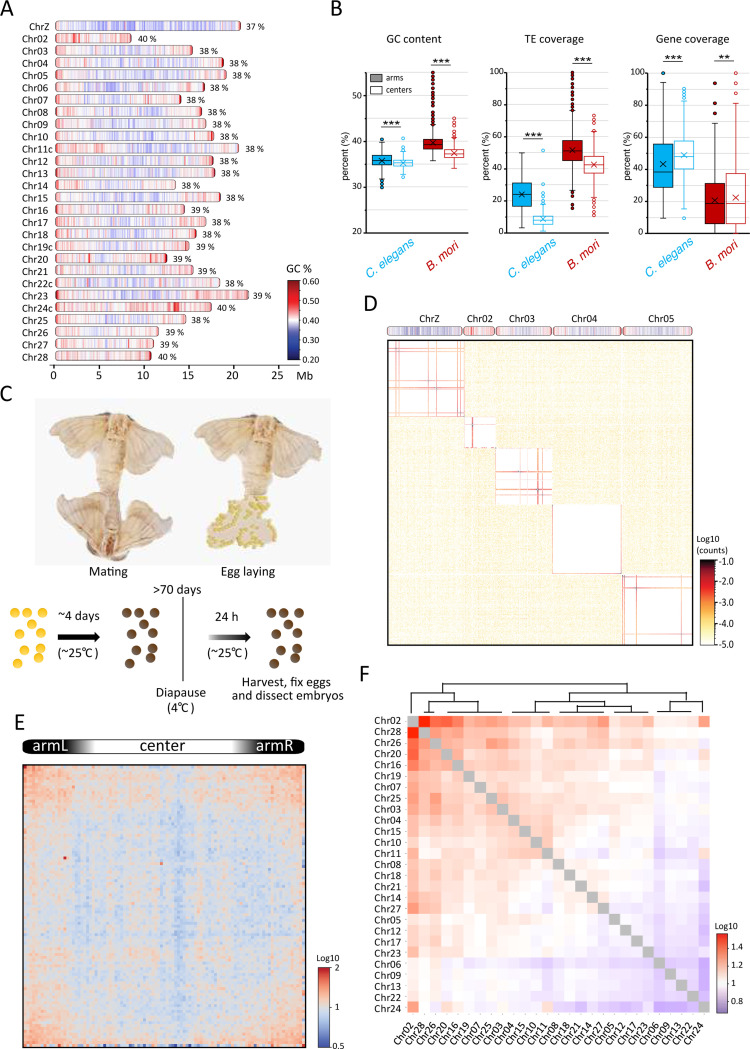
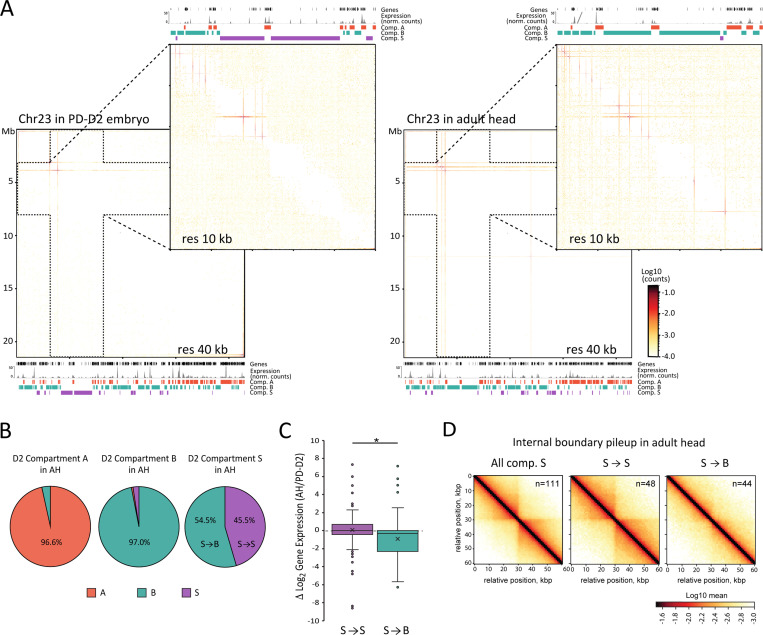
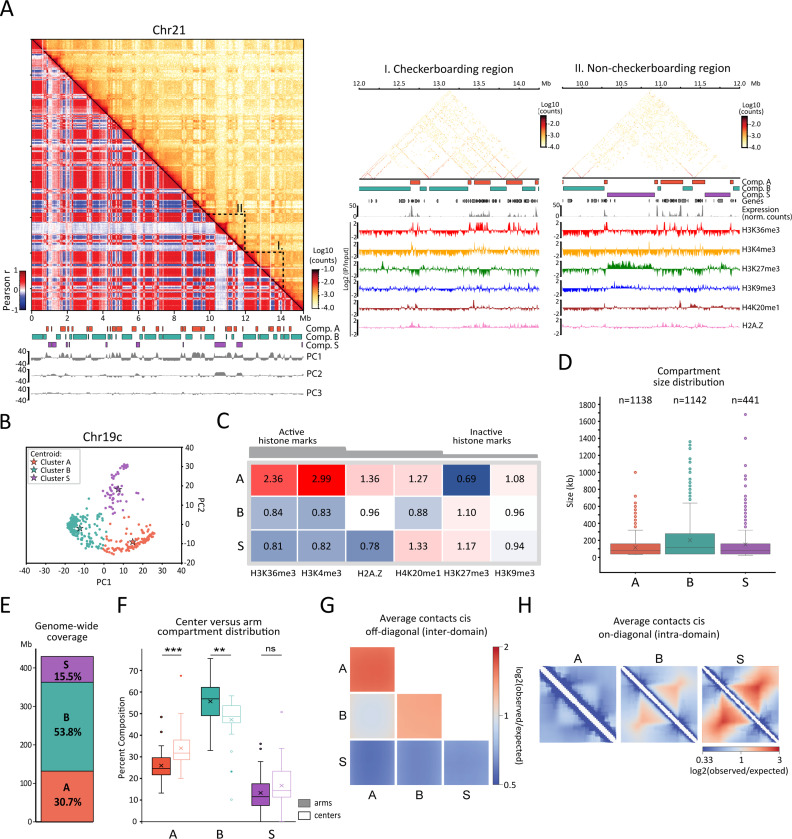
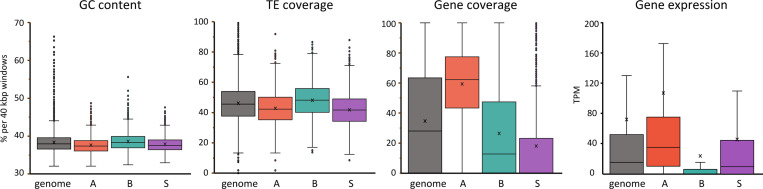
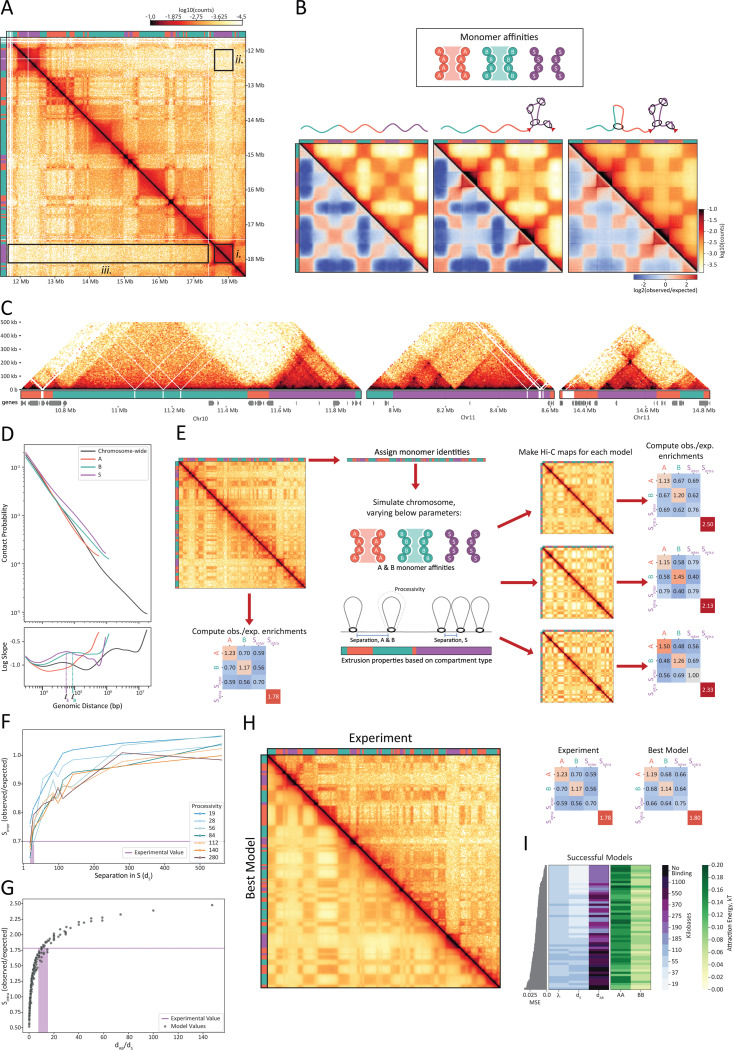
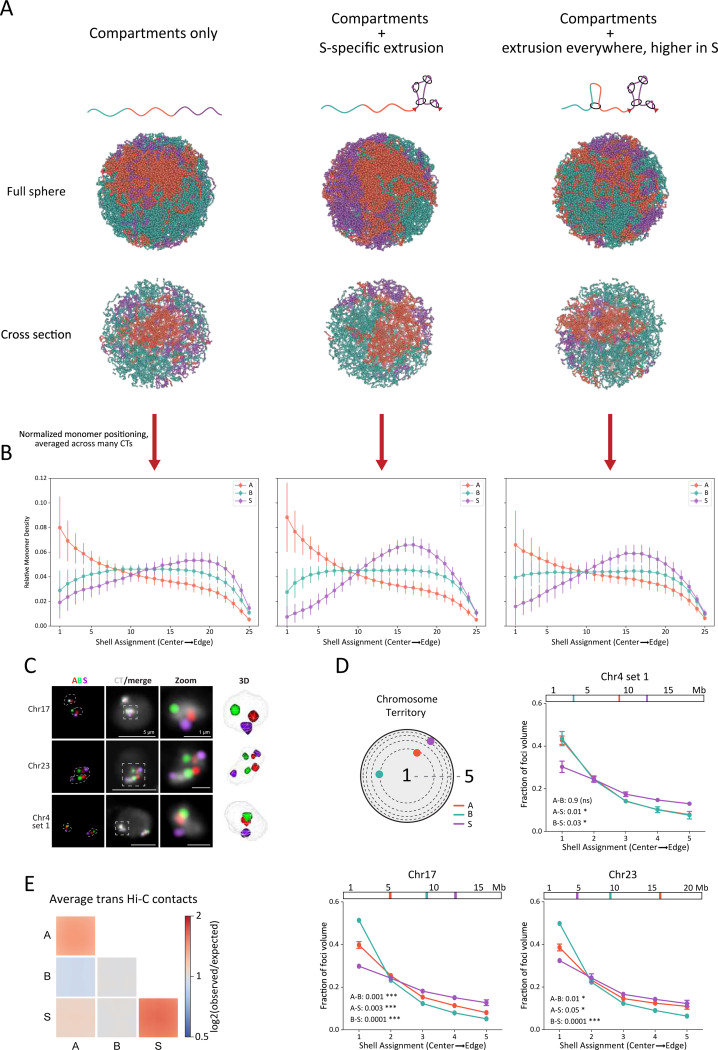
The hallmarks of chromosome organization in multicellular eukaryotes are chromosome territories (CT), chromatin compartments, and insulated domains, including topologically associated domains (TADs). Yet, most of these elements of chromosome organization are derived from analyses of a limited set of model organisms, while large eukaryotic groups, including insects, remain mostly unexplored. Here we combine Hi-C, biophysical modeling, and microscopy to characterize the 3D genome architecture of the silkmoth, . In contrast to other eukaryotes, chromosomes form highly separated territories. Similar to other eukaryotes, chromosomes segregate into active A and inactive B compartments, yet unlike in vertebrate systems, contacts between euchromatic A regions appear to be a strong driver of compartmentalization. Remarkably, we also identify a third compartment, called secluded "S," with a unique contact pattern. Each S region shows prominent short-range self-contacts and is remarkably devoid of contacts with the rest of the chromosome, including other S regions. Compartment S hosts a unique combination of genetic and epigenetic features, localizes towards the periphery of CTs, and shows developmental plasticity. Biophysical modeling reveals that the formation of such secluded domains requires highly localized loop extrusion within them, along with a low level of extrusion in A and B. Our Hi-C data supports predicted genome-wide and localized extrusion. Such a broad, non-uniform distribution of extruders has not been seen in other organisms. Overall, our analyses support loop extrusion in insects and highlight the evolutionary plasticity of 3D genome organization, driven by a new combination of known processes.
多细胞真核生物中染色体组织的标志是染色体区域(CT)、染色质区室和绝缘结构域,包括拓扑相关结构域(TAD)。然而,这些染色体组织的大多数元素都来自对有限一组模式生物的分析,而包括昆虫在内的大型真核生物群体大多仍未被探索。在这里,我们结合高通量染色体构象捕获技术(Hi-C)、生物物理建模和显微镜技术来表征家蚕的三维基因组结构。与其他真核生物不同,家蚕染色体形成高度分离的区域。与其他真核生物相似,家蚕染色体分离为活跃的A区室和不活跃的B区室,但与脊椎动物系统不同的是,常染色质A区域之间的接触似乎是区室化的一个重要驱动因素。值得注意的是,我们还识别出第三个区室,称为隔离的“S”区室,具有独特的接触模式。每个S区域都显示出显著的短程自接触,并且与染色体的其余部分,包括其他S区域,明显缺乏接触。S区室具有独特的遗传和表观遗传特征组合,定位于染色体区域的外围,并表现出发育可塑性。生物物理建模表明,这种隔离结构域的形成需要在其中进行高度局部化的环挤压,同时在A区室和B区室中进行低水平的挤压。我们的Hi-C数据支持全基因组范围内和局部的挤压预测。在其他生物体中尚未见过这种广泛的、非均匀分布的挤压因子。总体而言,我们的分析支持昆虫中的环挤压,并强调了三维基因组组织的进化可塑性,这是由已知过程的新组合驱动的。