Guo Dong, Liu Hui, Zhao Sheng, Lu Xinya, Wan Haoyu, Zhao Yitao, Liang Xinzhi, Zhang Anbiao, Wu Mengyuan, Xiao Zhisheng, Hu Ning, Li Zhong, Xie Denghui
Department of Orthopedic Surgery, Center for Orthopedic Surgery, The Third Affiliated Hospital of Southern Medical University, Guangzhou, 510630, PR China.
Guangdong Provincial Key Laboratory of Bone and Joint Degeneration Diseases, Guangzhou, 510630, PR China.
Bioact Mater. 2024 Jul 23;41:221-238. doi: 10.1016/j.bioactmat.2024.07.026. eCollection 2024 Nov.
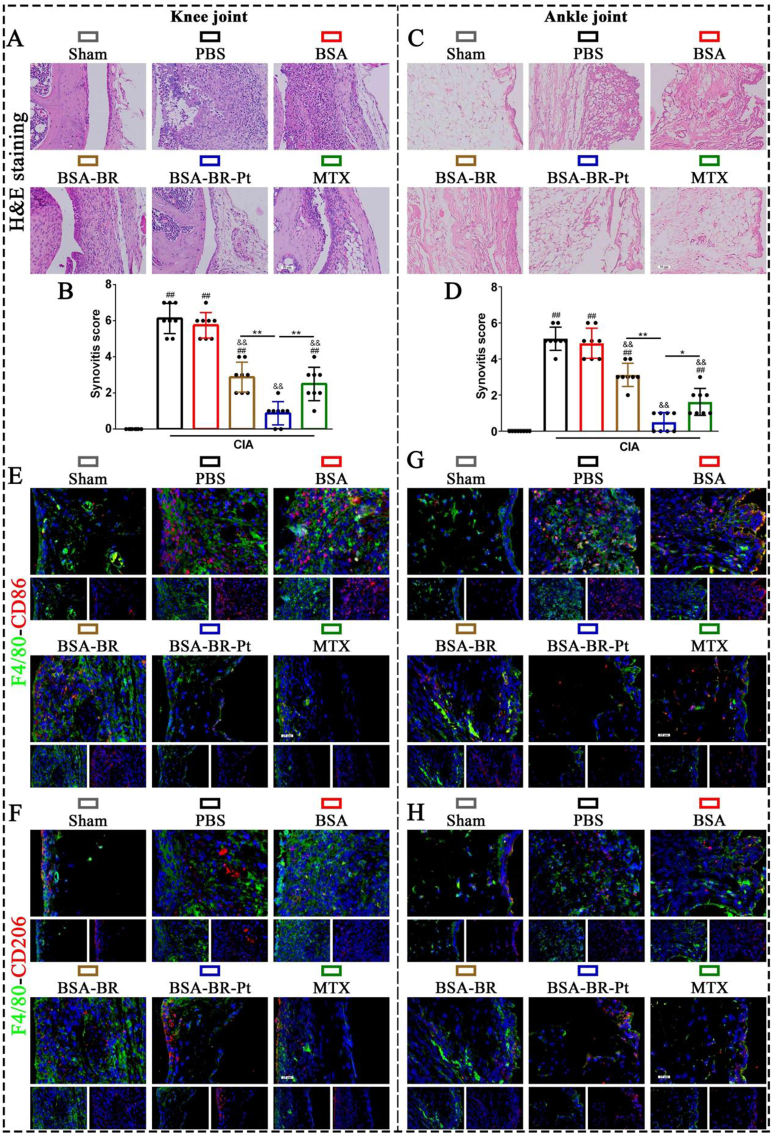
A detrimental feedback loop between hypoxia and oxidative stress consistently drives macrophage polarization toward a pro-inflammatory M1 phenotype, thus persistently aggravating rheumatoid arthritis (RA) progression. Herein, an enzyme-catalyzed nanoplatform with synergistic hypoxia-relieving and reactive oxygen species (ROS)-scavenging properties was developed using bovine serum albumin-bilirubin-platinum nanoparticles (BSA-BR-Pt NPs). Bilirubin was employed to eliminate ROS, while platinum exhibited a synergistic effect in scavenging ROS and simultaneously generated oxygen. In mice RA model, BSA-BR-Pt NPs treatment exhibited superior effects, resulting in significant improvements in joint inflammation, cartilage damage, and bone erosion, compared to methotrexate, the most widely used antirheumatic drug. Mechanistically, RNA-sequencing data and experimental results elucidated that BSA-BR-Pt NPs induced a re-polarization of hypoxic M1 macrophages to M2 macrophages via switching glycolysis to oxidative phosphorylation through the inhibition of HIF-1α pathway. Collectively, this research for the first time elaborated the underlying mechanism of enzyme-catalyzed nanoplatform in orchestrating macrophage polarization, and identified a novel therapeutic strategy for RA and other inflammatory disorders.
缺氧与氧化应激之间的有害反馈回路持续推动巨噬细胞极化为促炎性M1表型,从而持续加剧类风湿性关节炎(RA)的进展。在此,利用牛血清白蛋白-胆红素-铂纳米颗粒(BSA-BR-Pt NPs)开发了一种具有协同缓解缺氧和清除活性氧(ROS)特性的酶催化纳米平台。胆红素用于清除ROS,而铂在清除ROS方面具有协同作用,并同时产生氧气。在小鼠RA模型中,与使用最广泛的抗风湿药物甲氨蝶呤相比,BSA-BR-Pt NPs治疗表现出更优的效果,可显著改善关节炎症、软骨损伤和骨质侵蚀。从机制上讲,RNA测序数据和实验结果表明,BSA-BR-Pt NPs通过抑制HIF-1α途径将糖酵解转换为氧化磷酸化,从而诱导缺氧的M1巨噬细胞重新极化为M2巨噬细胞。总的来说,这项研究首次阐述了酶催化纳米平台在调控巨噬细胞极化中的潜在机制,并确定了一种针对RA和其他炎症性疾病的新型治疗策略。