Programa de Pós-graduação em Ecologia e Conservação, Universidade Federal do Paraná, Curitiba, Brazil.
Programa de Pós-graduação em Zoologia, Universidade Federal do Paraná, Curitiba, Brazil.
PLoS Negl Trop Dis. 2024 Aug 16;18(8):e0012430. doi: 10.1371/journal.pntd.0012430. eCollection 2024 Aug.
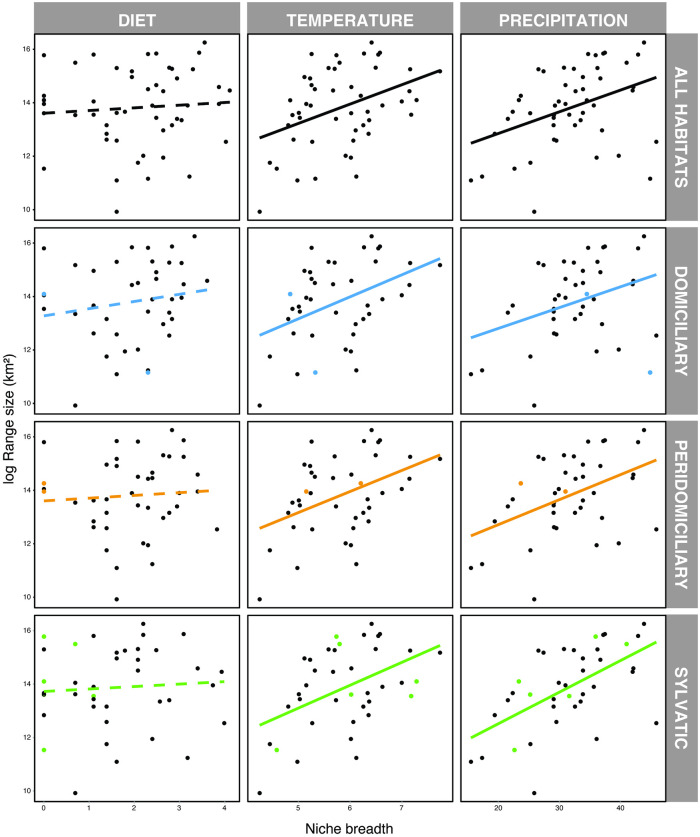
Ecological theory predicts that species that can utilise a greater diversity of resources and, therefore, have wider niche breadths should also occupy larger geographic areas (the 'niche breadth-range size hypothesis'). Here, we tested this hypothesis for a blood-sucking group of insects of medical significance: the Triatominae (aka 'kissing bugs') (Hemiptera: Reduviidae). Given that niches can be viewed from different perspectives, we tested this hypothesis based on both dietary and climatic niches. We assembled the most complete dataset of triatomine feeding patterns to date by reviewing 143 studies from the literature up to 2021 and tested whether the niche breadth-range size hypothesis held for this group for both dietary and climatic components of the niche. Temperature and precipitation niche breadths were estimated from macro-environmental variables, while diet breadth was calculated based on literature data that used PCR and/or ELISA to identify different types of hosts as blood sources per triatomine species. Our results showed that temperature and precipitation niche breadths, but not dietary breadth, were positively correlated with range sizes, independent of evolutionary history among species. These findings support the predictions from the range size-niche breadth hypothesis concerning climate but not diet, in Triatominae. It also shows that support for the niche breadth-range size hypothesis is dependent upon the niche axis under consideration, which can explain the mixed support for this hypothesis in the ecological literature.
生态理论预测,能够利用更多资源的物种,因此具有更广泛的生态位宽度,也应该占据更大的地理区域(“生态位宽度-范围大小假说”)。在这里,我们针对具有医学意义的吸血昆虫组——三锥虫科(又名“接吻虫”)(半翅目:锥蝽科),检验了这一假说。鉴于生态位可以从不同的角度来看待,我们根据饮食和气候生态位来检验这一假说。我们通过查阅截至 2021 年的文献中 143 项研究,对三锥虫的摄食模式进行了迄今为止最完整的数据集组装,检验了对于这一组群的饮食和气候生态位的组成部分,生态位宽度-范围大小假说是否成立。温度和降水生态位宽度是根据宏观环境变量来估计的,而饮食宽度则是根据文献数据计算的,这些数据使用 PCR 和/或 ELISA 来识别每一种三锥虫物种的不同类型的宿主作为血液来源。我们的研究结果表明,温度和降水生态位宽度,但不是饮食宽度,与范围大小呈正相关,这与物种间的进化历史无关。这些发现支持了三锥虫科中与气候有关的范围大小-生态位宽度假说的预测,但与饮食无关。这也表明,对生态位宽度-范围大小假说的支持取决于所考虑的生态位轴,这可以解释该假说在生态学文献中存在的混合支持。