University of California, San Diego Herbert Wertheim School of Public Health and Human Longevity Science, La Jolla, USA.
San Diego School of Medicine, Department of Obstetrics, Gynecology, and Reproductive Sciences, Division of Maternal Fetal Medicine, University of California, 9300 Campus Point Dr., MC 7433, , La Jolla, USA.
BMC Public Health. 2024 Aug 16;24(1):2230. doi: 10.1186/s12889-024-19776-0.
Wearing a mask was a crucial component in slowing the COVID-19 pandemic. However, little is known about the intersectionality between mask usage, risk perception, and infection. The purpose of this study was to investigate whether risk perceptions and masking behaviors are associated with contracting SARS-CoV-2 and how contracting SARS-CoV-2 subsequently changes masking behaviors in specific situations.
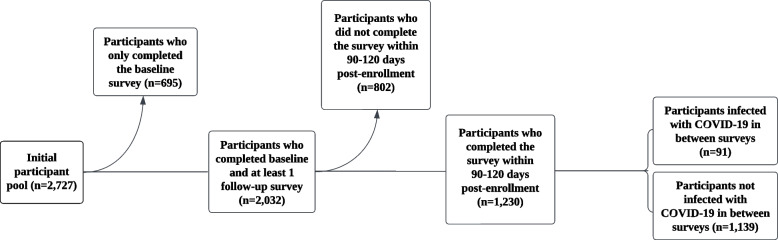
This cohort study utilized survey data from the UC San Diego ZAP COVID-19 study (n = 1,230) to evaluate the risk of contracting SARS-CoV-2 in relation to baseline risk perceptions and masking behaviors in various situations and how contracting SARS-CoV-2 affects subsequent masking behavior.
We found that more consistent self-reported mask use in indoor public spaces (p = 0.03) and in other people's houses (p = 0.002) was associated with remaining free of SARS-CoV-2 infection. We also found that contracting SARS-CoV-2 was associated with a subsequent increase in mask use in other people's houses (p = 0.01).
Our findings suggest that consistent mask use is correlated with decreased infection and that contracting SARS-CoV-2 may modify mask use behaviors in high-risk situations. These findings may help inform future public health messaging for infectious disease prevention.
This study has not been previously registered as it is an observational study. There was no pre-registration of the analytic plan for the present study.
佩戴口罩是减缓 COVID-19 大流行的关键因素。然而,人们对口罩使用、风险认知和感染之间的交叉关系知之甚少。本研究的目的是调查风险认知和戴口罩行为是否与感染 SARS-CoV-2 有关,以及感染 SARS-CoV-2 后如何改变特定情况下的戴口罩行为。
本队列研究利用加州大学圣地亚哥 ZAP COVID-19 研究(n=1230)的调查数据,评估与基线风险认知和各种情况下的戴口罩行为相关的感染 SARS-CoV-2 的风险,以及感染 SARS-CoV-2 如何影响随后的戴口罩行为。
我们发现,在室内公共场所(p=0.03)和在其他人的家中(p=0.002)更一致地报告戴口罩与保持 SARS-CoV-2 感染阴性有关。我们还发现,感染 SARS-CoV-2 与随后在其他人的家中增加戴口罩行为有关(p=0.01)。
我们的研究结果表明,一致的戴口罩与感染减少有关,而感染 SARS-CoV-2 可能会改变高风险情况下的口罩使用行为。这些发现可能有助于为传染病预防提供未来的公共卫生信息。
本研究之前未注册,因为它是一项观察性研究。本研究目前没有预先注册分析计划。