• 文献检索
  • 文档翻译
  • 深度研究
  • 学术资讯
  • Suppr Zotero 插件Zotero 插件
  • 邀请有礼
  • 套餐&价格
  • 历史记录
应用&插件
Suppr Zotero 插件Zotero 插件浏览器插件Mac 客户端Windows 客户端微信小程序
定价
高级版会员购买积分包购买API积分包
服务
文献检索文档翻译深度研究API 文档MCP 服务
关于我们
关于 Suppr公司介绍联系我们用户协议隐私条款
关注我们

Suppr 超能文献

核心技术专利:CN118964589B侵权必究
粤ICP备2023148730 号-1Suppr @ 2026

文献检索

告别复杂PubMed语法,用中文像聊天一样搜索,搜遍4000万医学文献。AI智能推荐,让科研检索更轻松。

立即免费搜索

文件翻译

保留排版,准确专业,支持PDF/Word/PPT等文件格式,支持 12+语言互译。

免费翻译文档

深度研究

AI帮你快速写综述,25分钟生成高质量综述,智能提取关键信息,辅助科研写作。

立即免费体验

评估巴西的高血压护理质量:2013 年和 2019 年国家健康调查中公共和私人服务中的性别、种族和社会经济交叉问题。

Assessing hypertension care quality in Brazil: gender, race, and socioeconomic intersection in public and private services, 2013 and 2019 national health surveys.

机构信息

Post-Graduate Program in Epidemiology, Federal University of Pelotas, City of Pelotas, State of Rio Grande do Sul, Brazil.

Department of Social Medicine, Faculty of Medicine, Federal University of Pelotas, City of Pelotas, State of Rio Grande do Sul, Brazil.

出版信息

BMC Health Serv Res. 2024 Aug 16;24(1):939. doi: 10.1186/s12913-024-11358-5.

DOI:10.1186/s12913-024-11358-5
PMID:39152425
原文链接:https://pmc.ncbi.nlm.nih.gov/articles/PMC11330122/
Abstract

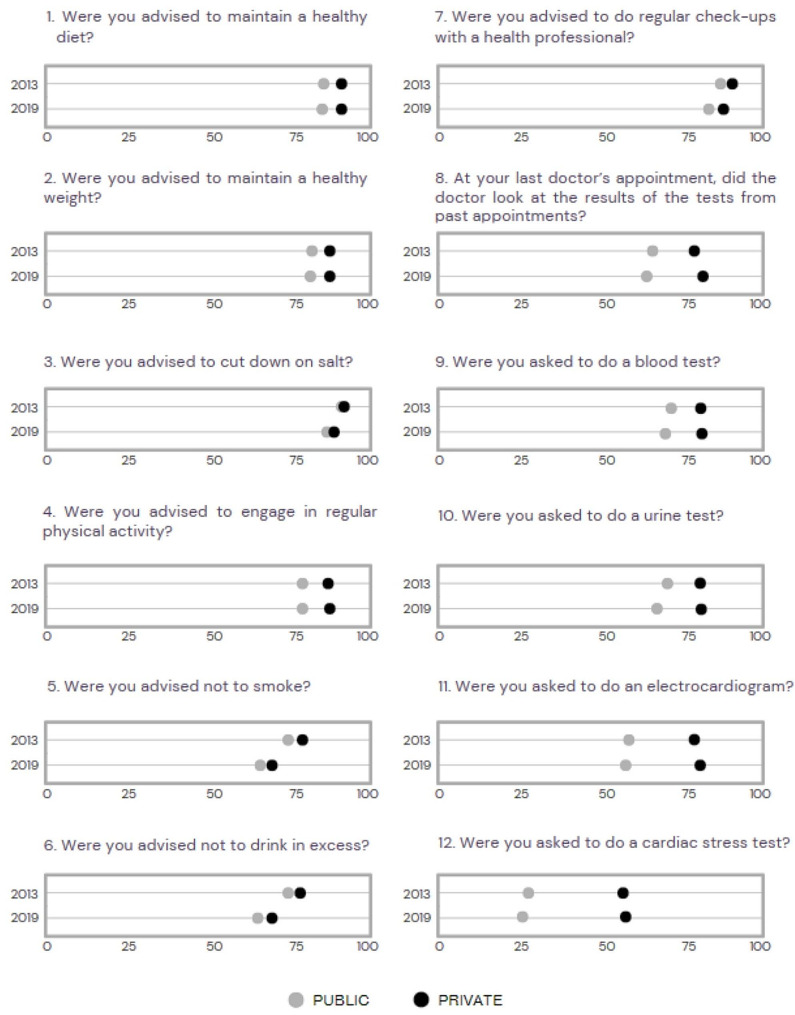
We conducted a cross-sectional study of hypertension care in public and private services, analyzing gender, color, and socioeconomic status. Using data from the 2013 (n = 60,202) and 2019 (n = 90,846) national health surveys, hypertension prevalence increased from 21.4 to 23.9%. Quality of care declined from 41.7 to 35.4%, particularly in public services, disproportionately affecting low-income Black women. Poisson regression estimated prevalence ratios (PRs), with the lowest adjusted PR for high-quality care among low-income Black women. These findings highlight persistent health inequalities and the urgent need for intersectoral policies to promote health equity.

摘要

我们进行了一项横断面研究,分析了公共和私人服务中的高血压护理情况,考虑了性别、肤色和社会经济地位因素。利用 2013 年(n=60202)和 2019 年(n=90846)国家健康调查的数据,高血压患病率从 21.4%上升至 23.9%。护理质量从 41.7%下降至 35.4%,尤其是在公共服务中,这对低收入的黑人女性产生了不成比例的影响。泊松回归估计了患病率比(PR),其中低收入黑人女性中高质量护理的调整后 PR 最低。这些发现突显了持续存在的健康不平等问题,迫切需要采取跨部门政策来促进健康公平。
https://cdn.ncbi.nlm.nih.gov/pmc/blobs/f327/11330122/8ace2bf5fe9d/12913_2024_11358_Fig1_HTML.jpg

相似文献

1
Assessing hypertension care quality in Brazil: gender, race, and socioeconomic intersection in public and private services, 2013 and 2019 national health surveys.评估巴西的高血压护理质量:2013 年和 2019 年国家健康调查中公共和私人服务中的性别、种族和社会经济交叉问题。
BMC Health Serv Res. 2024 Aug 16;24(1):939. doi: 10.1186/s12913-024-11358-5.
2
Educational inequalities in hypertension: complex patterns in intersections with gender and race in Brazil.高血压方面的教育不平等:巴西在与性别和种族交叉方面的复杂模式。
Int J Equity Health. 2016 Nov 17;15(1):146. doi: 10.1186/s12939-016-0441-6.
3
Racial and gender inequities in the control of arterial hypertension in ELSA-Brasil: An intersectional approach.巴西成人健康纵向研究(ELSA-Brasil)中动脉高血压控制方面的种族和性别不平等:一种交叉性方法。
Soc Sci Med. 2025 Feb;367:117764. doi: 10.1016/j.socscimed.2025.117764. Epub 2025 Jan 24.
4
Social inequalities in indicators of use of healthcare services by adolescents in Campinas, São Paulo, Brazil.巴西圣保罗坎皮纳斯青少年使用医疗保健服务指标的社会不平等。
Cad Saude Publica. 2024 Apr 29;40(4):e00146523. doi: 10.1590/0102-311XEN146523. eCollection 2024.
5
Socioeconomic patterns in the use of public and private health services and equity in health care.公共和私人卫生服务利用中的社会经济模式与医疗保健公平性。
BMC Health Serv Res. 2008 Sep 14;8:183. doi: 10.1186/1472-6963-8-183.
6
Health and healthcare disparities among U.S. women and men at the intersection of sexual orientation and race/ethnicity: a nationally representative cross-sectional study.美国男女在性取向与种族/族裔交叉点上的健康与医疗差异:一项具有全国代表性的横断面研究。
BMC Public Health. 2017 Dec 19;17(1):964. doi: 10.1186/s12889-017-4937-9.
7
Social inequalities in health behaviors among Brazilian adults: National Health Survey, 2013.巴西成年人健康行为中的社会不平等:2013年全国健康调查
Int J Equity Health. 2016 Nov 17;15(1):148. doi: 10.1186/s12939-016-0439-0.
8
Equally inequitable? A cross-national comparative study of racial health inequalities in the United States and Canada.同样不公平?美国和加拿大种族健康不平等的跨国比较研究。
Soc Sci Med. 2016 Jul;161:19-26. doi: 10.1016/j.socscimed.2016.05.028. Epub 2016 May 18.
9
Family planning, antenatal and delivery care: cross-sectional survey evidence on levels of coverage and inequalities by public and private sector in 57 low- and middle-income countries.计划生育、产前护理和分娩护理:57个低收入和中等收入国家公共部门和私营部门覆盖水平及不平等情况的横断面调查证据
Trop Med Int Health. 2016 Apr;21(4):486-503. doi: 10.1111/tmi.12681. Epub 2016 Mar 7.
10
Use of antihypertensive and antidiabetic medications in Brazil: an analysis of socioeconomic differences. National Health Survey, 2013.巴西抗高血压和抗糖尿病药物的使用情况:社会经济差异分析。2013年全国健康调查
Rev Bras Epidemiol. 2019 Oct 7;22Suppl 02(Suppl 02):E190014.SUPL.2. doi: 10.1590/1980-549720190014.supl.2. eCollection 2019.

引用本文的文献

1
Trends in incidence, prevalence, and mortality of non-communicable diseases in Iraq (2003-2021).伊拉克非传染性疾病的发病率、患病率和死亡率趋势(2003 - 2021年)
BMC Public Health. 2025 Jan 29;25(1):374. doi: 10.1186/s12889-024-21080-w.

本文引用的文献

1
[Gender and skin color/race intersections in food insecurity across Brazilian households].[巴西家庭粮食不安全状况中的性别与肤色/种族交叉问题]
Cad Saude Publica. 2023 Jan 6;38(11):e00130422. doi: 10.1590/0102-311XPT130422. eCollection 2023.
2
Self-reported arterial hypertension, use of health services and guidelines for care in Brazilian population: National Health Survey, 2019.自我报告的动脉高血压、卫生服务利用和巴西人口保健指南:2019 年国家健康调查。
Epidemiol Serv Saude. 2022 Aug 8;31(spe1):e2021369. doi: 10.1590/SS2237-9622202200012.especial. eCollection 2022.
3
2019 National Health Survey: progress in monitoring the health of the Brazilian people.
2019年全国健康调查:巴西人民健康监测进展
Epidemiol Serv Saude. 2022 Aug 8;31(spe1):e2021309. doi: 10.1590/SS2237-9622202200001.especial.
4
Adequacy of care for people with arterial hypertension in Brazil: National Health Survey, 2013 and 2019.巴西动脉高血压患者的医疗服务充足度:2013 年和 2019 年全国健康调查。
Epidemiol Serv Saude. 2022 Jan 1;31(2):e2021916. doi: 10.1590/S2237-96222022000200005. eCollection 2022.
5
Status of the main noncommunicable diseases and lifestyles in the Brazilian population: Brazilian National Health Survey, 2013 and 2019.巴西人群中主要非传染性疾病和生活方式的状况:2013年和2019年巴西全国健康调查
Cad Saude Publica. 2022 May 6;38Suppl 1(Suppl 1):PT276021. doi: 10.1590/0102-311XPT276021. eCollection 2022.
6
Gender and racial inequalities in the access to and the use of Brazilian health services.巴西卫生服务获取和使用方面的性别和种族不平等。
Cien Saude Colet. 2021 Sep;26(9):4021-4032. doi: 10.1590/1413-81232021269.05732021. Epub 2021 May 2.
7
The Family Health Strategy coverage in Brazil: what reveal the 2013 and 2019 National Health Surveys.巴西家庭健康战略覆盖情况:2013 年和 2019 年全国健康调查揭示的内容。
Cien Saude Colet. 2021 Jun 14;26(suppl 1):2543-2556. doi: 10.1590/1413-81232021266.1.43952020. eCollection 2021.
8
Brazilian Guidelines of Hypertension - 2020.《巴西高血压指南 - 2020》
Arq Bras Cardiol. 2021 Mar;116(3):516-658. doi: 10.36660/abc.20201238.
9
Factors associated with poor access to health services in Brazil.巴西卫生服务获取困难的相关因素。
Rev Bras Epidemiol. 2020 Dec 18;24:e210004. doi: 10.1590/1980-549720210004. eCollection 2020.
10
National Health Survey 2019: history, methods and perspectives.2019 年全国健康调查:历史、方法和展望。
Epidemiol Serv Saude. 2020 Oct 5;29(5):e2020315. doi: 10.1590/S1679-49742020000500004. eCollection 2020.