Xu Yanfei, Zhang Zhenxuan, Wu Ke, Wang Jungang, Hou Bo, Shan Ruoting, Li Ling, Ding Mingyue
School of Power and Mechanical Engineering, Wuhan University, Wuhan, 430072, China.
Suzhou Institute of Wuhan University, Suzhou, 215125, China.
Nat Commun. 2024 Aug 18;15(1):7099. doi: 10.1038/s41467-024-51472-w.
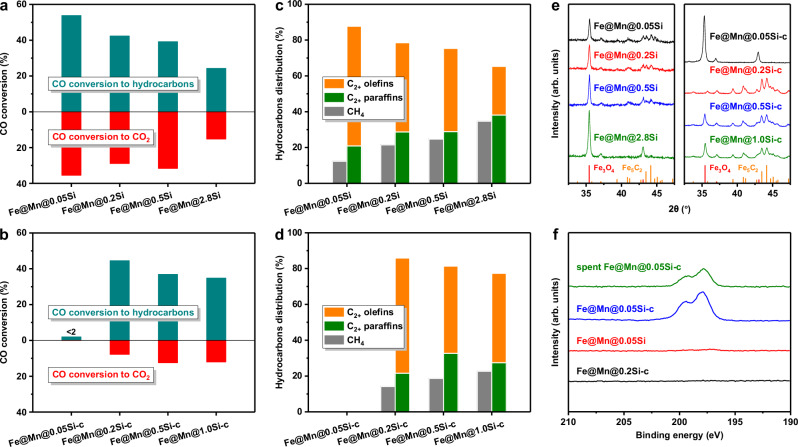
Iron-based Fischer-Tropsch synthesis (FTS) catalyst is widely used for syngas conversion, but its iron carbide active phase is easily oxidized into FeO by the water produced during reaction, leading to the deterioration of catalytic performance. Here, we show an efficient strategy for protecting the iron carbide active phase of FTS catalyst by surface hydrophobization. The hydrophobic surface can reduce the water concentration in the core vicinity of catalyst during syngas conversion, and thus inhibit the oxidation of iron species by water, which enhances the C - C coupling ability of catalyst and promotes the formation of long-chain olefins. More significantly, it is unraveled that appropriate shell thickness plays a crucial role in stabilizing the iron carbide active phase without FeO formation and achieving good catalytic performance.
铁基费托合成(FTS)催化剂被广泛用于合成气转化,但其碳化铁活性相容易被反应过程中产生的水氧化成FeO,导致催化性能恶化。在此,我们展示了一种通过表面疏水化保护FTS催化剂碳化铁活性相的有效策略。疏水表面可以降低合成气转化过程中催化剂核心附近的水浓度,从而抑制铁物种被水氧化,增强催化剂的C-C偶联能力并促进长链烯烃的形成。更重要的是,研究发现合适的壳层厚度在稳定碳化铁活性相而不形成FeO以及实现良好催化性能方面起着关键作用。