Gronewold Andrew, Bednar Jenna, Cort Marjorie, Rueda Vianey, Moore Michael, Allan Jon
School for Environment and Sustainability, University of Michigan, Ann Arbor, MI, USA.
Ford School of Public Policy, University of Michigan, Ann Arbor, MI, USA.
Nat Commun. 2024 Aug 17;15(1):7087. doi: 10.1038/s41467-024-51456-w.
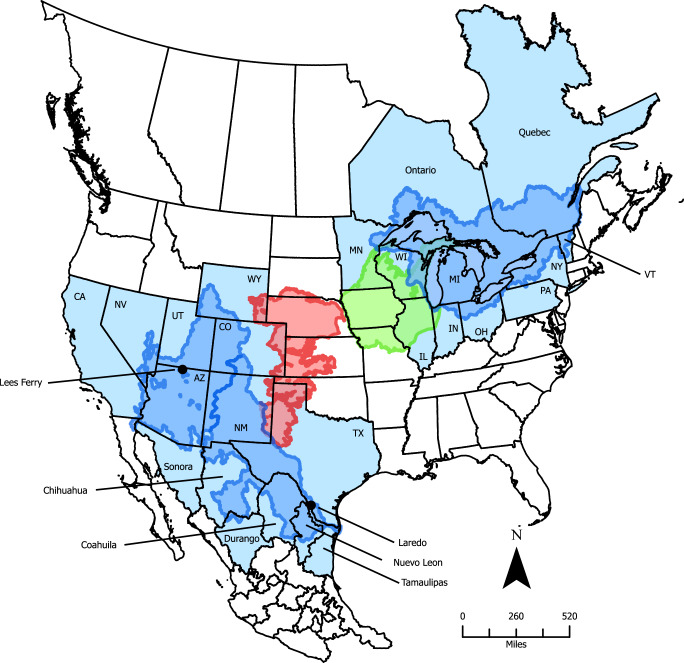
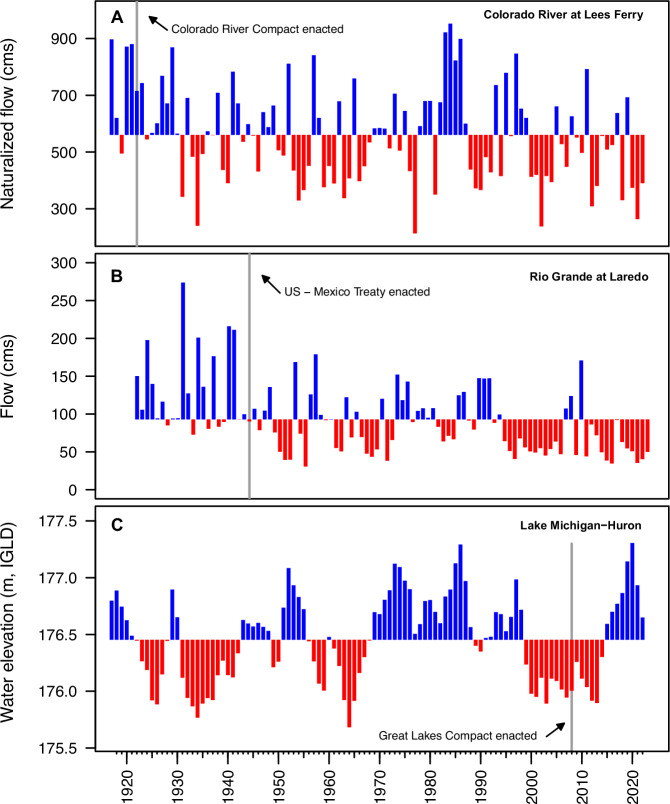
The growing number of threats facing continental-scale transboundary water treaties warrants contemporary evaluation of not only the political and climatological conditions under which they were constructed, but also of how different management strategies for accommodating changes in those conditions can lead to treaty success or failure. We assess these threats by highlighting key attributes and vulnerabilities of water treaties across North America that frame a diverse set of future water management priorities. While these threats are ubiquitous globally, they are particularly pronounced in North America where water-abundant basins along the border between the United States (US) and Canada contrast with arid basins along the border between the US and Mexico. We propose addressing these needs through a three-step call to action for management agencies, politicians, and the public at large to embrace a holistic perspective on transboundary water agreements.
大陆规模的跨界水条约面临的威胁日益增多,这不仅需要对其制定时的政治和气候条件进行当代评估,还需要评估针对这些条件变化的不同管理策略如何导致条约的成功或失败。我们通过强调北美水条约的关键属性和脆弱性来评估这些威胁,这些属性和脆弱性构成了一系列不同的未来水资源管理重点。虽然这些威胁在全球普遍存在,但在北美尤为突出,美国(US)和加拿大边境沿线水资源丰富的流域与美国和墨西哥边境沿线的干旱流域形成了鲜明对比。我们建议通过向管理机构、政治家和广大公众发出三步行动呼吁,以全面看待跨界水协议,从而满足这些需求。