Kim Jihyun, Kim Byung Eui, Ahn Kangmo, Leung Donald Y M
Department of Pediatrics, Samsung Medical Center, Sungkyunkwan University School of Medicine, Seoul, Korea.
Department of Health Sciences and Technology, Samsung Advanced Institute for Health Sciences & Technology, Seoul, Korea.
Allergy Asthma Immunol Res. 2024 Jul;16(4):323-337. doi: 10.4168/aair.2024.16.4.323.
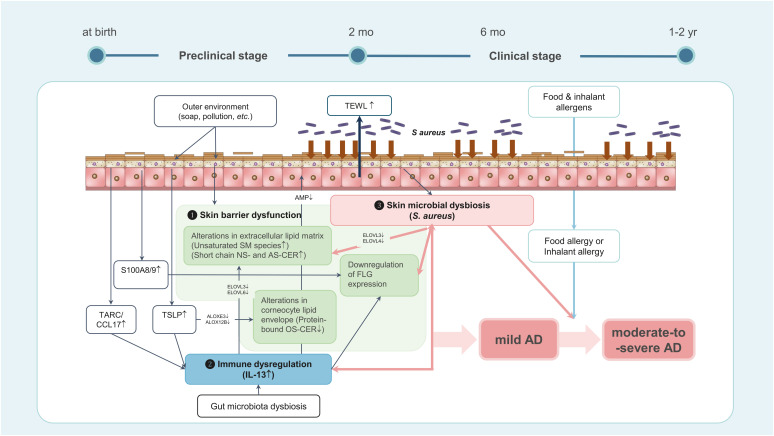
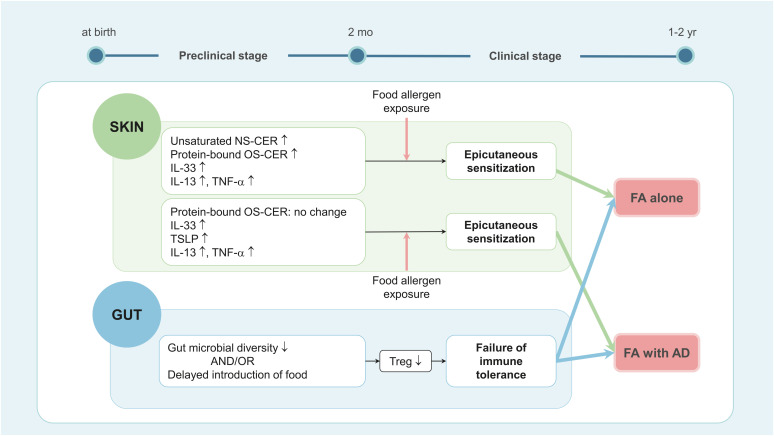
The pathogenesis of atopic dermatitis (AD) is multifactorial, involving a dynamic interplay between genetic susceptibility, skin-barrier dysfunction, microbiome alterations, and immune dysregulation, whereas food allergy (FA) arises from the interplay of transcutaneous sensitization to food allergens and failure in the induction of oral tolerance. Skin epicutaneous sensitization is commonly involved in the development of AD and FA. Although clinical trials have been conducted to prevent AD or FA by applications of emollients on the skin after birth, the results are not consistent. For more effective preventive strategies, reliable biomarkers are required to identify high-risk individuals. Skin tape stripping (STS) is a non-invasive technique for identifying these biomarkers in the skin. By analyzing the stratum corneum collected via STS, researchers can gain molecular or cellular insights into the early pathogenesis and potential progression of AD and FA. This review aims to elucidate the critical aspects of AD and FA, underlying their pathogenesis, early manifestations, and STS's potential as a tool for identifying predictive non-invasive biomarkers in infants prior to onset of clinical disease.
特应性皮炎(AD)的发病机制是多因素的,涉及遗传易感性、皮肤屏障功能障碍、微生物群改变和免疫失调之间的动态相互作用,而食物过敏(FA)则源于对食物过敏原的经皮致敏和口服耐受诱导失败之间的相互作用。皮肤经皮致敏通常参与AD和FA的发生发展。尽管已经进行了临床试验,通过在出生后在皮肤上涂抹润肤剂来预防AD或FA,但其结果并不一致。为了制定更有效的预防策略,需要可靠的生物标志物来识别高危个体。皮肤胶带剥离(STS)是一种用于识别皮肤中这些生物标志物的非侵入性技术。通过分析通过STS收集的角质层,研究人员可以深入了解AD和FA的早期发病机制和潜在进展的分子或细胞层面情况。本综述旨在阐明AD和FA的关键方面,包括其发病机制、早期表现以及STS作为在临床疾病发作前识别婴儿预测性非侵入性生物标志物的工具的潜力。