Xiao Xianjun, Xue Peiwen, Yan Xiangyun, Li Yanqiu, Shi Yunzhou, Qin Haiyan, Qin Di, Cao Wei, Zou Zihao, Wang Lu, Jin Rongjiang, Li Ying, Yao Junpeng, Li Juan
School of Health Preservation and Rehabilitation, Chengdu University of Traditional Chinese Medicine, Chengdu, Sichuan, 610075, People's Republic of China.
Acupuncture and Tuina School, Chengdu University of Traditional Chinese Medicine, Chengdu, Sichuan, 610075, People's Republic of China.
Clin Cosmet Investig Dermatol. 2024 Aug 12;17:1827-1839. doi: 10.2147/CCID.S474422. eCollection 2024.
Emerging evidence links gut microbiota and their by-products, notably short-chain fatty acids (SCFAs), to urticaria. This study employs multiple Mendelian Randomization (MR) analyses to unravel the complex interactions among gut microbiota, SCFAs, and different subtypes of urticaria, aiming to elucidate the underlying mechanisms and enhance future clinical research.
We analyzed published genome-wide association study (GWAS) summary statistics to identify associations between gut microbiota and three common subtypes of urticaria: spontaneous, dermatographic, and temperature-triggered. Initial two-sample and reverse MR analyses explored the causality in these relationships. Subsequent multivariate MR analyses investigated the role of SCFAs in modulating these interactions, with multiple sensitivity analyses to ensure robustness.
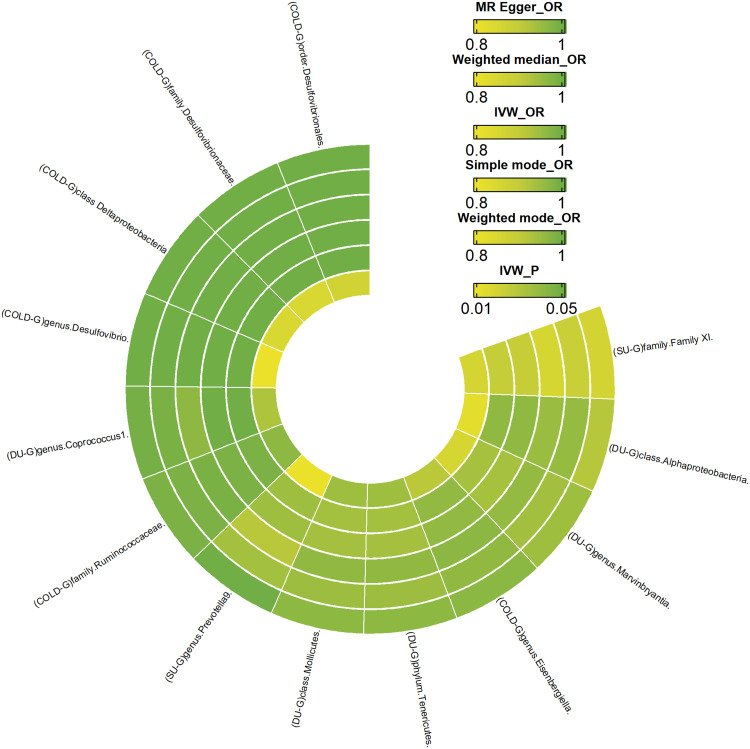
Specific taxa were differently associated with various urticaria subtypes. From microbiota to urticaria: one taxon was negatively associated with dermatographic urticaria; seven taxa were negatively associated and four positively associated with temperature-triggered urticaria; four taxa were negatively associated and six positively associated with spontaneous urticaria. Conversely, from urticaria to microbiota: five taxa were negatively associated with dermatographic urticaria; four were negatively and two positively associated with temperature-triggered urticaria; and two were negatively associated with spontaneous urticaria. These associations were observed at a nominal significance level ( < 0.05). After applying Bonferroni correction for multiple testing, these associations did not reach statistical significance. The observed trends, however, provide insights into potential microbiota-urticaria interactions. Multivariate MR analyses elucidated the role of SCFAs, particularly acetate, which plays a crucial role in modulating immune response. Adjusting for acetate revealed direct effects of Actinobacteria, Bifidobacteriales, and Bifidobacteriaceae on spontaneous urticaria, with corresponding mediation effects of -22%, -24.9%, and -24.9% respectively. Similarly, adjustments for Alcaligenaceae and Betaproteobacteria indicated significant negative effects of acetate on dermatographic and spontaneous urticaria, with mediation effects of -21.7% and -23.7%, respectively.
This study confirms the interconnected roles of gut microbiota, SCFAs, and urticaria. It highlights SCFAs' potential mediating role in influencing urticaria through microbiota, providing insights for future therapeutic strategies.
新出现的证据将肠道微生物群及其副产物,尤其是短链脂肪酸(SCFAs),与荨麻疹联系起来。本研究采用多种孟德尔随机化(MR)分析来揭示肠道微生物群、短链脂肪酸和不同亚型荨麻疹之间的复杂相互作用,旨在阐明潜在机制并加强未来的临床研究。
我们分析了已发表的全基因组关联研究(GWAS)汇总统计数据,以确定肠道微生物群与三种常见荨麻疹亚型之间的关联:自发性、皮肤划痕症性和温度诱发型。最初的两样本和反向MR分析探讨了这些关系中的因果关系。随后的多变量MR分析研究了短链脂肪酸在调节这些相互作用中的作用,并进行了多次敏感性分析以确保稳健性。
特定的分类群与各种荨麻疹亚型的关联不同。从微生物群到荨麻疹:一个分类群与皮肤划痕症性荨麻疹呈负相关;七个分类群与温度诱发型荨麻疹呈负相关,四个呈正相关;四个分类群与自发性荨麻疹呈负相关,六个呈正相关。相反,从荨麻疹到微生物群:五个分类群与皮肤划痕症性荨麻疹呈负相关;四个与温度诱发型荨麻疹呈负相关,两个呈正相关;两个与自发性荨麻疹呈负相关。这些关联在名义显著性水平(<0.05)上被观察到。在对多重检验应用Bonferroni校正后,这些关联未达到统计学显著性。然而,观察到的趋势为潜在的微生物群 - 荨麻疹相互作用提供了见解。多变量MR分析阐明了短链脂肪酸的作用,特别是乙酸盐,它在调节免疫反应中起关键作用。调整乙酸盐后发现放线菌门、双歧杆菌目和双歧杆菌科对自发性荨麻疹有直接影响,相应的中介效应分别为 -22%、-24.9% 和 -24.9%。同样,对产碱菌科和β-变形菌纲的调整表明乙酸盐对皮肤划痕症性和自发性荨麻疹有显著负面影响,中介效应分别为 -21.7% 和 -23.7%。
本研究证实了肠道微生物群、短链脂肪酸和荨麻疹之间的相互关联作用。它强调了短链脂肪酸在通过微生物群影响荨麻疹方面的潜在中介作用,为未来的治疗策略提供了见解。