Department of Neurology, The First Affiliated Hospital of Hainan Medical University, 31 Longhua Road Haikou, Haikou, 570201, Hainan, China.
Regenerative Medicine Institute, School of Medicine, National University of Ireland (NUI), Galway, Ireland.
BMC Neurol. 2024 Aug 27;24(1):297. doi: 10.1186/s12883-024-03805-x.
The relationship between gut microbiota and vertigo, specifically Benign Paroxysmal Vertigo (BPV) and Vertigo of Central (VC), remains underexplored.
This study aims to investigate the causal relationships between gut microbiota and two types of vertigo, BPV and VC. Additionally, the study seeks to explore the mediation effects of metabolic, inflammatory, and psychological factors on these relationships. We hypothesize that specific taxa of gut microbiota have a causal effect on the risk of developing BPV and VC. The mediation effects of HbA1c, obesity, major depression, and interleukin-18 levels significantly influence the relationships between gut microbiota and vertigo.
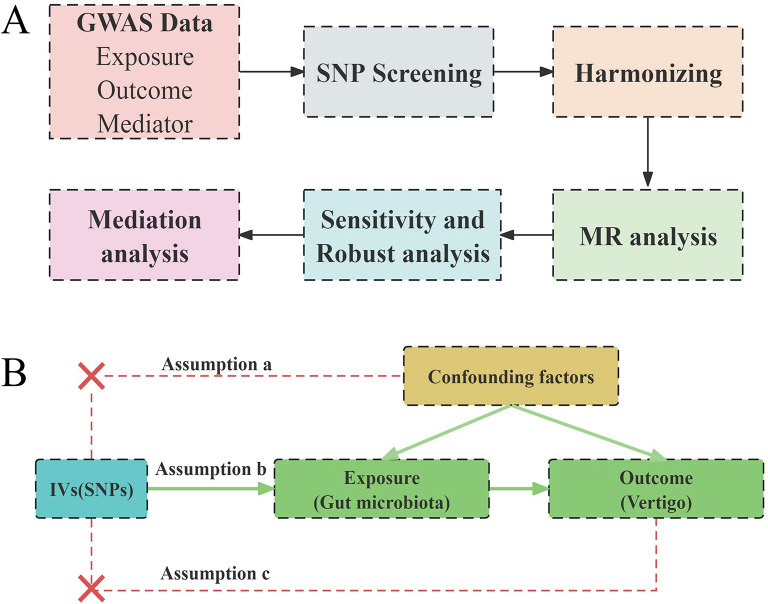
Utilizing a bidirectional two-sample Mendelian randomization approach, this study investigated causal associations between gut microbiota and the two types of vertigo. A network MR assessed mediation effects of HbA1c, major depression, obesity, and interleukin-18 levels, with data sourced from several consortia, including MiBioGen.
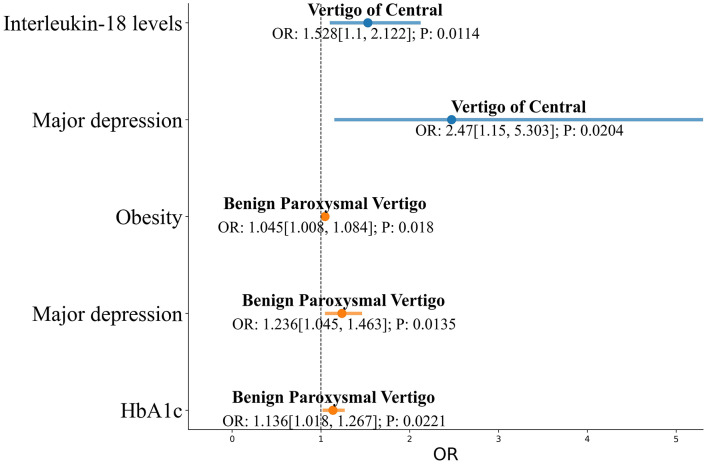
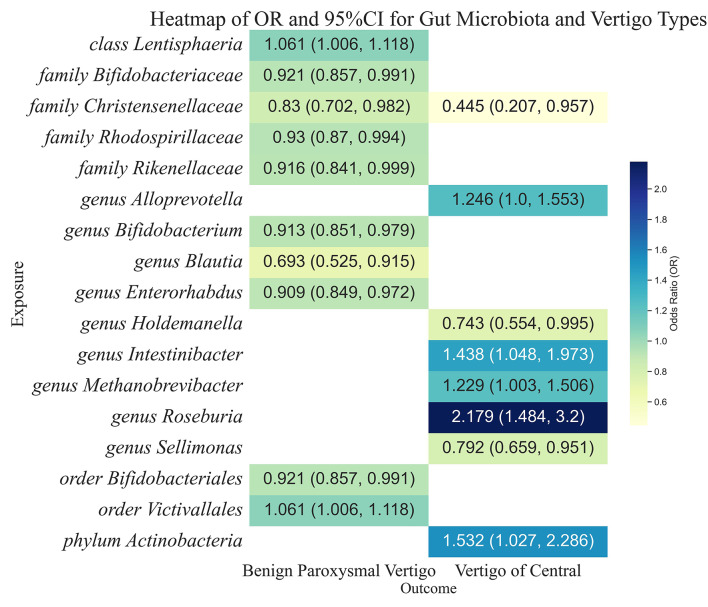
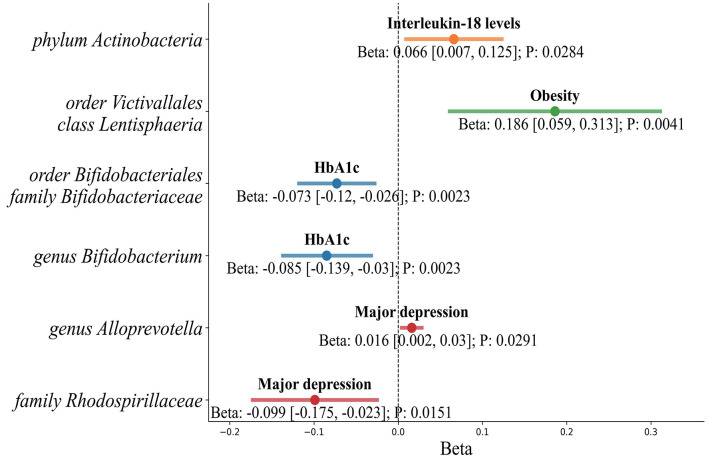
Distinct gut microbiota displayed varying influences on BPV and VC risks. A total of ten taxa affect BPV. Among these, two taxa have an odds ratio (OR) greater than 1, including one class, one order. Conversely, eight taxa have an OR less than 1, encompassing four families, three genera, and one order. The OR for these taxa ranges from 0.693 to 0.930, with p-values between 0.006 and 0.048. For VC, eight taxa were found to have an impact. Five of these taxa exhibit an OR greater than 1, including four genera and one phylum. The OR for these taxa ranges from 1.229 to 2.179, with p-values from 0.000 to 0.046. The remaining three taxa have an OR less than 1, comprising one family and two genera, with an OR range of 0.445 to 0.792 and p-values ranging from 0.013 to 0.050. The mediation analysis for BPV shows that major depression, obesity, and HbA1c are key mediators between specific taxa and BPV. Major depression mediates 28.77% of the effect of family Rhodospirillaceae on BPV. Obesity mediates 13.90% of the effect of class Lentisphaeria/order Victivallales. HbA1c mediates 11.79% of the effect of genus Bifidobacterium, 11.36% of family Bifidobacteriaceae/order Bifidobacteriales. For VC, interleukin-18 levels and major depression are significant mediators. Interleukin-18 levels mediate 6.56% of the effect of phylum Actinobacteria. Major depression mediates 6.51% of the effect of genus Alloprevotella.
The study highlights potential causal links between gut microbiota and vertigo, emphasizing metabolic and psychological mediators. These insights underscore the therapeutic potential of targeting gut health in vertigo management.
肠道微生物群与眩晕之间的关系,特别是良性阵发性眩晕(BPV)和中枢性眩晕(VC)之间的关系,仍未得到充分研究。
本研究旨在探讨肠道微生物群与两种类型眩晕(BPV 和 VC)之间的因果关系。此外,该研究还探讨了代谢、炎症和心理因素对这些关系的中介作用。我们假设特定的肠道微生物群类群对 BPV 和 VC 发病风险具有因果影响。HbA1c、肥胖、重度抑郁症和白细胞介素-18 水平的中介效应显著影响肠道微生物群与眩晕之间的关系。
本研究采用双向双向孟德尔随机化方法,研究肠道微生物群与两种类型眩晕之间的因果关系。网络 MR 评估了 HbA1c、重度抑郁症、肥胖和白细胞介素-18 水平的中介效应,数据来自包括 MiBioGen 在内的多个联盟。
不同的肠道微生物群对 BPV 和 VC 风险有不同的影响。共有 10 种肠道微生物群类群影响 BPV。其中,两种类群的比值比(OR)大于 1,包括一个纲、一个目。相反,八种类群的 OR 小于 1,包括四个科、三个属和一个目。这些类群的 OR 范围为 0.693 至 0.930,p 值介于 0.006 和 0.048 之间。对于 VC,发现有八种肠道微生物群类群有影响。其中五种类群的 OR 大于 1,包括四个属和一个门。这些类群的 OR 范围为 1.229 至 2.179,p 值介于 0.000 至 0.046 之间。其余三种类群的 OR 小于 1,包括一个科和两个属,OR 范围为 0.445 至 0.792,p 值介于 0.013 至 0.050 之间。BPV 的中介分析表明,重度抑郁症、肥胖和 HbA1c 是特定类群与 BPV 之间的关键中介。重度抑郁症介导了科 Rhodospirillaceae 对 BPV 的影响的 28.77%。肥胖介导了纲 Lentisphaeria/目 Victivallales 对 BPV 的影响的 13.90%。HbA1c 介导了属双歧杆菌的 11.79%,属双歧杆菌科/双歧杆菌目的 11.36%。对于 VC,白细胞介素-18 水平和重度抑郁症是重要的中介。白细胞介素-18 水平介导了门放线菌对 VC 的影响的 6.56%。重度抑郁症介导了属 Alloprevotella 对 VC 的影响的 6.51%。
本研究强调了肠道微生物群与眩晕之间的潜在因果关系,并强调了代谢和心理因素的中介作用。这些研究结果突显了靶向肠道健康在眩晕管理中的治疗潜力。