Zhang Yuancheng, Cui Pengfei, Shi Jianzhong, Zeng Xianying, Jiang Yongping, Chen Yuan, Zhang Jie, Wang Congcong, Wang Yan, Tian Guobin, Chen Hualan, Kong Huihui, Deng Guohua
State Key Laboratory of Animal Disease Control and Prevention, Harbin Veterinary Research Institute, Chinese Academy of Agricultural Sciences, Harbin, China.
NPJ Vaccines. 2024 Aug 19;9(1):152. doi: 10.1038/s41541-024-00947-4.
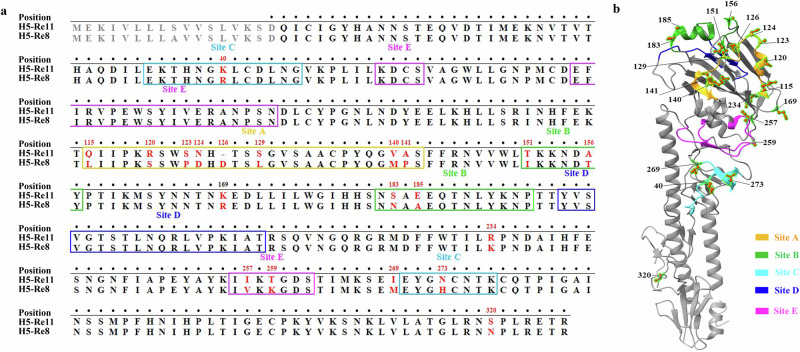
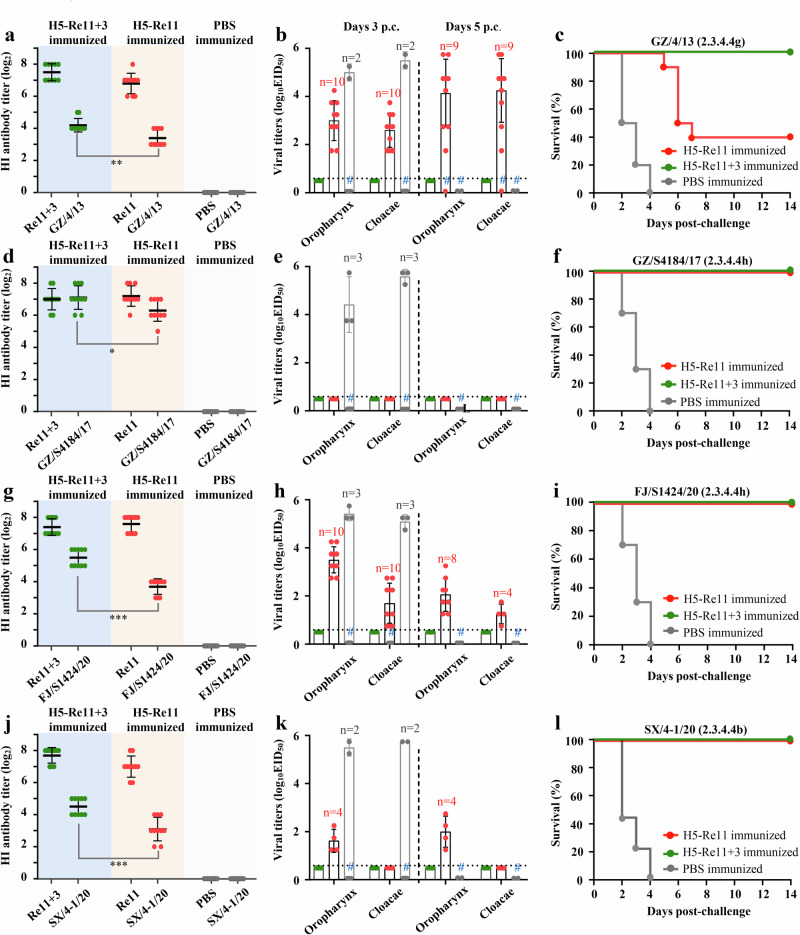
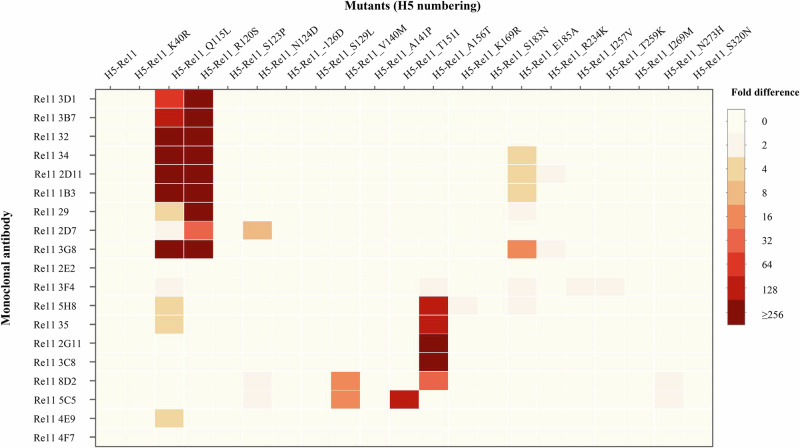
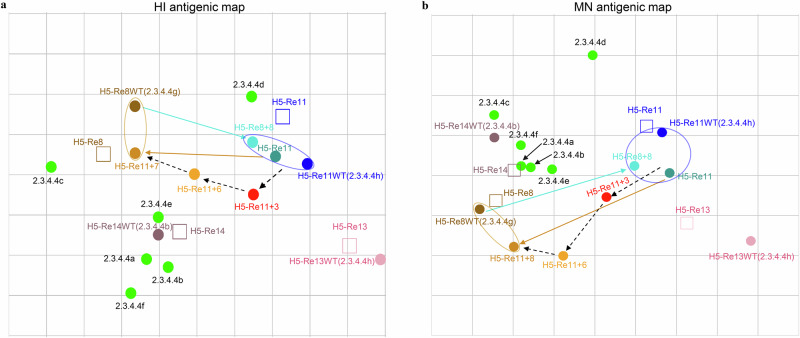
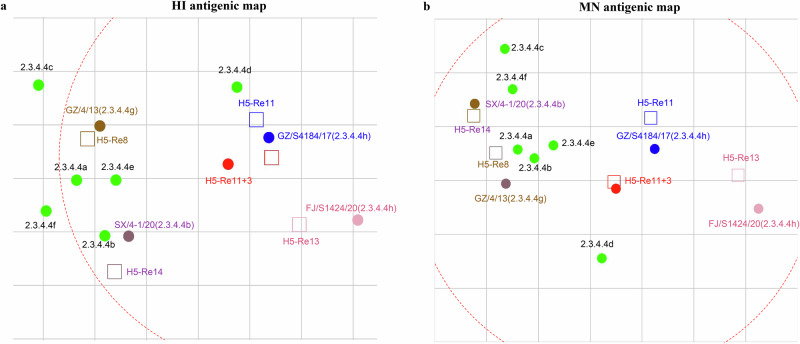
The global spread of H5 clade 2.3.4.4 highly pathogenic avian influenza (HPAI) viruses threatens poultry and public health. The continuous circulation of these viruses has led to their considerable genetic and antigenic evolution, resulting in the formation of eight subclades (2.3.4.4a-h). Here, we examined the antigenic sites that determine the antigenic differences between two H5 vaccine strains, H5-Re8 (clade 2.3.4.4g) and H5-Re11 (clade 2.3.4.4h). Epitope mapping data revealed that all eight identified antigenic sites were located within two classical antigenic regions, with five sites in region A (positions 115, 120, 124, 126, and 140) and three in region B (positions 151, 156, and 185). Through antigenic cartography analysis of mutants with varying numbers of substitutions, we confirmed that a combination of mutations in these eight sites reverses the antigenicity of H5-Re11 to that of H5-Re8, and vice versa. More importantly, our analyses identified H5-Re11_Q115L/R120S/A156T (H5-Re11 + 3) as a promising candidate for a broad-spectrum vaccine, positioned centrally in the antigenic map, and offering potential universal protection against all variants within the clade 2.3.4.4. H5-Re11 + 3 serum has better cross-reactivity than sera generated with other 2.3.4.4 vaccines, and H5-Re11 + 3 vaccine provided 100% protection of chickens against antigenically drifted H5 viruses from various 2.3.4.4 antigenic groups. Our findings suggest that antigenic regions A and B are immunodominant in H5 viruses, and that antigenic cartography-guided vaccine design is a promising strategy for selecting a broad-spectrum vaccine.
H5进化分支2.3.4.4高致病性禽流感(HPAI)病毒的全球传播威胁着家禽和公共卫生。这些病毒的持续传播导致了它们在基因和抗原方面的显著进化,形成了八个亚分支(2.3.4.4a - h)。在此,我们研究了决定两种H5疫苗株H5 - Re8(进化分支2.3.4.4g)和H5 - Re11(进化分支2.3.4.4h)之间抗原差异的抗原位点。表位定位数据显示,所有八个已确定的抗原位点都位于两个经典抗原区域内,其中五个位点在A区域(第115、120、124、126和140位),三个在B区域(第151、156和185位)。通过对具有不同替换数目的突变体进行抗原图谱分析,我们证实这八个位点的突变组合可使H5 - Re11的抗原性逆转至H5 - Re8的抗原性,反之亦然。更重要的是,我们的分析确定H5 - Re11_Q115L/R120S/A156T(H5 - Re11 + 3)是一种有前景的广谱疫苗候选株,它位于抗原图谱的中心位置,有望对进化分支2.3.4.4内的所有变体提供普遍保护。H5 - Re11 + 3血清比其他2.3.4.4疫苗产生的血清具有更好的交叉反应性,并且H5 - Re11 + 疫苗为鸡提供了100%的保护,使其免受来自各种2.3.4.4抗原组的抗原性漂移H5病毒的侵害。我们的研究结果表明,抗原区域A和B在H5病毒中具有免疫优势,并且抗原图谱引导的疫苗设计是选择广谱疫苗的一种有前景的策略。