Department of Physical Education, Zhejiang Chinese Medical University, Hangzhou, Zhejiang, China.
Sports Coaching College, Beijing Sport University, Beijing, China.
Sci Rep. 2024 Aug 19;14(1):19131. doi: 10.1038/s41598-024-70198-9.
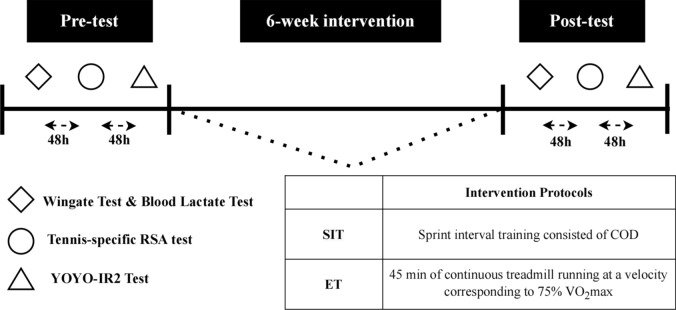
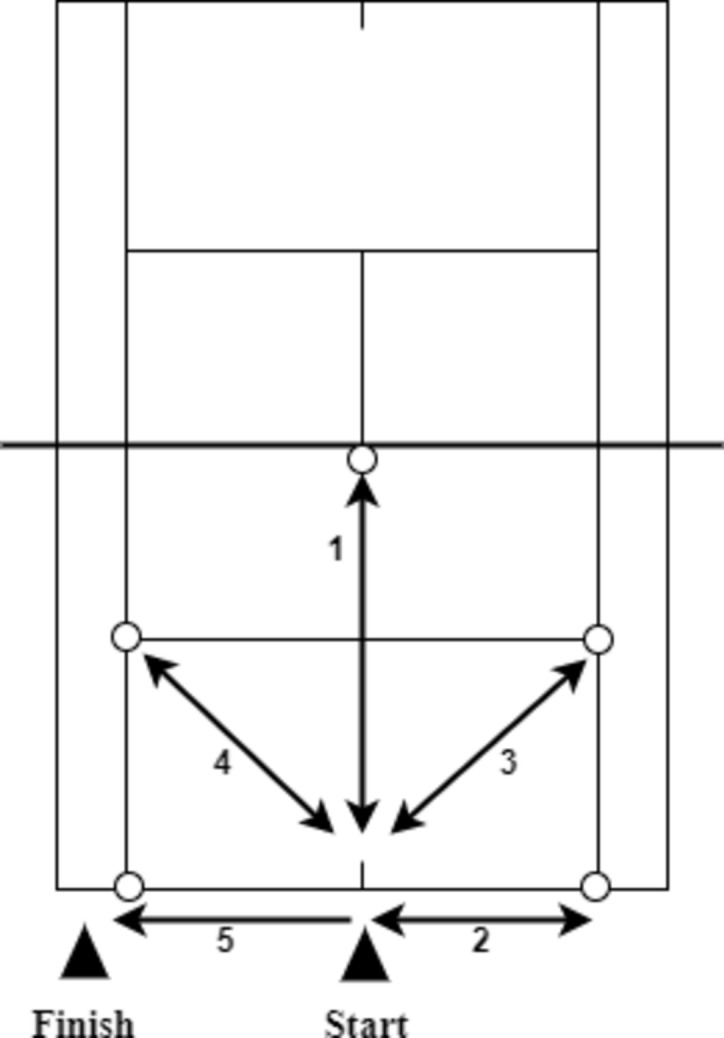
Sprint interval training (SIT) is a potent exercise strategy to enhance athletes' anaerobic capacity in a time-efficient manner. This study aimed to investigate the impact of low-volume, court-based SIT on the anaerobic capacity and sport-specific performance in competitive tennis players. Twenty-four competitive collegiate tennis players were randomly assigned to either the SIT group (n = 12; three sessions per week of court-based repeated-sprint training) or the traditional endurance training (ET) group (n = 12; three sessions per week of 45-min continuous treadmill running, n = 12) for a 6-weeks intervention. Baseline and post-intervention assessments included the Wingate Anaerobic Test, elimination rate of blood lactate (BLAer), tennis-specific repeated sprint ability (RSA), and the Yo-Yo Intermittent Recovery Test Level 2 (YoYo-IR2). The results showed that SIT group demonstrated significant improvements in peak and average power during the Wingate test (p = 0.07; p < 0.001), along with a notable increase in YoYo-IR2 performance (7.8% increase, p = 0.04). Significant decreases were observed in both mean (5.1% decrease, p = 0.02) and sum RSA time (5.2% decrease, p = 0.02) in the tennis-specific RSA assessments. Additionally, the SIT group showed significantly higher effective training time and TRIMP in the 90-100% HRmax zone compared to the ET group (p < 0.01). This study underscores the potential benefits of low-volume, court-based SIT in enhancing anaerobic capacity and sport-specific performance in competitive tennis players, in comparison to traditional ET.
冲刺间歇训练(Sprint interval training,SIT)是一种高效的增强运动员无氧能力的运动策略。本研究旨在探讨基于球场的低容量 SIT 对竞技网球运动员无氧能力和专项运动表现的影响。24 名竞技大学生网球运动员被随机分为 SIT 组(n = 12;每周进行 3 次基于球场的重复冲刺训练)或传统耐力训练(endurance training,ET)组(n = 12;每周进行 3 次 45 分钟的连续跑步机跑步,n = 12),干预时间为 6 周。基线和干预后评估包括 Winger 无氧测试、血乳酸消除率(BLAer)、网球专项重复冲刺能力(RSA)和 Yo-Yo 间歇性恢复测试水平 2(YoYo-IR2)。结果显示,SIT 组在 Winger 测试中的峰值和平均功率均有显著提高(p = 0.07;p < 0.001),YoYo-IR2 性能也有显著提高(提高 7.8%,p = 0.04)。在网球专项 RSA 评估中,平均 RSA 时间(减少 5.1%,p = 0.02)和总和 RSA 时间(减少 5.2%,p = 0.02)均显著降低。此外,与 ET 组相比,SIT 组在 90-100% HRmax 区域的有效训练时间和 TRIMP 显著更高(p < 0.01)。本研究强调了低容量、基于球场的 SIT 在提高竞技网球运动员无氧能力和专项运动表现方面的潜在益处,优于传统 ET。