Department of Biomechanics and Sport Injuries, Faculty Physical Education and Sport Sciences, Kharazmi University, Tehran, Iran.
Department of Exercise Rehabilitation, Faculty of Sport Sciences, Bu-Ali Sina University, Hamedan, Iran.
BMC Musculoskelet Disord. 2024 Aug 19;25(1):652. doi: 10.1186/s12891-024-07759-6.
Dynamic knee valgus (DKV) is a risk factor for non-contact anterior cruciate ligament (ACL) injuries. Understanding the changes in the electromyographic activity of the lower extremity muscles in individuals with DKV helps trainers design ACL injury prevention exercises. Therefore, the present meta-analysis aimed to investigate the muscle activation of the lower limb muscles in individuals with DKV during single-leg and overhead squats.
Articles with titles, abstracts, and full texts were searched and screened independently by two reviewers in the Web of Science, Scopus, PubMed, and Google Scholar databases, without restrictions on publication date and in English using specified keywords from their inception to January 5, 2024. The quality of articles was evaluated using a modified version of the Downs and Black quality checklist. This meta-analysis used mean difference (MD) to compare the muscle activity patterns between individual with DKV and healthy individuals. Heterogeneity was detected using I-square (I) test.
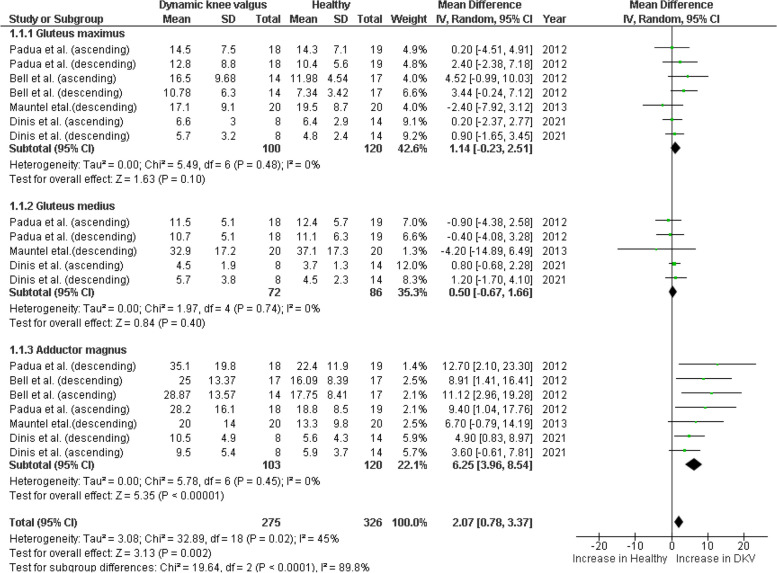
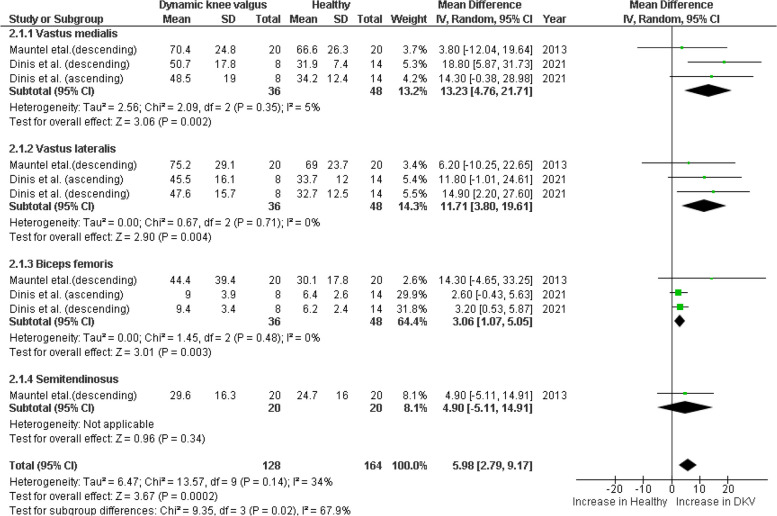
In total, four papers with 130 participants were included in the study. Evidence showed a significant difference between the DKV group and the healthy group regarding the activities of the adductor magnus (MD: 6.25, P < 0.001), vastus medialis (MD: 13.23, P = 0.002), vastus lateralis (MD: 11.71, P = 0.004), biceps femoris (MD: 3.06, P = 0.003), and tibialis anterior muscles (MD: 8.21, P = 0.02). Additionally, muscle activity in the DKV group was higher than that in the healthy group.
This meta-analysis reveals distinct muscle activation patterns in individuals with dynamic knee valgus (DKV), with increased activity in key muscles suggesting compensatory responses. These findings underscore the need for targeted rehabilitation to address muscle imbalances and improve knee stability.
动态膝关节外翻(DKV)是发生非接触性前交叉韧带(ACL)损伤的一个风险因素。了解 DKV 患者下肢肌肉的肌电图活动变化有助于教练设计 ACL 损伤预防练习。因此,本项荟萃分析旨在研究 DKV 患者在单腿和过头深蹲时下肢肌肉的肌肉激活情况。
通过在 Web of Science、Scopus、PubMed 和 Google Scholar 数据库中搜索和筛选具有标题、摘要和全文的文章,两位评审员独立进行,没有对出版日期的限制,使用指定的关键字从其开始到 2024 年 1 月 5 日进行英语搜索。使用 Downs 和 Black 质量检查表的修改版本评估文章的质量。本荟萃分析使用均数差值(MD)比较 DKV 患者和健康个体的肌肉活动模式。使用 I 平方(I)检验检测异质性。
共有 4 篇文献纳入了 130 名参与者。证据表明,在 DKV 组和健康组之间,大收肌(MD:6.25,P<0.001)、股内侧肌(MD:13.23,P=0.002)、股外侧肌(MD:11.71,P=0.004)、股二头肌(MD:3.06,P=0.003)和胫骨前肌(MD:8.21,P=0.02)的活动存在显著差异。此外,DKV 组的肌肉活动高于健康组。
本荟萃分析揭示了 DKV 患者的肌肉激活模式存在明显差异,关键肌肉的活动增加表明存在代偿反应。这些发现强调需要进行针对性的康复治疗,以解决肌肉失衡问题并改善膝关节稳定性。