Fleming Susannah, Mwandigha Lazaro, Fanshawe Thomas R
Department of Primary Care Health Sciences, University of Oxford, Woodstock Road, Oxford, OX2 6GG, UK.
GSK, GSK House, 980 Great West Road, Brentford, TW8 9GS, UK.
Diagn Progn Res. 2024 Aug 20;8(1):12. doi: 10.1186/s41512-024-00174-4.
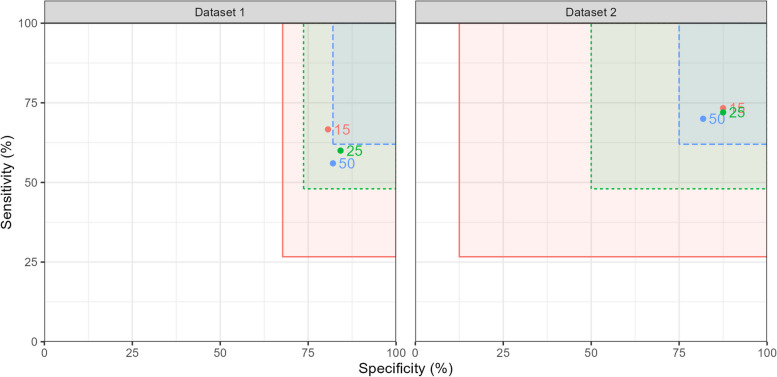
Interim analysis is a common methodology in randomised clinical trials but has received less attention in studies of diagnostic test accuracy. In such studies, early termination for futility may be beneficial if early evidence indicates that a diagnostic test is unlikely to achieve a clinically useful level of diagnostic performance, as measured by the sensitivity and specificity. In this paper, we describe relevant practical and analytical considerations when planning and performing interim analysis in diagnostic accuracy studies, focusing on stopping rules for futility. We present an adaptation of the exact group sequential method for diagnostic testing, with R code provided for implementing this method in practice. The method is illustrated using two simulated data sets and data from a published diagnostic accuracy study for point-of-care testing for SARS-CoV-2. The considerations described in this paper can be used to guide decisions as to when an interim analysis in a diagnostic accuracy study is suitable and highlight areas for further methodological development.
期中分析是随机临床试验中的一种常见方法,但在诊断试验准确性研究中受到的关注较少。在此类研究中,如果早期证据表明诊断试验不太可能达到临床上有用的诊断性能水平(以敏感性和特异性衡量),则因无效而提前终止试验可能是有益的。在本文中,我们描述了在诊断准确性研究中计划和进行期中分析时的相关实际和分析考虑因素,重点是无效性的停止规则。我们提出了一种适用于诊断测试的精确组序贯方法的改编版本,并提供了在实践中实施该方法的R代码。使用两个模拟数据集和一项已发表的关于SARS-CoV-2即时检测的诊断准确性研究的数据对该方法进行了说明。本文所述的考虑因素可用于指导关于诊断准确性研究中何时进行期中分析合适的决策,并突出进一步方法学发展的领域。