Science for Life Laboratory, Department of Medical Biochemistry and Microbiology, Uppsala University, Husargatan 3, 75237, Uppsala, Sweden.
Department of Microbiology, Tumor and Cell Biology (MTC), Centre for Translational Microbiome Research, Karolinska Institutet, Nobels Väg 6, 17177, Stockholm, Sweden.
Microbiome. 2024 Aug 19;12(1):153. doi: 10.1186/s40168-024-01870-5.
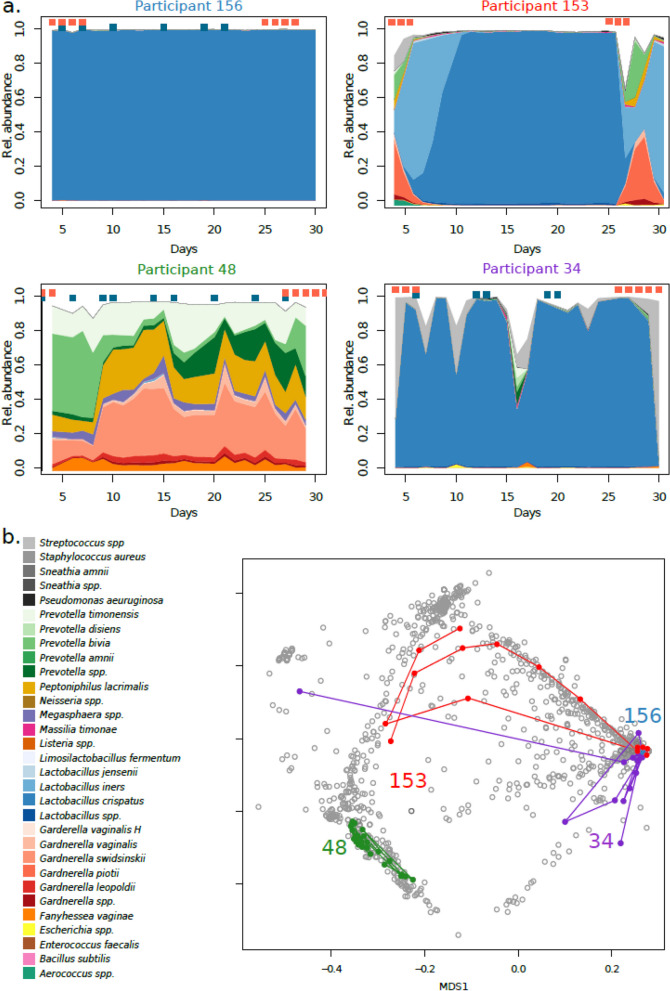
The composition of the vaginal microbiota during the menstrual cycle is dynamic, with some women remaining eu- or dysbiotic and others transitioning between these states. What defines these dynamics, and whether these differences are microbiome-intrinsic or mostly driven by the host is unknown. To address this, we characterized 49 healthy, young women by metagenomic sequencing of daily vaginal swabs during a menstrual cycle. We classified the dynamics of the vaginal microbiome and assessed the impact of host behavior as well as microbiome differences at the species, strain, gene, and phage levels.
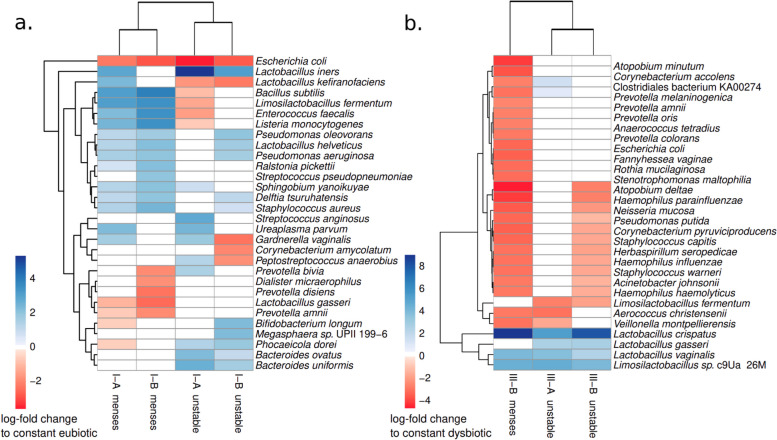
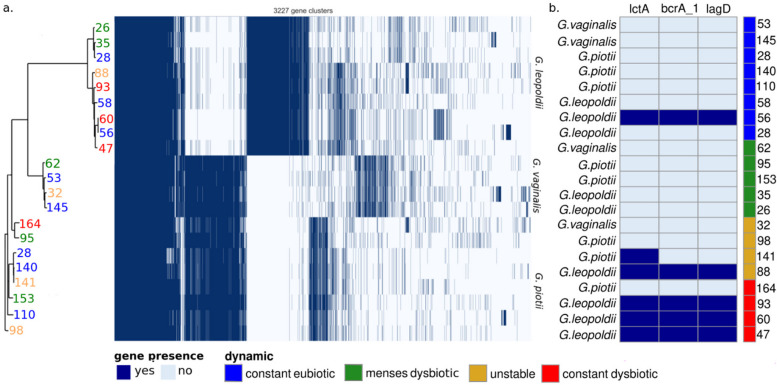
Based on the daily shifts in community state types (CSTs) during a menstrual cycle, the vaginal microbiome was classified into four Vaginal Community Dynamics (VCDs) and reported in a classification tool, named VALODY: constant eubiotic, constant dysbiotic, menses-related, and unstable dysbiotic. The abundance of bacteria, phages, and bacterial gene content was compared between the four VCDs. Women with different VCDs showed significant differences in relative phage abundance and bacterial composition even when assigned to the same CST. Women with unstable VCDs had higher phage counts and were more likely dominated by L. iners. Their Gardnerella spp. strains were also more likely to harbor bacteriocin-coding genes.
The VCDs present a novel time series classification that highlights the complexity of varying degrees of vaginal dysbiosis. Knowing the differences in phage gene abundances and the genomic strains present allows a deeper understanding of the initiation and maintenance of permanent dysbiosis. Applying the VCDs to further characterize the different types of microbiome dynamics qualifies the investigation of disease and enables comparisons at individual and population levels. Based on our data, to be able to classify a dysbiotic sample into the accurate VCD, clinicians would need two to three mid-cycle samples and two samples during menses. In the future, it will be important to address whether transient VCDs pose a similar risk profile to persistent dysbiosis with similar clinical outcomes. This framework may aid interdisciplinary translational teams in deciphering the role of the vaginal microbiome in women's health and reproduction. Video Abstract.
月经周期中阴道微生物组的组成是动态的,一些女性保持着生态平衡或生态失调,而另一些女性则在这两种状态之间转换。是什么定义了这些动态,这些差异是微生物组内在的还是主要由宿主驱动的,目前还不清楚。为了解决这个问题,我们通过对 49 名健康年轻女性在月经周期内每天阴道拭子的宏基因组测序来描述阴道微生物组的动态,并评估了宿主行为以及物种、菌株、基因和噬菌体水平的微生物组差异的影响。
基于月经周期中社区状态类型(CSTs)的日常变化,阴道微生物组被分为四种阴道群落动态(VCD),并在一个名为 VALODY 的分类工具中进行了报告:恒定生态平衡、恒定生态失调、月经相关和不稳定生态失调。在四个 VCD 之间比较了细菌、噬菌体和细菌基因含量的丰度。即使被分配到相同的 CST,具有不同 VCD 的女性在相对噬菌体丰度和细菌组成上也存在显著差异。具有不稳定 VCD 的女性具有更高的噬菌体计数,并且更有可能被 L. iners 主导。她们的 Gardnerella spp. 菌株也更有可能携带细菌素编码基因。
VCD 提出了一种新的时间序列分类方法,突出了不同程度阴道失调的复杂性。了解噬菌体基因丰度和存在的基因组菌株的差异可以更深入地了解永久性失调的启动和维持。将 VCD 应用于进一步描述不同类型的微生物组动态,可以对疾病进行调查,并在个体和人群水平上进行比较。根据我们的数据,为了能够将失调样本准确地分类到正确的 VCD,临床医生需要在月经中期采集两到三个样本和两个月经期样本。在未来,重要的是要确定短暂的 VCD 是否与具有相似临床结果的持续失调具有相似的风险特征。这个框架可以帮助跨学科的转化研究团队解读阴道微生物组在女性健康和生殖中的作用。视频摘要。