Mathur Sonal, Michelson Daniel, Shetty Tejaswi, Patel Vikram, Field Andy P
Sangath, New Delhi, India.
Department of Child & Adolescent Psychiatry, Institute of Psychiatry, Psychology & Neuroscience, King's College London, London, UK.
J Technol Behav Sci. 2024;9(3):418-427. doi: 10.1007/s41347-023-00356-9. Epub 2023 Oct 21.
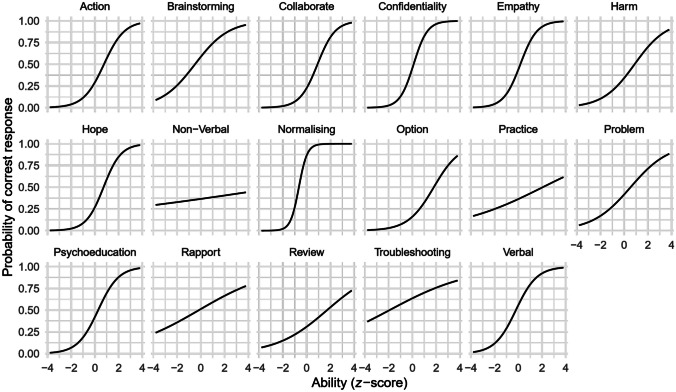
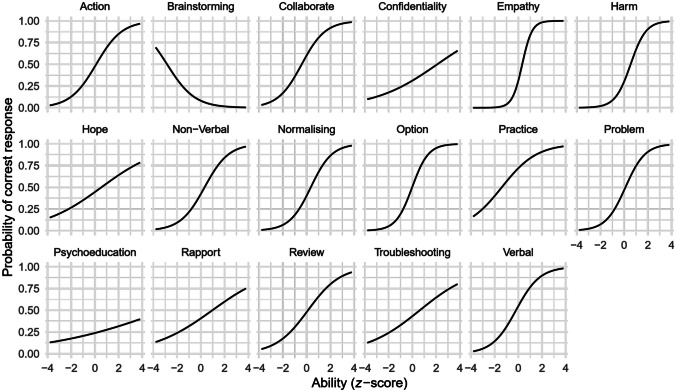
There are few reliable and feasible quality assurance methods to support scaling up of psychological interventions delivered by non-specialist providers. This paper reports on the phased development and validation of a digitally administered Knowledge of Problem Solving (KOPS) measure to assess competencies associated with a "task-shared" problem-solving intervention for adolescents with diverse mental health problems in India. Phase 1 established key competencies required to deliver the intervention, followed by item generation for a corresponding knowledge-based competency measure that could be administered efficiently through e-learning systems. In phase 2, items were refined based on responses from an "experienced" reference sample comprising 17 existing counsellors with direct experience of the problem-solving intervention, and a "novice" sample with 14 untrained university students and NGO staff. In phase 3, we evaluated two parallel versions of the measure in a validation sample ( = 277) drawn from universities and NGOs. The resulting 17-item measure was structured around a hypothetical case, followed by multiple-choice questions that asked about the most appropriate response to a practice-based scenario. The difficulty level of the test items was well matched to the ability level of participants (i.e. most items being of moderate difficulty and few items being easy or difficult). Only one item showed a negative discrimination index and was removed from the 17-item forms. The final 16-item version of the KOPS measure provides a scalable digital method to assess key psychotherapeutic competencies among non-specialists, particularly in relation to a transdiagnostic problem-solving intervention. Similar formats could be deployed more widely alongside e-learning programmes to expand the global workforce capable of delivering evidence-based psychological interventions.
The online version contains supplementary material available at 10.1007/s41347-023-00356-9.
几乎没有可靠且可行的质量保证方法来支持非专业提供者扩大心理干预服务。本文报告了一种数字化管理的解决问题知识(KOPS)测量工具的分阶段开发和验证情况,该工具用于评估与印度针对有各种心理健康问题的青少年的“任务分担”解决问题干预相关的能力。第一阶段确定了实施干预所需的关键能力,随后为相应的基于知识的能力测量工具生成项目,该工具可通过电子学习系统高效管理。在第二阶段,根据来自17名有解决问题干预直接经验的现有咨询师组成的“经验丰富”参考样本以及14名未受过训练的大学生和非政府组织工作人员组成的“新手”样本的回答对项目进行了完善。在第三阶段,我们在从大学和非政府组织抽取的验证样本(n = 277)中评估了该测量工具的两个平行版本。最终得到的17个项目的测量工具围绕一个假设案例构建,随后是多项选择题,询问对基于实践的情景的最合适反应。测试项目的难度水平与参与者的能力水平非常匹配(即大多数项目难度适中,很少有项目容易或困难)。只有一个项目显示出负区分度指数,并从17个项目的形式中删除。最终的16个项目版本的KOPS测量工具提供了一种可扩展的数字方法,用于评估非专业人员的关键心理治疗能力,特别是与跨诊断解决问题干预相关的能力。类似的形式可以更广泛地与电子学习计划一起部署,以扩大能够提供循证心理干预的全球劳动力队伍。
在线版本包含可在10.1007/s41347-023-00356-9获取的补充材料。