Division of Epidemiology and Public Health, School of Medicine, University of Nottingham, Nottingham, United Kingdom.
Department of Psychiatry, College of Health Sciences, School of Medicine, Addis Ababa University, Addis Ababa, Ethiopia.
PLoS One. 2021 Feb 25;16(2):e0246158. doi: 10.1371/journal.pone.0246158. eCollection 2021.
There are gaps in our understanding of how non-specialists, such as lay health workers, can achieve core competencies to deliver psychosocial interventions in low- and middle-income countries.
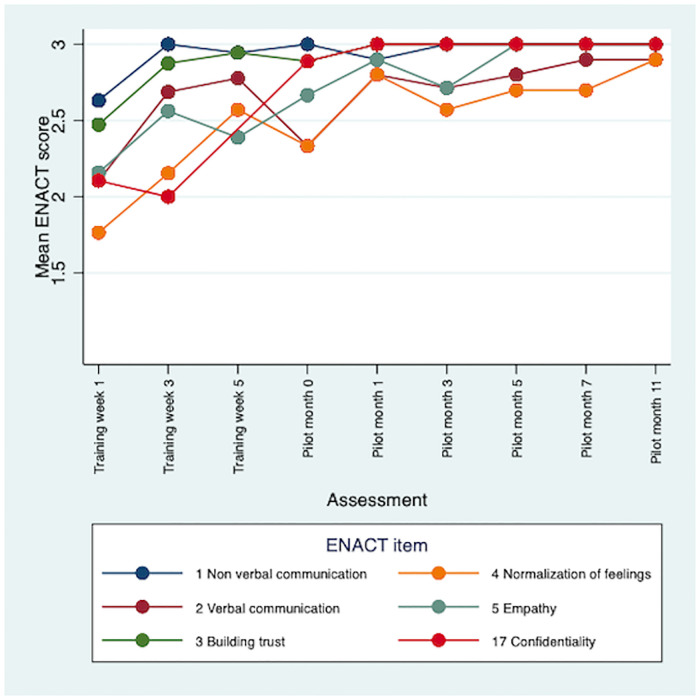
We conducted a 12-month mixed-methods study alongside the Rehabilitation Intervention for people with Schizophrenia in Ethiopia (RISE) pilot study. We rated a total of 30 role-plays and 55 clinical encounters of ten community-based rehabilitation (CBR) lay workers using an Ethiopian adaptation of the ENhancing Assessment of Common Therapeutic factors (ENACT) structured observational rating scale. To explore factors influencing competence, six focus group discussions and four in-depth interviews were conducted with 11 CBR workers and two supervisors at three time-points. We conducted a thematic analysis and triangulated the qualitative and quantitative data.
There were improvements in CBR worker competence throughout the training and 12-month pilot study. Therapeutic alliance competencies (e.g., empathy) saw the earliest improvements. Competencies in personal factors (e.g., substance use) and external factors (e.g., assessing social networks) were initially rated lower, but scores improved during the pilot. Problem-solving and giving advice competencies saw the least improvements overall. Multimodal training, including role-plays, field work and group discussions, contributed to early development of competence. Initial stigma towards CBR participants was reduced through contact. Over time CBR workers occupied dual roles of expert and close friend for the people with schizophrenia in the programme. Competence was sustained through peer supervision, which also supported wellbeing. More intensive specialist supervision was needed.
It is possible to equip lay health workers with the core competencies to deliver a psychosocial intervention for people with schizophrenia in a low-income setting. A prolonged period of work experience is needed to develop advanced skills such as problem-solving. A structured intervention with clear protocols, combined with peer supervision to support wellbeing, is recommended for good quality intervention delivery. Repeated ENACT assessments can feasibly and successfully be used to identify areas needing improvement and to guide on-going training and supervision.
我们对于非专业人员(例如基层卫生工作者)如何掌握核心能力以在中低收入国家提供心理社会干预措施知之甚少。
我们在埃塞俄比亚精神分裂症康复干预措施(RISE)试点研究中开展了一项为期 12 个月的混合方法研究。我们使用埃塞俄比亚版增强常见治疗因素评估工具(ENACT)结构观察评分量表,对 10 名社区康复(CBR)基层工作者的 30 次角色扮演和 55 次临床接触进行了评分。为了探讨影响能力的因素,我们在三个时间点对 11 名 CBR 工作者和 2 名主管进行了 6 次焦点小组讨论和 4 次深入访谈。我们进行了主题分析,并对定性和定量数据进行了三角分析。
在整个培训和 12 个月的试点研究过程中,CBR 工作者的能力均有所提高。治疗联盟能力(例如同理心)最早得到改善。个人因素(例如物质使用)和外部因素(例如评估社交网络)的能力最初评分较低,但在试点过程中有所提高。解决问题和提供建议的能力总体上提高最少。包括角色扮演、实地工作和小组讨论在内的多模式培训有助于能力的早期发展。通过接触,最初对 CBR 参与者的污名化有所减少。随着时间的推移,CBR 工作者在该项目中为精神分裂症患者扮演了专家和亲密朋友的双重角色。同伴监督支持了工作者的幸福感,从而维持了他们的能力。需要更密集的专业监督。
在低收入环境中,为基层卫生工作者配备提供精神分裂症患者心理社会干预措施的核心能力是可行的。需要有一段延长的工作经验才能发展解决问题等高级技能。建议采用具有明确方案的结构化干预措施,并结合同伴监督以支持幸福感,从而实现高质量的干预措施提供。重复使用 ENACT 评估可以切实有效地确定需要改进的领域,并指导持续的培训和监督。