Department of Biomolecular Health Sciences, Division of Infectious Diseases and Immunology, Faculty of Veterinary Medicine, Utrecht University, Utrecht, the Netherlands.
Department of Chemistry and Chemical Biology, Harvard University, Cambridge, Massachusetts, USA.
mBio. 2024 Sep 11;15(9):e0069124. doi: 10.1128/mbio.00691-24. Epub 2024 Aug 20.
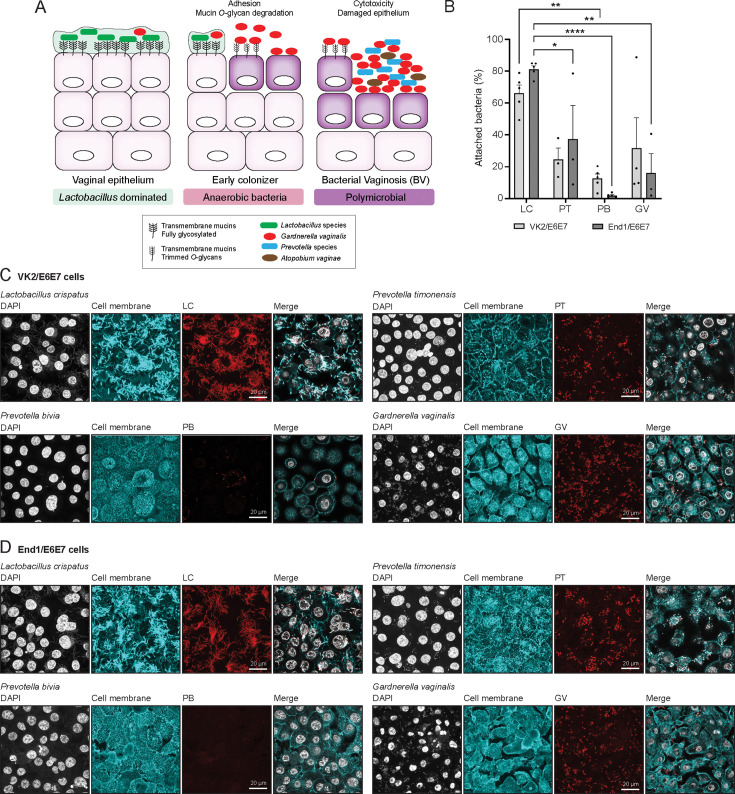
Bacterial vaginosis (BV) is a polymicrobial infection of the female reproductive tract. BV is characterized by replacement of health-associated species by diverse anerobic bacteria, including the well-known and are anerobes that are found in a significant number of BV patients, but their contributions to the disease process remain to be determined. Defining characteristics of anerobic overgrowth in BV are adherence to the mucosal surface and the increased activity of mucin-degrading enzymes such as sialidases in vaginal secretions. We demonstrate that but not strongly adheres to vaginal and endocervical cells to a similar level as but did not elicit a comparable proinflammatory epithelial response. The genome uniquely encodes a large set of mucus-degrading enzymes, including four putative fucosidases and two putative sialidases, PtNanH1 and PtNanH2. Enzyme assays demonstrated that fucosidase and sialidase activities in cell-bound and secreted fractions were significantly higher than for other vaginal anerobes. In infection assays, efficiently removed fucose and α2,3- and α2,6-linked sialic acid moieties from the epithelial glycocalyx. Recombinantly expressed NanH1 and NanH2 cleaved α2,3 and α2,6-linked sialic acids from the epithelial surface, and sialic acid removal by could be blocked using inhibitors. This study demonstrates that has distinct virulence-related properties that include initial adhesion and a high capacity for mucin degradation at the vaginal epithelial mucosal surface. Our results underline the importance of understanding the role of different anerobic bacteria in BV.
Bacterial vaginosis (BV) is a common vaginal infection that affects a significant proportion of women and is associated with reduced fertility and increased risk of secondary infections. is the most well-known BV-associated bacterium, but species including and may also play an important role. We showed that, similar to , adhered well to the vaginal epithelium, suggesting that both bacteria could be important in the first stage of infection. Compared to the other bacteria, was unique in efficiently removing the protective mucin sugars that cover the vaginal epithelium. These results underscore that vaginal bacteria play different roles in the initiation and development of BV.
细菌性阴道病(BV)是女性生殖道的一种多微生物感染。BV 的特征是健康相关物种被多种厌氧菌取代,包括众所周知的 和 。这些细菌是 BV 患者中大量存在的厌氧菌,但它们对疾病过程的贡献仍有待确定。BV 中厌氧菌过度生长的定义特征是粘附在黏膜表面和增加阴道分泌物中粘蛋白降解酶(如唾液酸酶)的活性。我们证明 像 一样强烈粘附于阴道和宫颈细胞,但不会引起类似的促炎上皮反应。 基因组独特地编码了一大组粘液降解酶,包括四个假定的岩藻糖酶和两个假定的唾液酸酶,PtNanH1 和 PtNanH2。酶分析表明,细胞结合和分泌部分的岩藻糖酶和唾液酸酶活性显著高于其他阴道厌氧菌。在感染实验中, 有效地从上皮糖萼中去除岩藻糖和α2,3-和α2,6-连接的唾液酸部分。重组表达的 NanH1 和 NanH2 从上皮表面切割α2,3 和α2,6-连接的唾液酸, 可以使用抑制剂阻断唾液酸的去除。本研究表明 具有独特的与毒力相关的特性,包括初始粘附和在阴道上皮黏膜表面高度降解粘蛋白的能力。我们的研究结果强调了了解不同厌氧菌在 BV 中的作用的重要性。
细菌性阴道病(BV)是一种常见的阴道感染,影响了很大一部分女性,与生育能力下降和继发感染风险增加有关。 是最著名的与 BV 相关的细菌,但包括 和 在内的其他 种可能也发挥着重要作用。我们发现,与 相似, 也能很好地粘附在阴道上皮上,这表明这两种细菌都可能是感染的早期阶段的重要因素。与其他细菌相比, 具有独特的高效去除覆盖阴道上皮的保护性粘蛋白糖的能力。这些结果强调了阴道细菌在 BV 的启动和发展中发挥不同的作用。