Institute for Digital Medicine, University Hospital Giessen, Philipps University, Marburg, Germany.
Department of Internal Medicine 3, Friedrich-Alexander University Erlangen-Nürnberg, Universitätsklinikum Erlangen, Erlangen, Germany.
J Med Internet Res. 2024 Aug 20;26:e56514. doi: 10.2196/56514.
Emergency departments (EDs) are frequently overcrowded and increasingly used by nonurgent patients. Symptom checkers (SCs) offer on-demand access to disease suggestions and recommended actions, potentially improving overall patient flow. Contrary to the increasing use of SCs, there is a lack of supporting evidence based on direct patient use.
This study aimed to compare the diagnostic accuracy, safety, usability, and acceptance of 2 SCs, Ada and Symptoma.
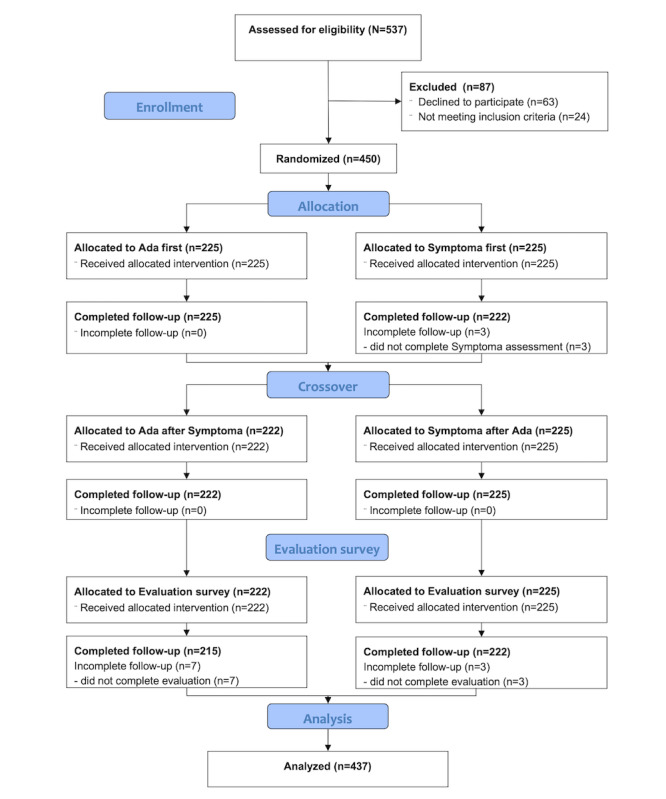
A randomized, crossover, head-to-head, double-blinded study including consecutive adult patients presenting to the ED at University Hospital Erlangen. Patients completed both SCs, Ada and Symptoma. The primary outcome was the diagnostic accuracy of SCs. In total, 6 blinded independent expert raters classified diagnostic concordance of SC suggestions with the final discharge diagnosis as (1) identical, (2) plausible, or (3) diagnostically different. SC suggestions per patient were additionally classified as safe or potentially life-threatening, and the concordance of Ada's and physician-based triage category was assessed. Secondary outcomes were SC usability (5-point Likert-scale: 1=very easy to use to 5=very difficult to use) and SC acceptance net promoter score (NPS).
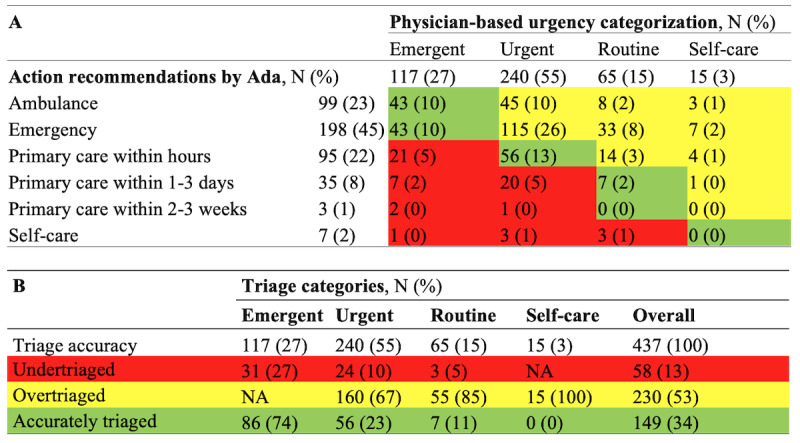
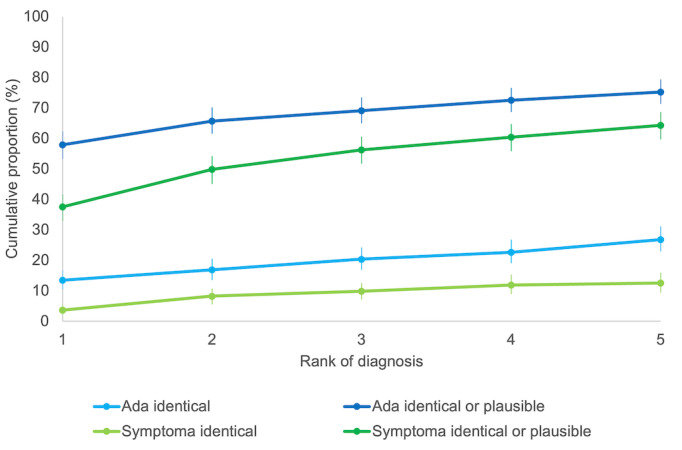
A total of 450 patients completed the study between April and November 2021. The most common chief complaint was chest pain (160/437, 37%). The identical diagnosis was ranked first (or within the top 5 diagnoses) by Ada and Symptoma in 14% (59/437; 27%, 117/437) and 4% (16/437; 13%, 55/437) of patients, respectively. An identical or plausible diagnosis was ranked first (or within the top 5 diagnoses) by Ada and Symptoma in 58% (253/437; 75%, 329/437) and 38% (164/437; 64%, 281/437) of patients, respectively. Ada and Symptoma did not suggest potentially life-threatening diagnoses in 13% (56/437) and 14% (61/437) of patients, respectively. Ada correctly triaged, undertriaged, and overtriaged 34% (149/437), 13% (58/437), and 53% (230/437) of patients, respectively. A total of 88% (385/437) and 78% (342/437) of participants rated Ada and Symptoma as very easy or easy to use, respectively. Ada's NPS was -34 (55% [239/437] detractors; 21% [93/437] promoters) and Symptoma's NPS was -47 (63% [275/437] detractors and 16% [70/437]) promoters.
Ada demonstrated a higher diagnostic accuracy than Symptoma, and substantially more patients would recommend Ada and assessed Ada as easy to use. The high number of unrecognized potentially life-threatening diagnoses by both SCs and inappropriate triage advice by Ada was alarming. Overall, the trustworthiness of SC recommendations appears questionable. SC authorization should necessitate rigorous clinical evaluation studies to prevent misdiagnoses, fatal triage advice, and misuse of scarce medical resources.
German Register of Clinical Trials DRKS00024830; https://drks.de/search/en/trial/DRKS00024830.
急诊科经常人满为患,越来越多的非紧急患者也选择到急诊科就诊。症状检查器(SC)可按需提供疾病建议和推荐操作,可能会改善整体患者流程。尽管 SC 的使用越来越多,但基于患者直接使用的支持证据却很缺乏。
本研究旨在比较 Ada 和 Symptoma 这 2 种 SC 的诊断准确性、安全性、可用性和接受度。
这是一项在埃尔朗根大学医院急诊科连续纳入成年患者的随机、交叉、头对头、双盲研究。患者均完成 Ada 和 Symptoma 2 种 SC 的检测。主要结局是 SC 的诊断准确性。共有 6 名盲法独立专家评估者将 SC 建议与最终出院诊断的诊断一致性分类为(1)完全一致,(2)合理,或(3)诊断上不同。此外,还将每位患者的 SC 建议分类为安全或可能危及生命,并评估 Ada 和基于医生的分诊类别之间的一致性。次要结局为 SC 的可用性(5 分李克特量表:1=非常易用至 5=非常难用)和 SC 接受度净推荐值(NPS)。
共有 450 名患者于 2021 年 4 月至 11 月期间完成了该研究。最常见的主诉是胸痛(160/437,37%)。Ada 和 Symptoma 分别将 14%(59/437;27%,117/437)和 4%(16/437;13%,55/437)的患者的相同诊断排在首位(或前 5 位诊断之一)。Ada 和 Symptoma 将 58%(253/437;75%,329/437)和 38%(164/437;64%,281/437)的患者的相同或合理诊断排在首位(或前 5 位诊断之一)。Ada 和 Symptoma 分别在 13%(56/437)和 14%(61/437)的患者中未提示可能危及生命的诊断。Ada 正确分诊、过度分诊和漏诊的患者分别为 34%(149/437)、13%(58/437)和 53%(230/437)。分别有 88%(385/437)和 78%(342/437)的参与者认为 Ada 和 Symptoma 非常易于使用或易于使用。Ada 的 NPS 为-34(55%[239/437]反对者;21%[93/437]推荐者),Symptoma 的 NPS 为-47(63%[275/437]反对者和 16%[70/437]推荐者)。
Ada 的诊断准确性高于 Symptoma,更多的患者会推荐 Ada,并认为 Ada 易于使用。令人震惊的是,这 2 种 SC 都未能识别出大量未被识别的可能危及生命的诊断,且 Ada 的分诊建议也不恰当。总体而言,SC 推荐的可信度似乎值得怀疑。SC 的授权应需要进行严格的临床评估研究,以防止误诊、致命的分诊建议和滥用稀缺的医疗资源。
德国临床试验注册处 DRKS00024830;https://drks.de/search/en/trial/DRKS00024830。