Biomolecular Sciences Research Centre, Department of Biosciences and Chemistry, Faculty of Health and Wellbeing, Sheffield Hallam University, Sheffield S1 1WB, United Kingdom.
Egg Facility, Liverpool Shared Research Facilities, Technology Infrastructure and Environment Directorate, University of Liverpool, Liverpool, United Kingdom.
J Breath Res. 2024 Sep 11;18(4):046010. doi: 10.1088/1752-7163/ad7166.
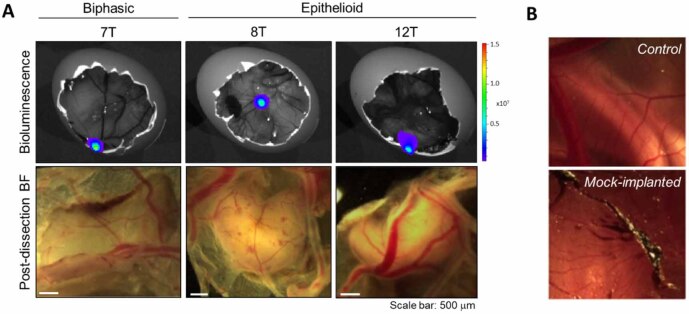
Malignant pleural mesothelioma (MPM) is an aggressive cancer associated with asbestos exposure. MPM is often diagnosed late, at a point where limited treatment options are available, but early intervention could improve the chances of successful treatment for MPM patients. Biomarkers to detect MPM in at-risk individuals are needed to implement early diagnosis technologies. Volatile organic compounds (VOCs) have previously shown diagnostic potential as biomarkers when analysed in MPM patient breath. In this study, chorioallantoic membrane (CAM) xenografts of MPM cell lines were used as models of MPM tumour development for VOC biomarker discovery with the aim of generating targets for investigation in breath, biopsies or other complex matrices. VOC headspace analysis of biphasic or epithelioid MPM CAM xenografts was performed using solid-phase microextraction and gas chromatography-mass spectrometry. We successfully demonstrated the capture, analysis and separation of VOC signatures from CAM xenografts and controls. A panel of VOCs was identified that showed discrimination between MPM xenografts generated from biphasic and epithelioid cells and CAM controls. This is the first application of the CAM xenograft model for the discovery of VOC biomarkers associated with MPM histological subtypes. These findings support the potential utility of non-invasive VOC profiling from breath or headspace analysis of tissues for detection and monitoring of MPM.
恶性胸膜间皮瘤 (MPM) 是一种与石棉暴露相关的侵袭性癌症。MPM 通常在晚期诊断,此时可用的治疗选择有限,但早期干预可能会提高 MPM 患者成功治疗的机会。需要用于检测高危人群中 MPM 的生物标志物,以实施早期诊断技术。挥发性有机化合物 (VOC) 之前已显示出作为生物标志物的诊断潜力,因为它们在 MPM 患者的呼吸中进行分析。在这项研究中,绒毛尿囊膜 (CAM) 的 MPM 细胞系异种移植被用作 MPM 肿瘤发展的模型,以用于 VOC 生物标志物的发现,旨在为呼吸、活检或其他复杂基质中的研究生成目标。使用固相微萃取和气相色谱-质谱法对双相或上皮样 MPM CAM 异种移植进行 VOC 顶空分析。我们成功地证明了从 CAM 异种移植和对照物中捕获、分析和分离 VOC 特征。确定了一组 VOC,这些 VOC 可区分源自双相和上皮样细胞的 MPM 异种移植与 CAM 对照物。这是首次将 CAM 异种移植模型应用于发现与 MPM 组织学亚型相关的 VOC 生物标志物。这些发现支持了非侵入性 VOC 分析从呼吸或组织的顶空分析中检测和监测 MPM 的潜在应用。