Faculty of Dentistry, Department of Prosthodontics, Aydın Adnan Menderes University, Efeler, Aydın, Türkiye.
Faculty of Dentistry, Department of Prosthodontics, Izmir Democracy University, Konak, Izmir, Türkiye.
BMC Oral Health. 2024 Aug 20;24(1):967. doi: 10.1186/s12903-024-04745-1.
Effects of the aging process on the flexural strength of Y-TZP and different Y-PSZ ceramics of different thicknesses were investigated.
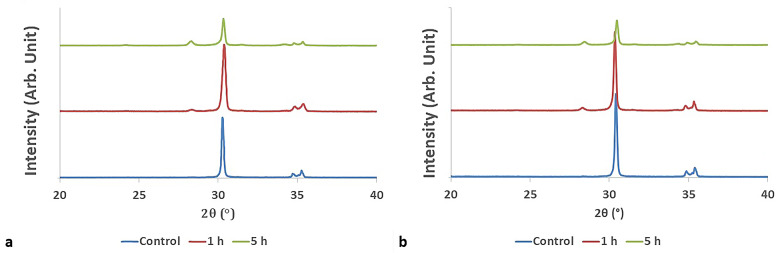
300 disc-shaped samples (12 mm diameter, 0.8 and 1.5 mm thicknesses) were made from 5 different zirconia materials 3Y-TZP LA, 4Y-PSZ, 5Y-PSZ, 3 + 5Y-PSZ and 4 + 5Y-PSZ. Experimental groups were artificially aged in an autoclave at 134 °C, 2 bar pressure for 1 and 5 h; control groups were not subjected to any treatment. Microstructural analysis was conducted using Scanning Electron Microscopy, and X-Ray Diffraction analysis determined the crystalline phase content. The impact of aging on flexural strength was investigated with the use of the biaxial flexural strength test. Data were analyzed using three-way ANOVA tests with a significance level of p < 0.05, applying Bonferroni correction for multiple comparisons.
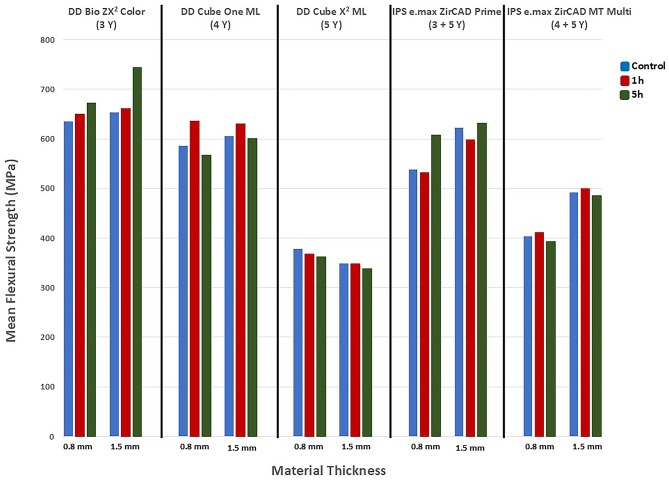
Statistically significant differences in flexural strength were observed among the materials and the material thicknesses (p < 0.05), while there were no significant differences among the aging times (p > 0.05). The highest mean flexural strength values were recorded in the case of the 3 Y-TZP-1.5 mm-5 h group (744.1 ± 61.2 MPa), which was attributed to phase-transformation toughening. The lowest values were observed in the case of the 5 Y-PSZ-1.5 mm-5 h (338.3 ± 34.8 MPa) group.
Both material type and thickness significantly affect the flexural strength of zirconia ceramics, whereas aging time does not; thus, material selection and thickness are crucial considerations for clinicians.
本研究旨在探讨不同厚度的 Y-TZP 和不同 Y-PSZ 陶瓷在老化过程中抗弯强度的变化。
从 5 种不同的氧化锆材料(3Y-TZP LA、4Y-PSZ、5Y-PSZ、3+5Y-PSZ 和 4+5Y-PSZ)中制备了 300 个直径为 12mm、厚度分别为 0.8mm 和 1.5mm 的圆盘形样本。实验组在 134°C、2bar 压力下的高压釜中进行 1h 和 5h 的人工老化;对照组不进行任何处理。使用扫描电子显微镜进行微观结构分析,X 射线衍射分析确定晶体相含量。使用双轴弯曲强度试验研究老化对弯曲强度的影响。采用三因素方差分析,p<0.05,应用 Bonferroni 校正进行多重比较。
材料和材料厚度之间的抗弯强度存在显著差异(p<0.05),而老化时间之间无显著差异(p>0.05)。3Y-TZP-1.5mm-5h 组的平均抗弯强度最高(744.1±61.2MPa),这归因于相变增韧。5Y-PSZ-1.5mm-5h 组的平均抗弯强度最低(338.3±34.8MPa)。
材料类型和厚度显著影响氧化锆陶瓷的抗弯强度,而老化时间没有影响;因此,材料选择和厚度是临床医生的重要考虑因素。