Arcila Laura Viviana Calvache, Ramos Nathália de Carvalho, Campos Tiago Moreira Bastos, Dapieve Kiara Serafini, Valandro Luiz Felipe, de Melo Renata Marques, Bottino Marco Antonio
Department of Dental Materials and Prosthodontics, São Paulo State University (UNESP), Institute of Science and Technology, São José Dos Campos, Brazil.
College of Dentistry, University of Taubaté (Unitau), Taubaté, Brazil.
J Adv Prosthodont. 2021 Dec;13(6):385-395. doi: 10.4047/jap.2021.13.6.385. Epub 2021 Dec 22.
To characterize the microstructure of three yttria partially stabilized zirconia ceramics and to compare their hardness, indentation fracture resistance (IFR), biaxial flexural strength (BFS), and fatigue flexural strength.
Disc-shaped specimens were obtained from 3Y-TZP (Vita YZ HT), 4Y-PSZ (Vita YZ ST) and 5Y-PSZ (Vita YZ XT), following the ISO 6872/2015 guidelines for BFS testing (final dimensions of 12 mm in diameter, 0.7 and 1.2 ± 0.1 mm in thicknesses). Energy-dispersive X-ray spectroscopy (EDX), X-ray diffraction (XRD) and scanning electron microscopy (SEM) analyses were performed, and mechanical properties were assessed by Vickers hardness, IFR, quasi-static BFS and fatigue tests.
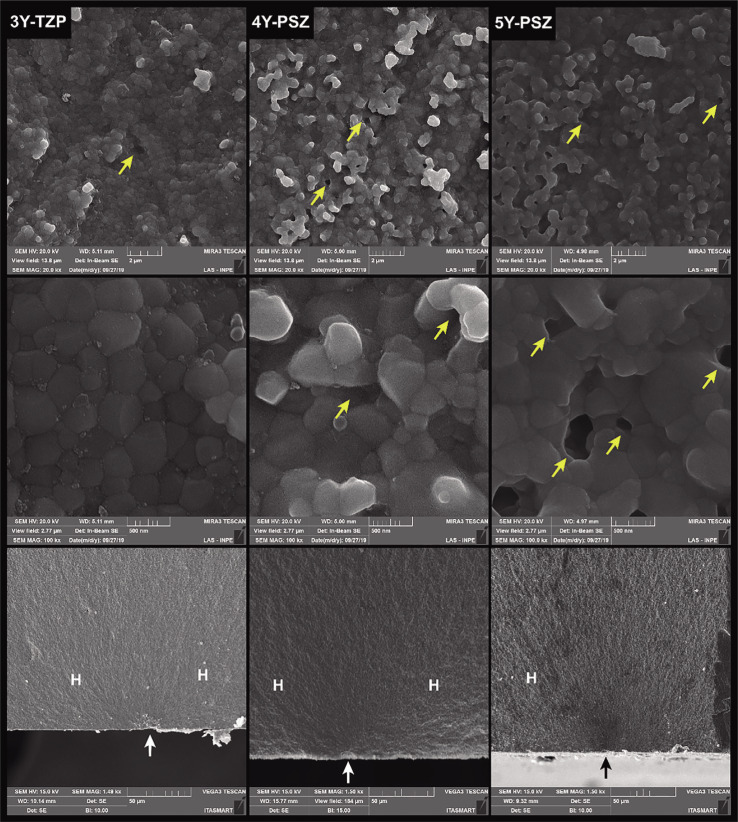
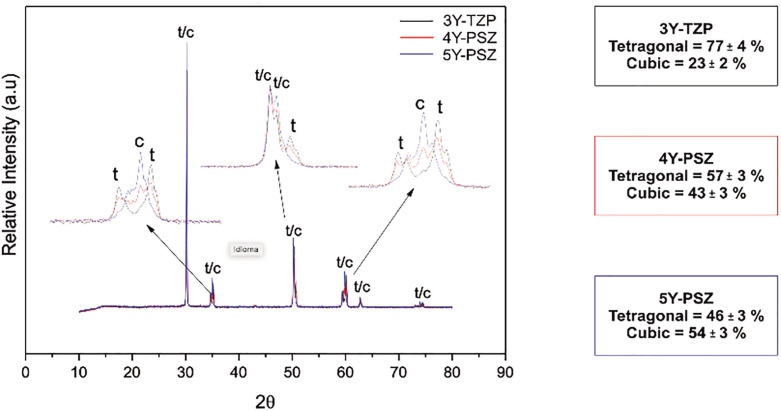
All ceramics showed similar chemical compositions, but mainly differed in the amount of yttria, which was higher as the amount of cubic phase in the diffractogram (5Y-PSZ > 4Y-PSZ > 3Y-TZP). The 4Y- and 5Y-PSZ specimens showed surface defects under SEM, while 3Y-TZP exhibited greater grain uniformity on the surface. 5Y-PSZ and 3Y-TZP presented the highest hardness values, while 3Y-TZP was higher than 4Y- and 5Y-PSZ with regard to the IFR. The 5Y-PSZ specimen (0.7 and 1.2 mm) showed the worst mechanical performance (fatigue BFS and cycles until failure), while 3Y-TZP and 4Y-PSZ presented statistically similar values, higher than 5Y-PSZ for both thicknesses (0.7 and 1.2 mm). Moreover, 3Y-TZP showed the highest (1.2 mm group) and the lowest (0.7 mm group) degradation percentage, and 5Y-PSZ had higher strength degradation than 4Y-PSZ group.
Despite the microstructural differences, 4Y-PSZ and 3Y-TZP had similar fatigue behavior regardless of thickness. 5Y-PSZ had the lowest mechanical performance.
表征三种氧化钇部分稳定氧化锆陶瓷的微观结构,并比较它们的硬度、压痕断裂韧性(IFR)、双轴弯曲强度(BFS)和疲劳弯曲强度。
按照ISO 6872/2015中BFS测试指南(最终尺寸为直径12mm,厚度0.7mm和1.2±0.1mm),从3Y-TZP(维他YZ HT)、4Y-PSZ(维他YZ ST)和5Y-PSZ(维他YZ XT)获取盘状试样。进行了能量色散X射线光谱(EDX)、X射线衍射(XRD)和扫描电子显微镜(SEM)分析,并通过维氏硬度、IFR、准静态BFS和疲劳试验评估机械性能。
所有陶瓷显示出相似的化学成分,但主要在氧化钇含量上有所不同,衍射图中立方相的含量越高(5Y-PSZ>4Y-PSZ>3Y-TZP)。4Y-PSZ和5Y-PSZ试样在SEM下显示表面缺陷,而3Y-TZP在表面表现出更大的晶粒均匀性。5Y-PSZ和3Y-TZP呈现出最高的硬度值,而在IFR方面3Y-TZP高于4Y-PSZ和5Y-PSZ。5Y-PSZ试样(0.7mm和1.2mm)显示出最差的机械性能(疲劳BFS和直至失效的循环次数),而3Y-TZP和4Y-PSZ呈现出统计学上相似的值,对于两种厚度(0.7mm和1.2mm)均高于5Y-PSZ。此外,3Y-TZP显示出最高(1.2mm组)和最低(0.7mm组)的降解百分比,并且5Y-PSZ的强度降解高于4Y-PSZ组。
尽管微观结构存在差异,但4Y-PSZ和3Y-TZP无论厚度如何都具有相似的疲劳行为。5Y-PSZ具有最低的机械性能。