Lu Mingshan, Sharmin Sumaiya, Tao Yong, Xia Xin, Yang Gongliang, Cong Yingying, Yang Guanhu, Jiang Jing, Xiao Yun, Peng Laura, Quan Joshua, Xu Bentong
Department of Economics, University of Calgary, Calgary, AB, Canada.
Department of Community Health Sciences, University of Calgary, Calgary, AB, Canada.
Front Neurol. 2024 Aug 6;15:1366685. doi: 10.3389/fneur.2024.1366685. eCollection 2024.
This study presents real-world evidence on the clinical outcomes of the Alberta Complementary Health Integration Project (ABCHIP), which utilized acupuncture to address pain and mental health issues in two vulnerable populations in Alberta: youth (aged 24 and below) and elderly (aged 55 and above).
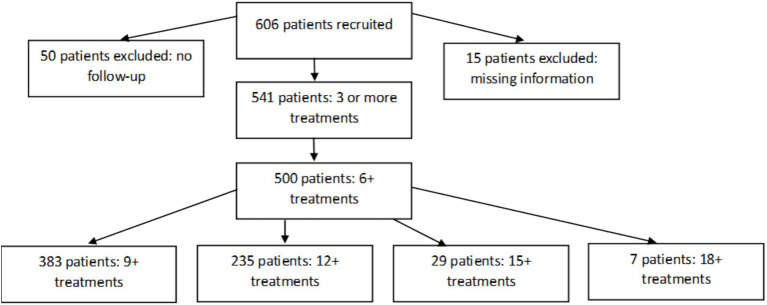
Over 282 days, a total of 606 patients received 5,424 acupuncture treatments. Tailored to each patients' specific pain and mental health concerns, an individualized treatment plan was selected, following a standard treatment protocol lasting 1 to 3 months. Patients were evaluated at least twice: initially and upon completing therapy. Primary treatment outcomes were assessed using various measures, including the Brief Pain Inventory (BPI), Pittsburgh Sleep Quality Index (PSQI), Patient Health Questionnaire 9 (PHQ9), PROMIS Anxiety 8a and its pediatric form PROMIS Anxiety-Pediatric, PROMIS Short Form v1.0 Fatigue 8a and its pediatric counterpart PROMIS Pediatric Short Form v2.0 Fatigue 10a, PROMIS Short Form v1.1 Anger 5a and its version PROMIS SF v2.0 5a, and EQ-5D-5L. These measures gauged pain reduction, improved sleep quality, reduced depression, anxiety, fatigue, anger, and quality of life, respectively.
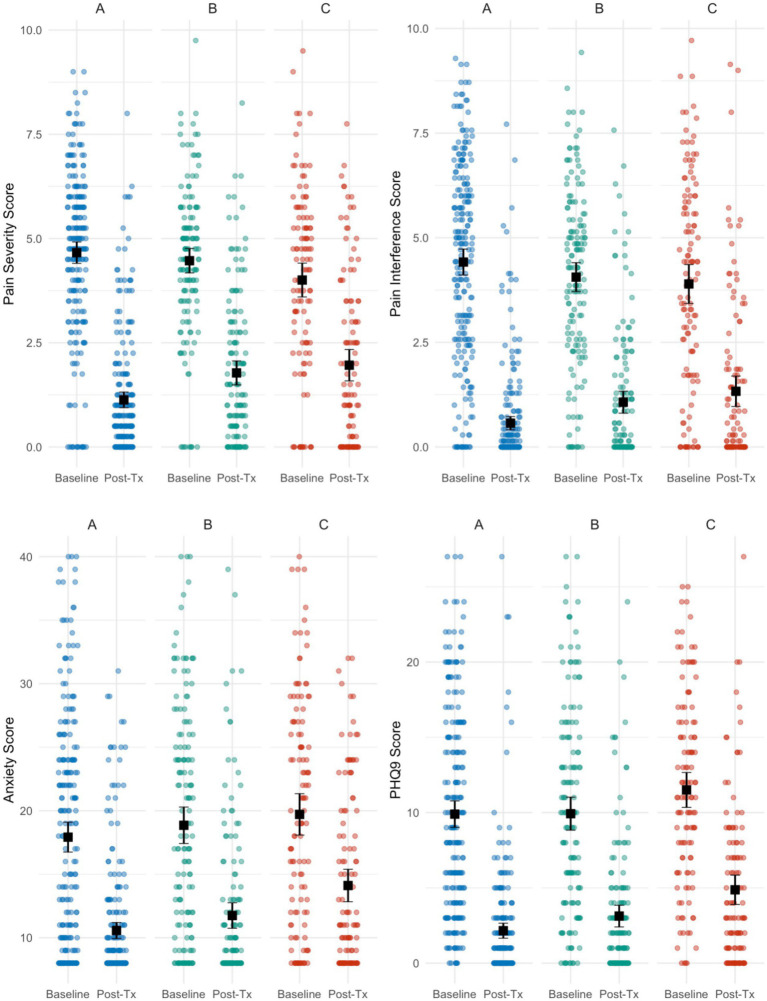
Analysis of data from 500 patients who received at least 6 acupuncture sessions through ABCHIP showed statistically significant improvements in clinical outcomes. Among this group, the subgroup of 235 patients who received at least 12 sessions demonstrated the most favorable treatment outcomes, including an 75.5% reduction in pain severity, a 53.1% improvement in sleep quality, a 78.4% drop in depression, a 41.1% decline in anxiety, a 43.7% decrease in fatigue, a 38.2% decrease in anger, and a 42.6% improvement in overall quality of life.
Integrating acupuncture with usual care demonstrates promise in enhancing mental health, alleviating chronic and general pain, and improving overall quality of life. The findings suggest that integrative programs, such as ABCHIP, present an effective approach to addressing pain and mental health concerns in vulnerable populations, providing valuable insights for future healthcare interventions.
本研究提供了关于艾伯塔省补充健康整合项目(ABCHIP)临床结果的真实世界证据,该项目利用针灸来解决艾伯塔省两个弱势群体的疼痛和心理健康问题:青年(24岁及以下)和老年人(55岁及以上)。
在282天的时间里,共有606名患者接受了5424次针灸治疗。根据每位患者具体的疼痛和心理健康问题,遵循为期1至3个月的标准治疗方案,选择个性化的治疗计划。患者至少接受两次评估:初始评估和治疗结束时的评估。主要治疗结果使用多种测量方法进行评估,包括简明疼痛量表(BPI)、匹兹堡睡眠质量指数(PSQI)、患者健康问卷9(PHQ9)、PROMIS焦虑8a及其儿童版PROMIS儿童焦虑量表、PROMIS简表v1.0疲劳8a及其儿童对应版PROMIS儿童简表v2.0疲劳10a、PROMIS简表v1.1愤怒5a及其版本PROMIS SF v2.0 5a,以及EQ-5D-5L。这些测量方法分别衡量了疼痛减轻、睡眠质量改善、抑郁减轻、焦虑减轻、疲劳减轻、愤怒减轻和生活质量提高的情况。
对通过ABCHIP接受至少6次针灸治疗的500名患者的数据进行分析,结果显示临床结果有统计学意义的改善。在这一组中,接受至少12次治疗的235名患者亚组显示出最有利的治疗结果,包括疼痛严重程度降低75.5%、睡眠质量改善53.1%、抑郁降低78.4%、焦虑降低41.1%、疲劳降低43.7%、愤怒降低38.2%以及总体生活质量提高42.6%。
将针灸与常规护理相结合在促进心理健康、缓解慢性疼痛和一般性疼痛以及提高总体生活质量方面显示出前景。研究结果表明,像ABCHIP这样的综合项目为解决弱势群体的疼痛和心理健康问题提供了一种有效方法,为未来的医疗保健干预提供了有价值的见解。