
阿拉伯联合酋长国成年人中社交媒体与饮食行为的关联。
The association of social media with dietary behaviors among adults in the United Arab Emirates.
作者信息
Cheikh Ismail Leila, Osaili Tareq M, Naja Farah, Wartanian Mary, Elkabat Gadeer, Arnous Mariam, Alkoukou Hala, Mohamad Maysm N, Saleh Sheima T, Al Daour Rameez, Masuadi Emad, Ali Habiba I, Stojanovska Lily, Al Dhaheri Ayesha S
机构信息
Department of Clinical Nutrition and Dietetics, College of Health Sciences, University of Sharjah, Sharjah, 27272, United Arab Emirates.
Nuffield Department of Women's & Reproductive Health, University of Oxford, Oxford, OX1 2JD, UK.
出版信息
Heliyon. 2024 Jul 31;10(15):e35574. doi: 10.1016/j.heliyon.2024.e35574. eCollection 2024 Aug 15.
BACKGROUND
Social media is an online community that offers a digital setting where people create, share, and access a wide range of information, knowledge, and viewpoints. This study assessed the association between social media use and eating behaviors and whether sociodemographic characteristics and lifestyle habits are correlated with this association. In addition, it assessed whether this effect is different according to changes in lifestyle habits due to the COVID-19 pandemic among adults in the United Arab Emirates (UAE).
METHODOLOGY
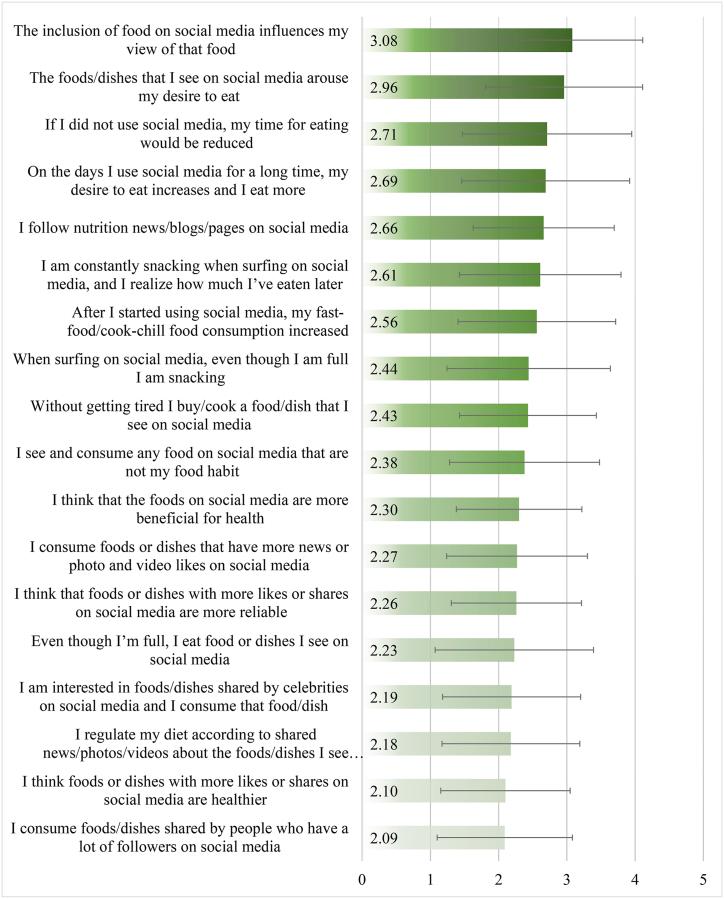
A cross-sectional web-based study was conducted among 1056 adults living in the UAE. Information on sociodemographic characteristics, social media use, and dietary habits were collected. The Scale of Effects of Social Media on Eating Behavior (SESMEB) was used and a total score ranging from 18 to 90 was generated with higher scores corresponding to a greater effect. The general linear model analysis assessed associations of certain characteristics with the score. Independent T-test and one-way ANOVA test were used to investigate differences based on changes in lifestyle habits due to COVID-19.
RESULTS
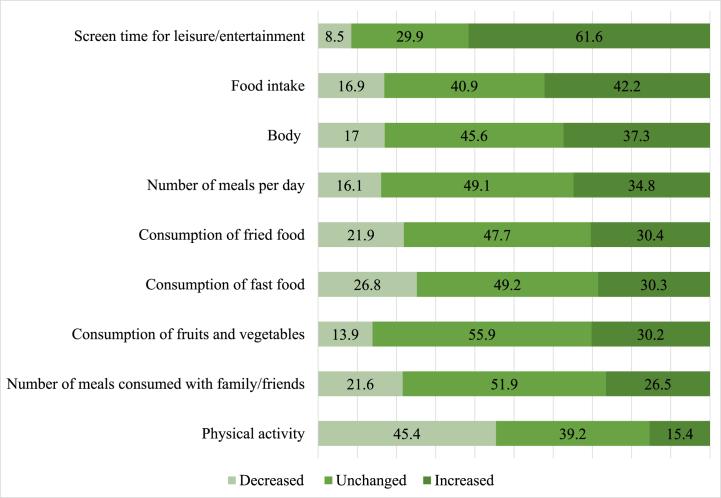
Most participants (80.3 %) reported using social media >2 h/day. The mean score was 44.15 ± 12.68 (range 18-90). Increasing age, being a male, spending less time on social media, and not following influencers were associated with lower SESMEB scores. Not consuming breakfast and spending more time on screens for leisure were associated with higher scores (p < 0.05). Significantly higher scores were recorded for those previously infected with COVID-19 and who reported an increase in screen time, food intake, body weight, and meals/day (p < 0.05).
CONCLUSION
Social media appears to have an association with adults' dietary habits in the UAE. Spending more time on social media, being a female, and having more screen time were associated with a higher impact. Targeted programs are needed to increase awareness and advocate for a positive lifestyle with social media use.
背景
社交媒体是一个在线社区,提供了一个数字环境,人们可以在其中创建、分享和获取广泛的信息、知识和观点。本研究评估了社交媒体使用与饮食行为之间的关联,以及社会人口统计学特征和生活方式习惯是否与这种关联相关。此外,它还评估了在阿拉伯联合酋长国(阿联酋)成年人中,由于新冠疫情导致生活方式习惯发生变化,这种影响是否有所不同。
方法
对居住在阿联酋的1056名成年人进行了一项基于网络的横断面研究。收集了有关社会人口统计学特征、社交媒体使用情况和饮食习惯的信息。使用了社交媒体对饮食行为影响量表(SESMEB),生成的总分范围为18至90分,分数越高表明影响越大。一般线性模型分析评估了某些特征与该分数之间的关联。使用独立样本t检验和单因素方差分析来研究因新冠疫情导致生活方式习惯变化而产生的差异。
结果
大多数参与者(80.3%)报告每天使用社交媒体超过2小时。平均得分是44.15±12.68(范围18 - 90)。年龄增长、男性、在社交媒体上花费时间较少以及不关注有影响力的人,与较低的SESMEB得分相关。不吃早餐和在休闲屏幕上花费更多时间与较高得分相关(p < 0.05)。曾感染新冠病毒且报告屏幕时间、食物摄入量、体重和每日用餐次数增加的人得分显著更高(p < 0.05)。
结论
在阿联酋,社交媒体似乎与成年人的饮食习惯有关。在社交媒体上花费更多时间、女性以及有更多屏幕时间与更大的影响相关。需要有针对性的项目来提高认识,并倡导通过使用社交媒体养成积极的生活方式。


 Zotero 插件