Department of Clinical Nutrition and Dietetics, College of Health Sciences, University of Sharjah, Sharjah, United Arab Emirates.
Nuffield Department of Women's & Reproductive Health, University of Oxford, Oxford, United Kingdom.
PLoS One. 2023 Oct 25;18(10):e0293386. doi: 10.1371/journal.pone.0293386. eCollection 2023.
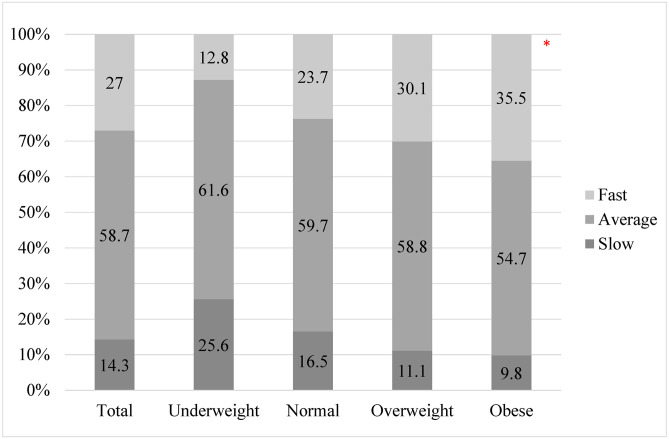
The relationship between obesity and satiation is complex and bidirectional. Understanding differences in reasons for meal termination may enhance our understanding of overeating risks and susceptibility to overconsumption. This study aimed to investigate the reasons why individuals in the UAE stop eating. A cross-sectional web-based study was conducted among adults ≥18 years in the UAE (n = 1482). Using a self-administered online questionnaire, we collected information on sociodemographic characteristics, lifestyle habits, and eating behavior using the Reasons Individuals Stop Eating-Questionnaire (RISE-Q-15) used twice for breakfast/main meal. The items were categorized into five scales; decreased food appeal (DFA), physical satisfaction (PS), planned amount (PA), self-consciousness (SC), and decreased priority of eating (DPE). All items were scored from 1 to 7 ranging between 3 to 21 on each scale. A paired t-test was used to evaluate the difference between the RISE-Q scores on each scale concerning the two meals. The main reason why participants stopped eating breakfast was under the PS scale (14.91 ± 3.72), followed by the PA scale (14.58 ± 3.00). The main reason why participants stopped eating main meals was under the PS scale (14.78 ± 3.56), followed by the PA scale (14.77 ± 43.81). The mean score of the DPE scale was significantly higher for breakfast than the main meal (p = 0.038). More than half of the participants reported an average eating rate (58.7%). Pearson's chi-square analysis revealed that the eating rate was dependent on BMI (p<0.001). Considering individual mealtimes and addressing factors related to PS and PA of food is crucial when designing nutrition interventions aiming to promote healthy eating habits among adults in the UAE.
肥胖与饱腹感之间的关系是复杂且双向的。了解停止进食的原因差异可能会增强我们对暴饮暴食风险和易感性的理解。本研究旨在调查阿联酋人停止进食的原因。在阿联酋进行了一项横断面网络研究,纳入≥18 岁的成年人(n=1482)。使用自我管理的在线问卷,我们使用 Reasons Individuals Stop Eating-Questionnaire(RISE-Q-15)收集了社会人口统计学特征、生活方式习惯和饮食行为信息,该问卷在早餐/主餐时使用了两次。项目分为五个量表;食物吸引力下降(DFA)、身体满足感(PS)、计划摄入量(PA)、自我意识(SC)和进食优先级下降(DPE)。每个量表的所有项目评分范围均为 1 至 7,每个量表的分值为 3 至 21。采用配对 t 检验评估每个量表的 RISE-Q 评分在两餐之间的差异。参与者停止吃早餐的主要原因是 PS 量表(14.91±3.72),其次是 PA 量表(14.58±3.00)。参与者停止吃主餐的主要原因是 PS 量表(14.78±3.56),其次是 PA 量表(14.77±43.81)。DPE 量表的平均得分早餐显著高于主餐(p=0.038)。超过一半的参与者报告平均进食速度(58.7%)。Pearson 卡方分析显示,进食速度与 BMI 相关(p<0.001)。考虑个体用餐时间和解决与 PS 和 PA 相关的食物因素对于设计旨在促进阿联酋成年人健康饮食习惯的营养干预措施至关重要。