V Cabral Fernanda, Xu QianFeng, Greer Alexander, Lyons Alan M, Hasan Tayyaba
Wellman Center for Photomedicine, Massachusetts General Hospital and Harvard Medical School, 40 Blossom Street, Boston, Massachusetts 02114, United States.
SingletO2 Therapeutics LLC, VentureLink, Room 524B, 211 Warren Street, Newark, New Jersey 07103, United States.
ACS Appl Bio Mater. 2024 Sep 16;7(9):6175-6185. doi: 10.1021/acsabm.4c00733. Epub 2024 Aug 21.
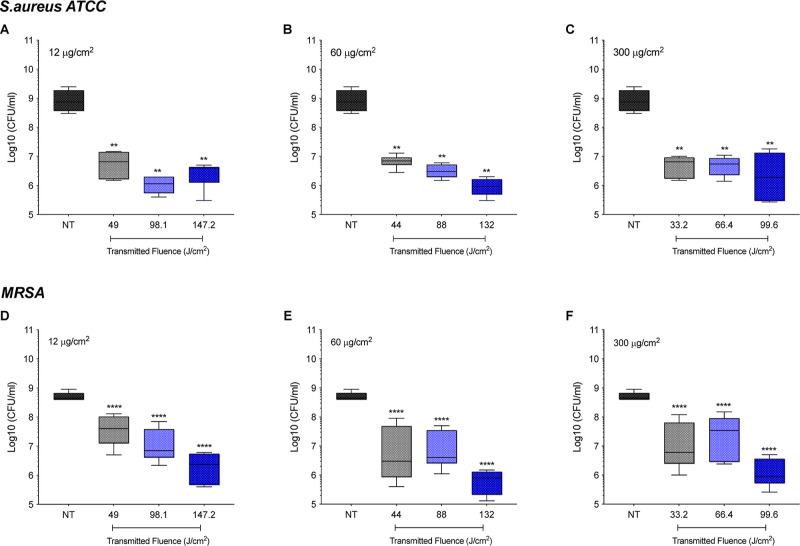
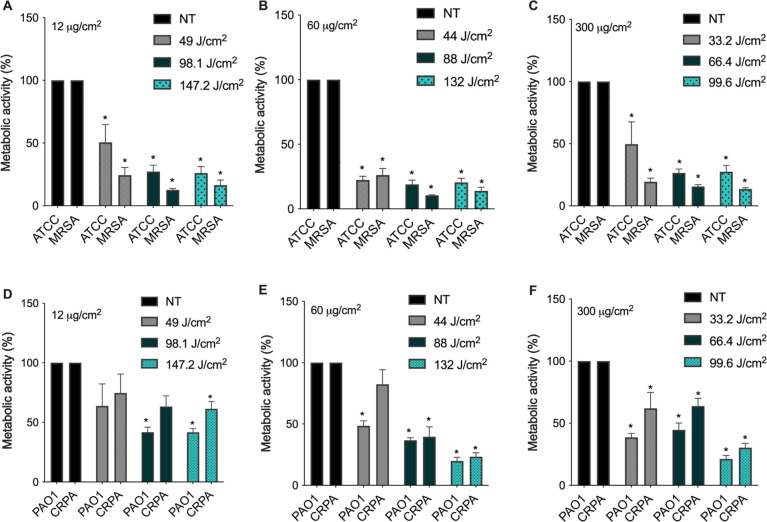
The rise of antimicrobial resistance poses a critical public health threat worldwide. While antimicrobial photodynamic therapy (aPDT) has demonstrated efficacy against multidrug-resistant (MDR) bacteria, its effectiveness can be limited by several factors, including the delivery of the photosensitizer (PS) to the site of interest and the development of bacterial resistance to PS uptake. There is a need for alternative methods, one of which is superhydrophobic antimicrobial photodynamic therapy (SH-aPDT), which we report here. SH-aPDT is a technique that isolates the PS on a superhydrophobic (SH) membrane, generating airborne singlet oxygen (O) that can diffuse up to 1 mm away from the membrane. In this study, we developed a SH polydimethylsiloxane dressing coated with PS verteporfin. These dressings contain air channels called a plastron for supplying oxygen for aPDT and are designed so that there is no direct contact of the PS with the tissue. Our investigation focuses on the efficacy of SH-aPDT on biofilms formed by drug-sensitive and MDR strains of Gram-positive ( and methicillin-resistant) and Gram-negative bacteria ( and carbapenem-resistant). SH-aPDT reduces bacterial biofilms by approximately 3 log with a concomitant decrease in their metabolism as measured by MTT. Additionally, the treatment disrupted extracellular polymeric substances, leading to a decrease in biomass and biofilm thickness. This innovative SH-aPDT approach holds great potential for combating antimicrobial resistance, offering an effective strategy to address the challenges posed by drug-resistant wound infections.
抗菌药物耐药性的上升对全球公共卫生构成了严重威胁。虽然抗菌光动力疗法(aPDT)已证明对多重耐药(MDR)细菌有效,但其有效性可能受到多种因素的限制,包括将光敏剂(PS)递送至感兴趣部位以及细菌对PS摄取产生耐药性。因此需要替代方法,其中之一就是我们在此报告的超疏水抗菌光动力疗法(SH-aPDT)。SH-aPDT是一种将PS隔离在超疏水(SH)膜上的技术,可产生能扩散至距膜1毫米远的空气中单线态氧(O)。在本研究中,我们开发了一种涂有PS维替泊芬的超疏水聚二甲基硅氧烷敷料。这些敷料包含称为气盾的气道,用于为aPDT提供氧气,其设计使得PS不会与组织直接接触。我们的研究重点是SH-aPDT对由革兰氏阳性(和耐甲氧西林)以及革兰氏阴性细菌(和耐碳青霉烯)的药敏菌株和MDR菌株形成的生物膜的疗效。通过MTT测量,SH-aPDT可使细菌生物膜减少约3个对数,同时其代谢也随之降低。此外,该处理破坏了细胞外聚合物,导致生物量和生物膜厚度减少。这种创新的SH-aPDT方法在对抗抗菌药物耐药性方面具有巨大潜力,为应对耐药性伤口感染带来的挑战提供了一种有效策略。