Laboratory of Dietetics and Clinical Nutrition, Department of Public Health, Experimental and Forensic Medicine, University of Pavia, Pavia, 27100, Italy.
Biostatistics and Clinical Epidemiology Unit, Department of Public Health, Experimental and Forensic Medicine, University of Pavia, Pavia, 27100, Italy.
Eur J Nutr. 2024 Dec;63(8):2911-2920. doi: 10.1007/s00394-024-03473-0. Epub 2024 Aug 21.
BACKGROUND/OBJECTIVES: Gestational Weight Gain (GWG) impacts maternal and fetal health; deviations from optimal ranges pose health risks. Maternal lifestyle before and during pregnancy strongly influences GWG. This study explores factors linked to inadequate GWG, focusing on Mediterranean Diet (MD) adherence and specific food consumption.
SUBJECTS/METHODS: 178 pregnant women were enrolled at Fondazione IRCCS Policlinico San Matteo (Pavia) during pre-hospital care before birth meeting inclusion/exclusion criteria. Sociodemographic data, pre-pregnancy BMI, GWG, MD adherence, physical activity (PA) levels, and smoking habits were retrospectively collected. Validated questionnaires adapted for the target group, assessed MD adherence and PA level. Participants were classified into adequate (AGWG) and inadequate GWG groups following IOM guidelines.
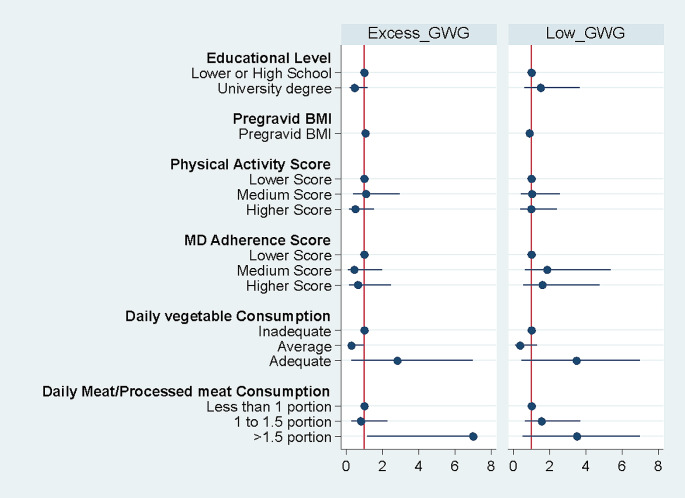
Among 200 pregnant women (aged 30-36), 37.1% experienced low GWG and 24.1% excessive GWG. Our study revealed a significant association between inadequate GWG and educational level (P = 0.011); pre-pregnancy BMI (P = 0.005); MD adherence (P = 0.008), and daily average consumption of vegetables (P < 0.001). Our results also showed that a lower risk of EGWG vs. AGWG was associated with daily average consumption of vegetables (RRR = 0.279, P = 0.004), while a higher risk of EGWG vs. AGWG was associated with high daily meat product consumption (> 1.5 portions/day) (RRR = 7.83, P = 0.03).
These findings emphasize the importance of promoting lifestyle changes before and during pregnancy to tackle the increasing incidence of inadequate GWG and improve the health outcomes of both mother and child.
背景/目的:妊娠体重增加(GWG)会影响母婴健康;偏离最佳范围会带来健康风险。母亲在怀孕前后的生活方式会强烈影响 GWG。本研究探讨了与 GWG 不足相关的因素,重点关注地中海饮食(MD)的依从性和特定食物的摄入。
受试者/方法:在 Fondazione IRCCS Policlinico San Matteo(帕维亚)产前保健期间,纳入了 178 名符合纳入/排除标准的孕妇。回顾性收集了社会人口统计学数据、孕前 BMI、GWG、MD 依从性、体力活动(PA)水平和吸烟习惯。适用于目标人群的经过验证的问卷评估了 MD 的依从性和 PA 水平。参与者根据 IOM 指南分为适当 GWG(AGWG)和不足 GWG 组。
在 200 名孕妇(年龄 30-36 岁)中,37.1%经历了低 GWG,24.1%经历了高 GWG。我们的研究表明,GWG 不足与教育水平(P=0.011);孕前 BMI(P=0.005);MD 依从性(P=0.008)和蔬菜的每日平均摄入量(P<0.001)显著相关。我们的结果还表明,与 AGWG 相比,EGWG 的风险较低与蔬菜的每日平均摄入量(RRR=0.279,P=0.004)相关,而与 AGWG 相比,EGWG 的风险较高与每日大量食用肉类产品(>1.5 份/天)(RRR=7.83,P=0.03)相关。
这些发现强调了在怀孕前后促进生活方式改变的重要性,以解决 GWG 不足的发生率不断增加的问题,并改善母婴的健康结果。