Department of Biochemistry and Molecular Biology, Schools of Biology and Chemistry, Instituto Universitario de Investigación Neuroquímica (IUIN), Complutense University, Madrid ES-28040, Spain.
Centro de Investigación Biomédica en Red de Enfermedades Neurodegenerativas (CIBERNED), Instituto de Salud Carlos III, Madrid ES-28029, Spain.
J Neurosci. 2024 Sep 25;44(39):e0701242024. doi: 10.1523/JNEUROSCI.0701-24.2024.
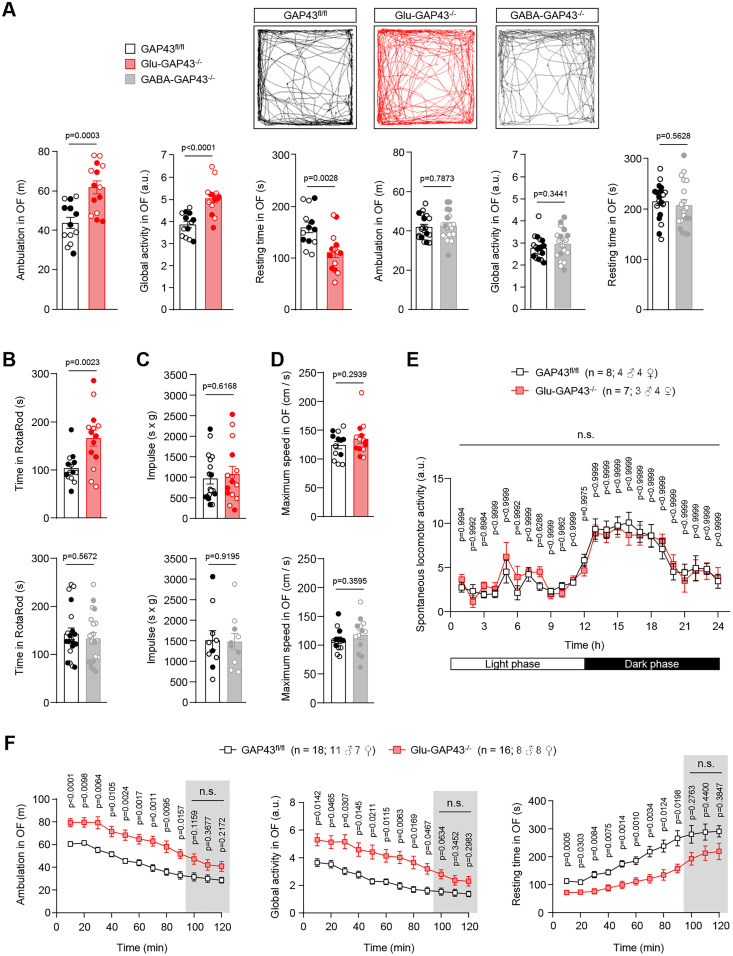
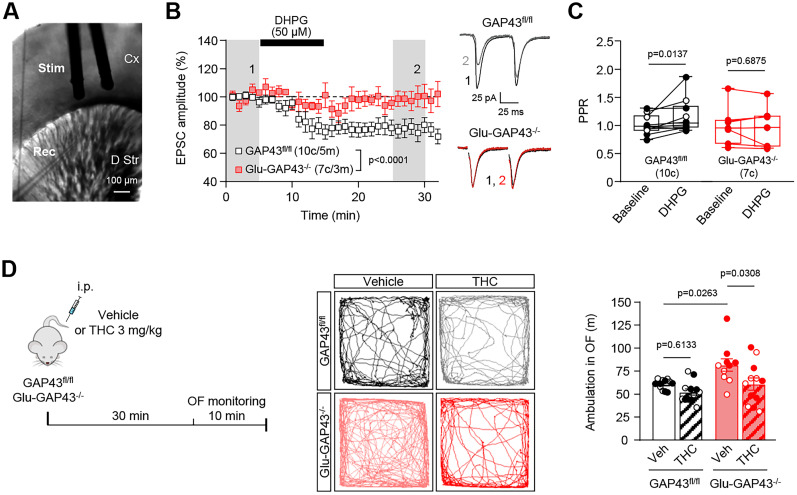
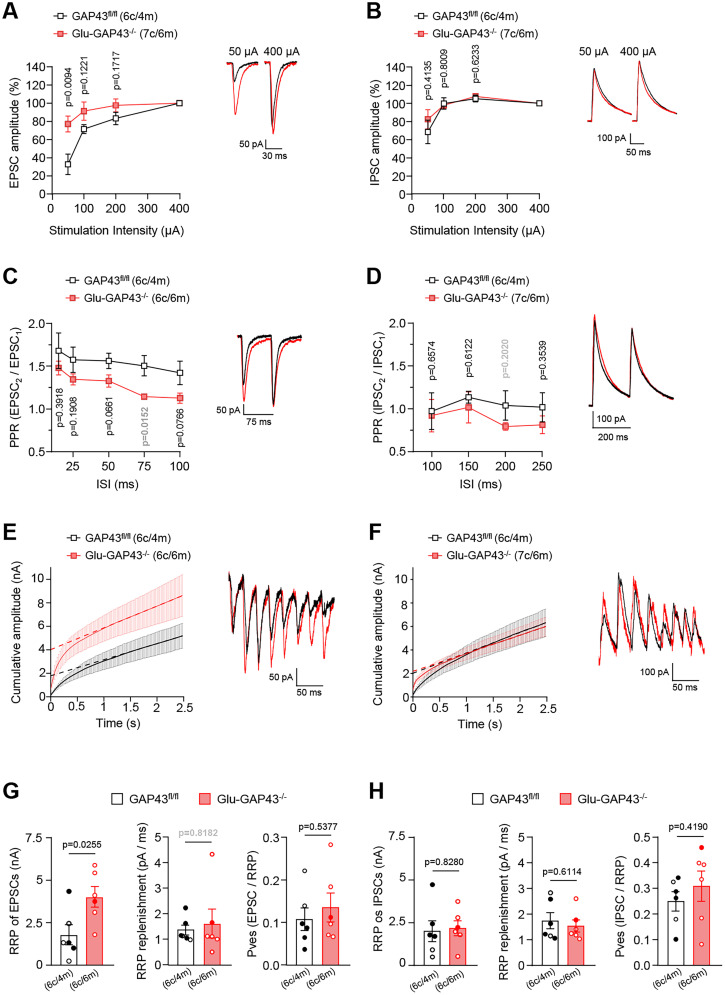
Growth-associated protein of 43 kDa (GAP43) is a key cytoskeleton-associated component of the presynaptic terminal that facilitates neuroplasticity. Downregulation of GAP43 expression has been associated to various psychiatric conditions in humans and evokes hippocampus-dependent memory impairments in mice. Despite the extensive studies conducted on hippocampal GAP43 in past decades, however, very little is known about its roles in modulating the excitatory versus inhibitory balance in other brain regions. We recently generated conditional knock-out mice in which the gene was selectively inactivated in either telencephalic glutamatergic neurons ( ; mice, hereafter Glu-GAP43 mice) or forebrain GABAergic neurons ( ; mice, hereafter GABA-GAP43 mice). Here, we show that Glu-GAP43 but not GABA-GAP43 mice of either sex show a striking hyperactive phenotype when exposed to a novel environment. This behavioral alteration of Glu-GAP43 mice was linked to a selective activation of dorsal-striatum neurons, as well as to an enhanced corticostriatal glutamatergic transmission and an abrogation of corticostriatal endocannabinoid-mediated long-term depression. In line with these observations, GAP43 was abundantly expressed in corticostriatal glutamatergic terminals of wild-type mice. The novelty-induced hyperactive phenotype of Glu-GAP43 mice was abrogated by chemogenetically inhibiting corticostriatal afferences with a G-coupled "designer receptor exclusively activated by designer drugs" (DREADDs), thus further supporting that novelty-induced activity is controlled by GAP43 at corticostriatal excitatory projections. Taken together, these findings show an unprecedented regulatory role of GAP43 in the corticostriatal circuitry and provide a new mouse model with a delimited neuronal-circuit alteration for studying novelty-induced hyperactivity, a phenotypic shortfall that occurs in diverse psychiatric diseases.
生长相关蛋白 43kDa(GAP43)是突触前末梢中关键的细胞骨架相关成分,可促进神经可塑性。GAP43 表达下调与人类多种精神疾病有关,并在小鼠中引起海马依赖性记忆损伤。尽管在过去几十年中对海马 GAP43 进行了广泛的研究,但对其在调节其他脑区兴奋性与抑制性平衡中的作用却知之甚少。我们最近生成了条件性敲除小鼠,其中 基因在大脑皮质谷氨酸能神经元( ;小鼠,以下简称 Glu-GAP43 小鼠)或前脑 GABA 能神经元( ;小鼠,以下简称 GABA-GAP43 小鼠)中选择性失活。在这里,我们发现雄性和雌性 Glu-GAP43 小鼠在暴露于新环境时表现出惊人的多动表型。Glu-GAP43 小鼠的这种行为改变与背侧纹状体神经元的选择性激活有关,以及皮质纹状体谷氨酸能传递的增强和皮质纹状体内源性大麻素介导的长时程抑制的缺失。与这些观察结果一致,GAP43 在野生型小鼠的皮质纹状体谷氨酸能末梢中大量表达。用化学遗传学方法抑制皮质纹状体传入的 G 蛋白偶联“仅被 designer 药物激活的 designer 受体”(DREADD),可消除 Glu-GAP43 小鼠的新奇诱导多动表型,这进一步表明新奇诱导的活动受皮质纹状体兴奋性投射中 GAP43 的控制。总之,这些发现显示了 GAP43 在皮质纹状体回路中前所未有的调节作用,并提供了一种新的具有限定性神经元回路改变的小鼠模型,用于研究新奇诱导的多动,这是多种精神疾病中存在的表型缺陷。