Brain Mapping Lab, Department of Biomedical, Dental Sciences and Morphological and Functional Images, University of Messina.
Department of Medicine, Surgery and Dentistry "Medical School of Salerno", University of Salerno.
Eur J Histochem. 2021 Oct 13;65(s1):3284. doi: 10.4081/ejh.2021.3284.
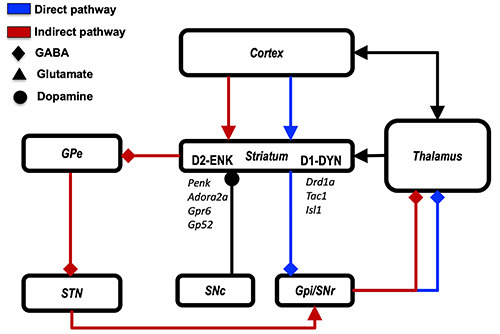
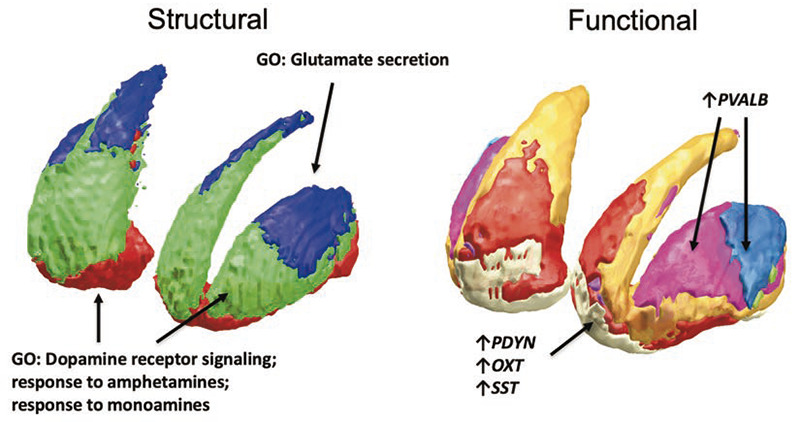
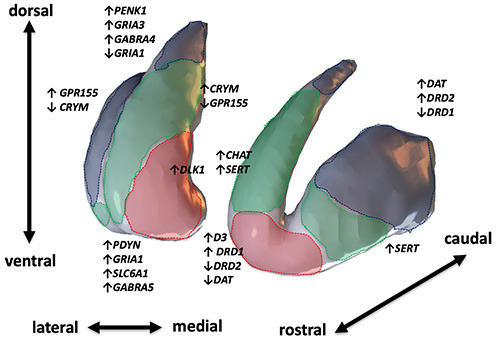
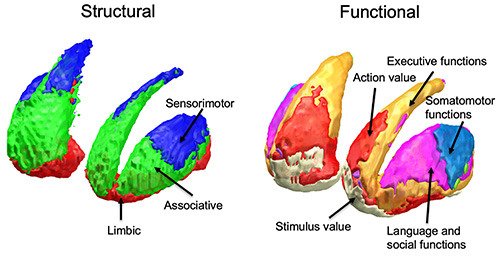
The striatum represents the major hub of the basal ganglia, receiving projections from the entire cerebral cortex and it is assumed to play a key role in a wide array of complex behavioral tasks. Despite being extensively investigated during the last decades, the topographical organization of the striatum is not well understood yet. Ongoing efforts in neuroscience are focused on analyzing striatal anatomy at different spatial scales, to understand how structure relates to function and how derangements of this organization are involved in various neuropsychiatric diseases. While being subdivided at the macroscale level into dorsal and ventral divisions, at a mesoscale level the striatum represents an anatomical continuum sharing the same cellular makeup. At the same time, it is now increasingly ascertained that different striatal compartments show subtle histochemical differences, and their neurons exhibit peculiar patterns of gene expression, supporting functional diversity across the whole basal ganglia circuitry. Such diversity is further supported by afferent connections which are heterogenous both anatomically, as they originate from distributed cortical areas and subcortical structures, and biochemically, as they involve a variety of neurotransmitters. Specifically, the cortico-striatal projection system is topographically organized delineating a functional organization which is maintained throughout the basal ganglia, subserving motor, cognitive and affective behavioral functions. While such functional heterogeneity has been firstly conceptualized as a tripartite organization, with sharply defined limbic, associative and sensorimotor territories within the striatum, it has been proposed that such territories are more likely to fade into one another, delineating a gradient-like organization along medio-lateral and ventro-dorsal axes. However, the molecular and cellular underpinnings of such organization are less understood, and their relations to behavior remains an open question, especially in humans. In this review we aimed at summarizing the available knowledge on striatal organization, especially focusing on how it links structure to function and its alterations in neuropsychiatric diseases. We examined studies conducted on different species, covering a wide array of different methodologies: from tract-tracing and immunohistochemistry to neuroimaging and transcriptomic experiments, aimed at bridging the gap between macroscopic and molecular levels.
纹状体代表基底神经节的主要枢纽,接收来自整个大脑皮层的投射,被认为在广泛的复杂行为任务中发挥关键作用。尽管在过去几十年中得到了广泛的研究,但纹状体的拓扑结构仍未得到很好的理解。神经科学领域的持续努力集中在分析不同空间尺度的纹状体解剖结构,以了解结构如何与功能相关,以及这种组织的紊乱如何与各种神经精神疾病有关。虽然在宏观尺度上被分为背侧和腹侧两个部分,但在中观尺度上,纹状体代表了一个具有相同细胞组成的解剖连续体。同时,现在越来越确定不同的纹状体隔室显示出细微的组织化学差异,它们的神经元表现出独特的基因表达模式,支持整个基底神经节回路的功能多样性。这种多样性进一步得到了传入连接的支持,这些连接在解剖上是异质的,因为它们起源于分布的皮质区域和皮质下结构,在生物化学上也是异质的,因为它们涉及多种神经递质。具体来说,皮质纹状体投射系统在空间上被组织起来,划定了一个贯穿整个基底神经节的功能组织,为运动、认知和情感行为功能提供支持。虽然这种功能异质性最初被概念化为三部分组织,纹状体内部有明显界定的边缘、联合和感觉运动区域,但有人提出,这些区域更有可能相互融合,沿着中侧和腹背轴划定一个梯度样的组织。然而,这种组织的分子和细胞基础了解较少,其与行为的关系仍然是一个悬而未决的问题,特别是在人类中。在这篇综述中,我们旨在总结纹状体组织的现有知识,特别是关注它如何将结构与功能联系起来,以及它在神经精神疾病中的改变。我们检查了在不同物种上进行的研究,涵盖了广泛的不同方法学:从追踪和免疫组织化学到神经影像学和转录组学实验,旨在弥合宏观和分子水平之间的差距。