Banjare Manoj Kumar, Barman Benvikram, Behera Kamalakanta, Khan Javed Masood, Banjare Ramesh Kumar, Pandey Siddharth, Ghosh Kallol Kumar
Department of Chemistry (MSS), MATS University, Pagaria Complex, Pandri, Raipur, Chhattisgarh, 492004, India.
Department of Chemistry, University of Allahabad, Prayagraj, Uttar Pradesh, 211002, India.
Heliyon. 2024 Aug 5;10(15):e35598. doi: 10.1016/j.heliyon.2024.e35598. eCollection 2024 Aug 15.
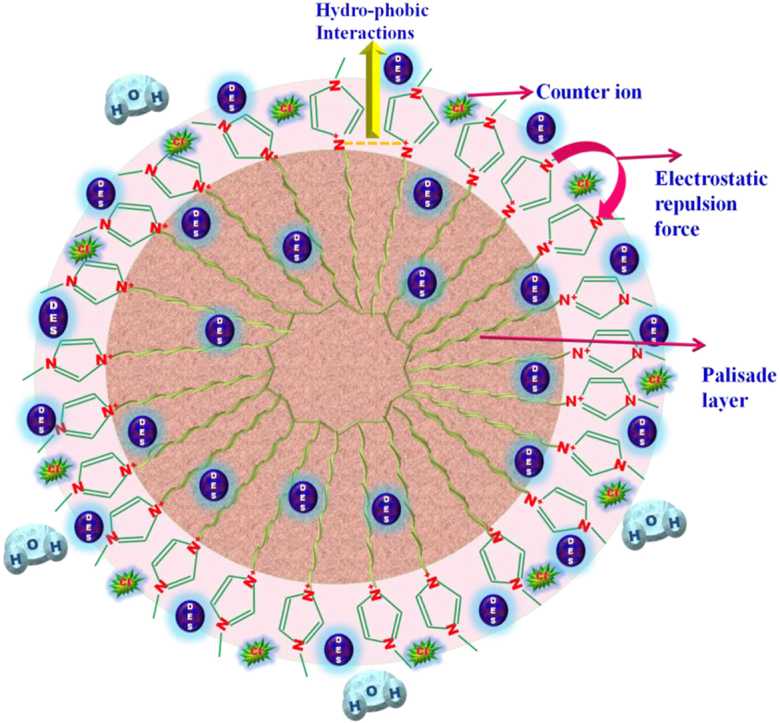
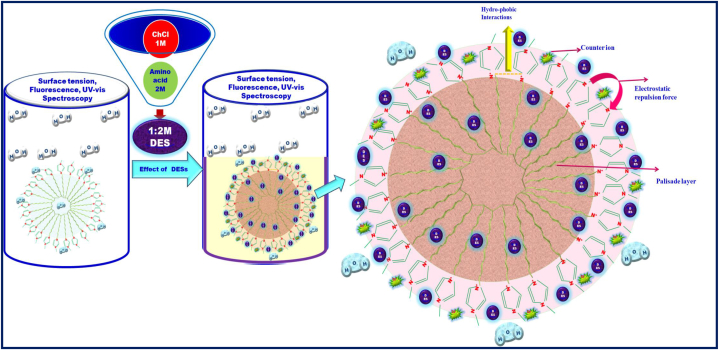
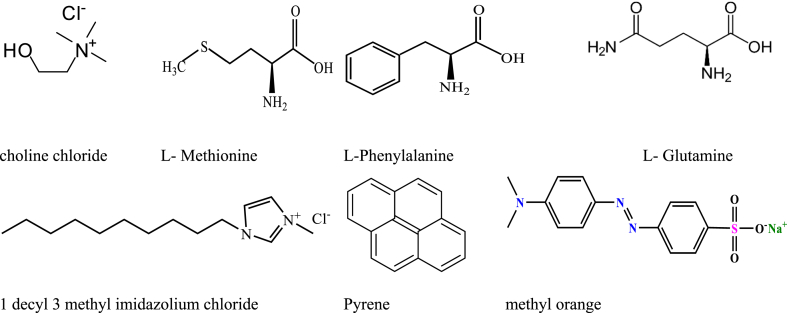
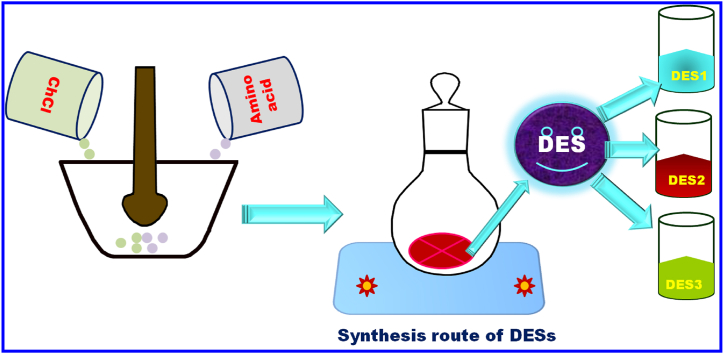
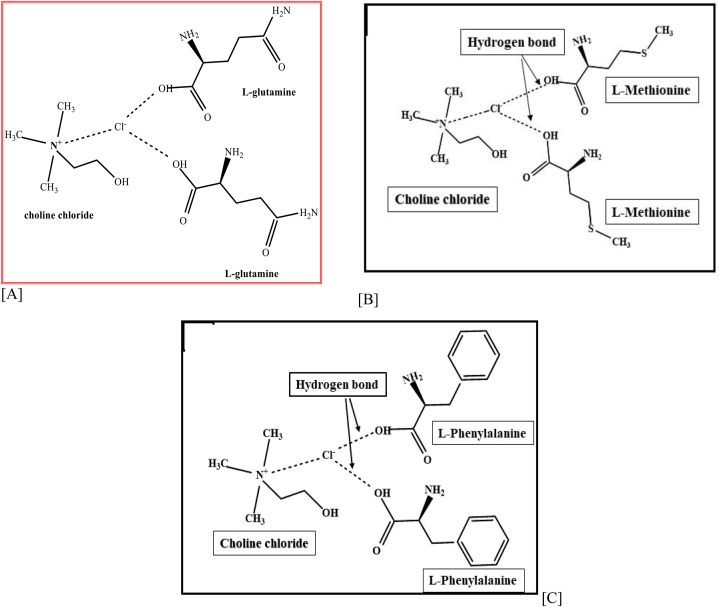
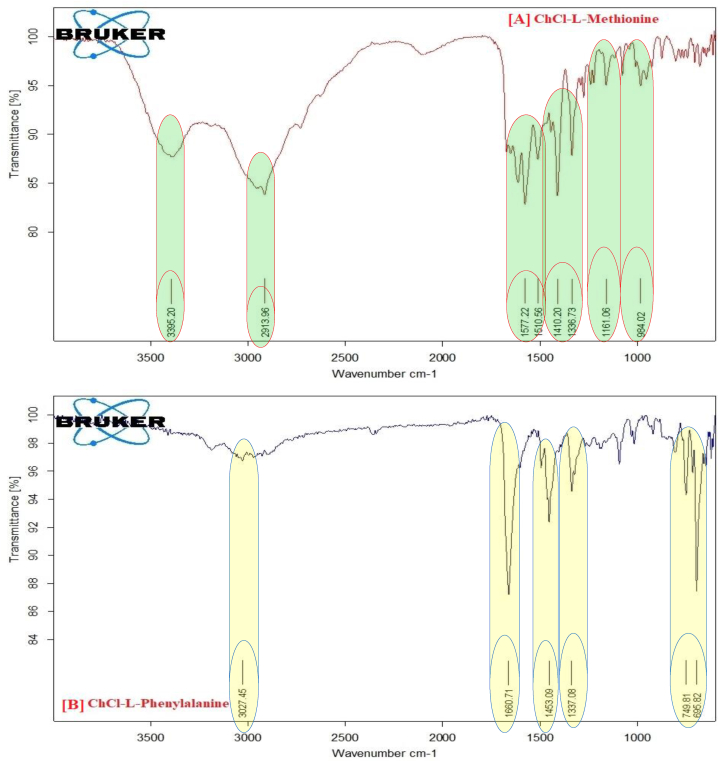
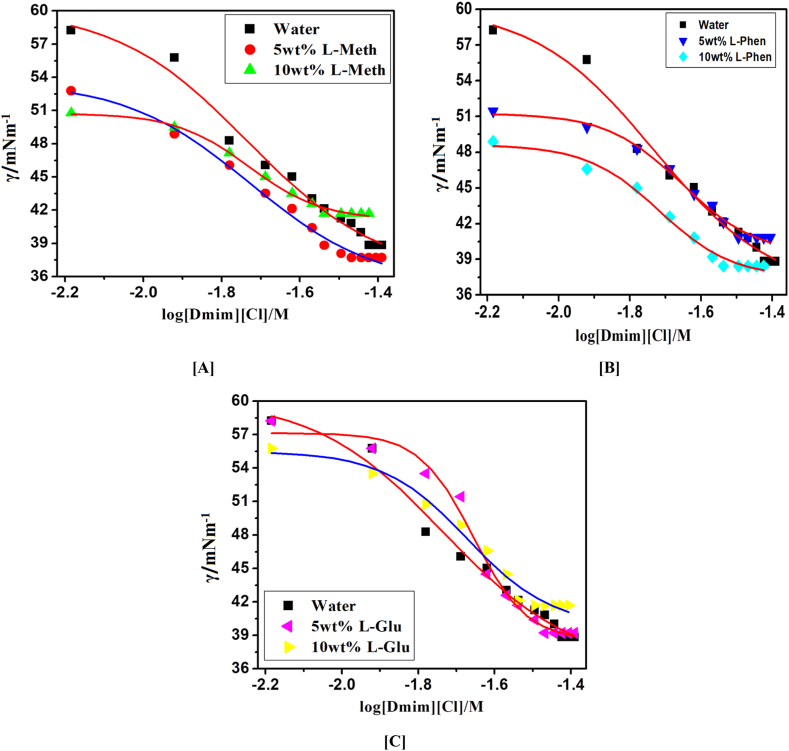
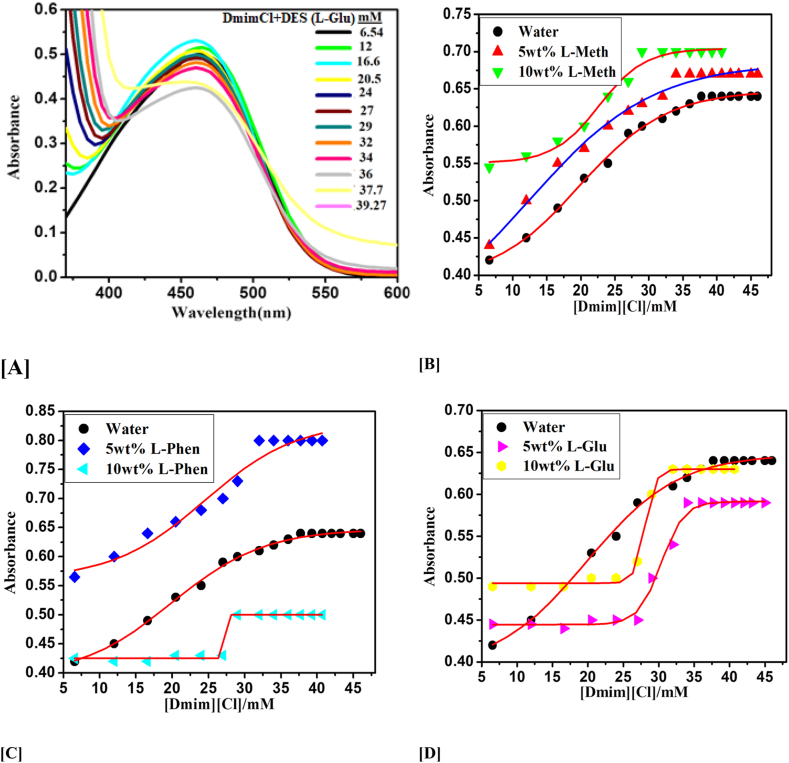
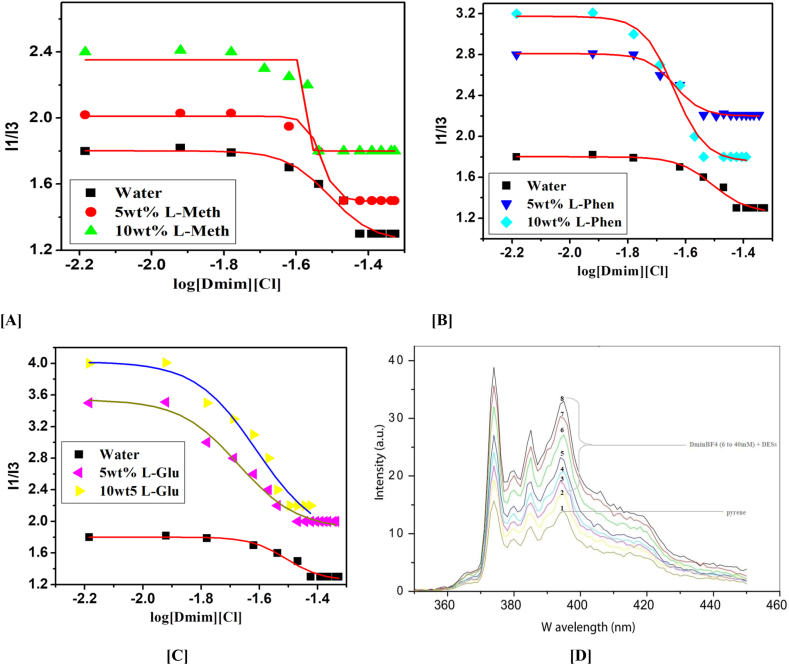
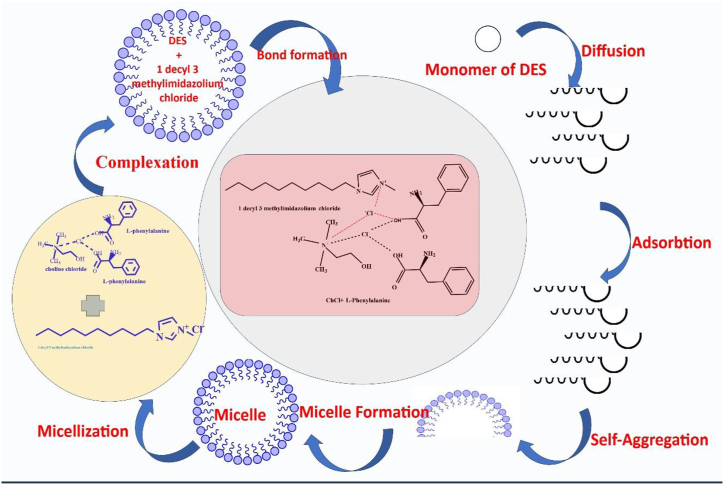
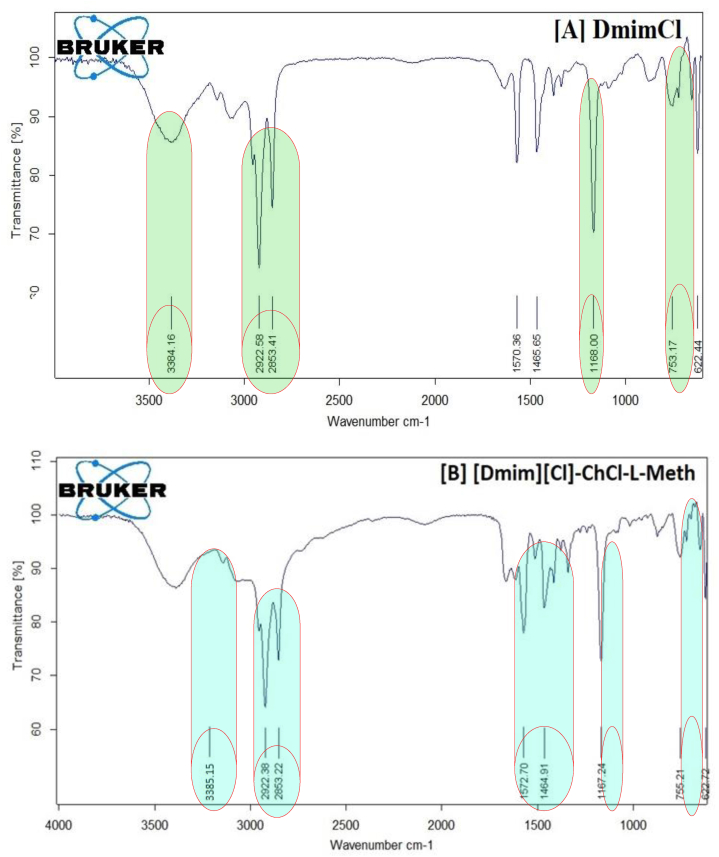
Interaction between a surface active ionic liquid (IL) viz. 1-decyl-3-methylimidazolium chloride [Dmim][Cl] with three novel amino acid-based deep eutectic solvents (DES, consisting of choline chloride and l-methionine (DES1), l-phenylalanine (DES2), and l-glutamine (DES3) in a 1: 2 mol ratio) is studied. Several techniques, including surface tension, fluorescence, UV-visible spectroscopy, and Fourier transform infrared (FTIR), were used to investigate the key micellar properties and intermolecular interactions between the IL and DESs. All the DESs studied here facilitate the micellization process successfully lowering the critical micelle concentrations (CMC) of [Dmim][Cl] with addition of 5 wt% and 10 wt% of DESs. In decreasing order of DES2 > DES1 > DES3, the affinity to promote IL [Dmim][Cl] aggregation within aqueous DES solutions. Additionally, the CMC values as well as the surface tension at CMC are both noticeably reduced significantly by DES2. The surface tension method determines how three amino acid-based DESs affect the CMC, Г, π, A and pC of micellization. When IL [Dmim][Cl] forms micelles within DES solutions, the solvophobic effect predominates, and the intermolecular hydrogen-bond interaction helps to form micelles. FTIR was used to examine the molecular interactions and structural changes of the ionic liquid self-assemblies in aqueous DESs. The results show that the presence of DESs greatly aids in the micellization of [Dmim][Cl], and to a greater extent for DES2 than for DES1/DES3. The colloidal properties of DES and their mixtures are advantageous for the solubility, micellization, and other features of ionic liquids; further details on this positive observation are provided in the results and discussion. In the areas of micellization, CMC, synthesis, catalysis, and environmental, biological, and pharmaceutical applications, among others, DESs are extremely useful.
研究了一种表面活性离子液体(IL)即1-癸基-3-甲基咪唑氯化物[Dmim][Cl]与三种新型氨基酸基深共熔溶剂(DES,由氯化胆碱和L-蛋氨酸(DES1)、L-苯丙氨酸(DES2)和L-谷氨酰胺(DES3)按1:2摩尔比组成)之间的相互作用。采用了多种技术,包括表面张力、荧光、紫外可见光谱和傅里叶变换红外(FTIR)光谱,来研究IL与DES之间的关键胶束性质和分子间相互作用。本文研究的所有DES都成功促进了胶束化过程,通过添加5 wt%和10 wt%的DES降低了[Dmim][Cl]的临界胶束浓度(CMC)。按照促进IL [Dmim][Cl]在DES水溶液中聚集的亲和力从高到低依次为DES2 > DES1 > DES3。此外,DES2显著降低了CMC值以及CMC处的表面张力。表面张力法确定了三种氨基酸基DES对胶束化的CMC、Г、π、A和pC的影响。当IL [Dmim][Cl]在DES溶液中形成胶束时,疏溶剂效应占主导,分子间氢键相互作用有助于形成胶束。FTIR用于研究离子液体自组装体在DES水溶液中的分子相互作用和结构变化。结果表明,DES的存在极大地促进了[Dmim][Cl]的胶束化,DES2的促进程度大于DES1/DES3。DES及其混合物的胶体性质有利于离子液体的溶解性、胶束化和其他特性;结果与讨论部分提供了关于这一积极观察结果的更多细节。在胶束化、CMC、合成、催化以及环境、生物和制药应用等领域,DES非常有用。