D Siri, Vellaturi Gopikrishna, Shaik Ibrahim Shaik Hussain, Molugu Srikanth, Desanamukula Venkata Subbaiah, Kocherla Raviteja, Vatambeti Ramesh
Department of CSE, Gokaraju Rangaraju Institute of Engineering and Technology, Hyderabad, India.
Department of Information Technology, MLR Institute of Technology, Hyderabad, India.
Heliyon. 2024 Jul 27;10(15):e35217. doi: 10.1016/j.heliyon.2024.e35217. eCollection 2024 Aug 15.
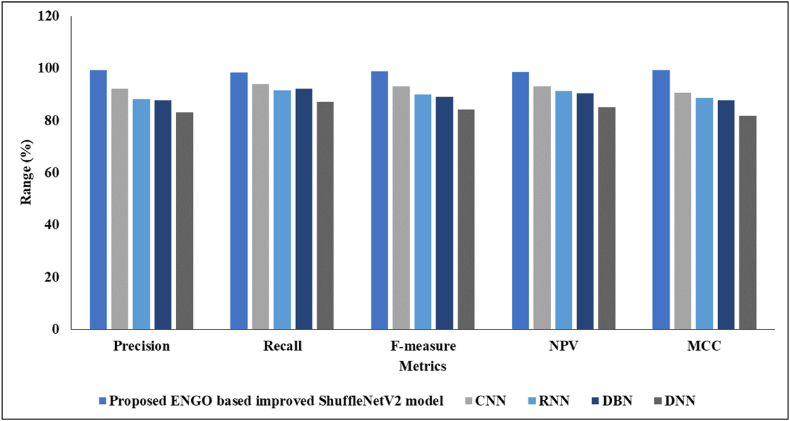
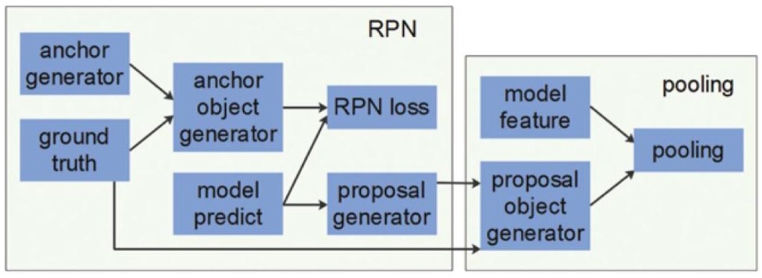
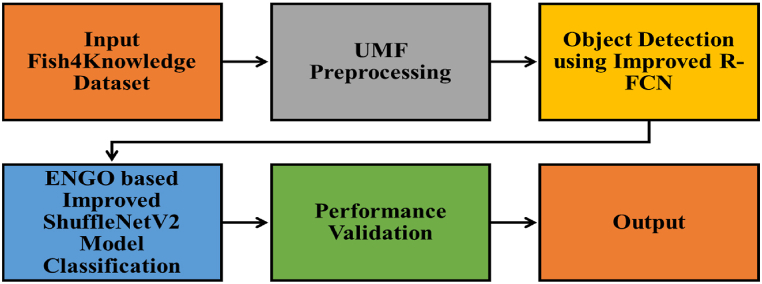
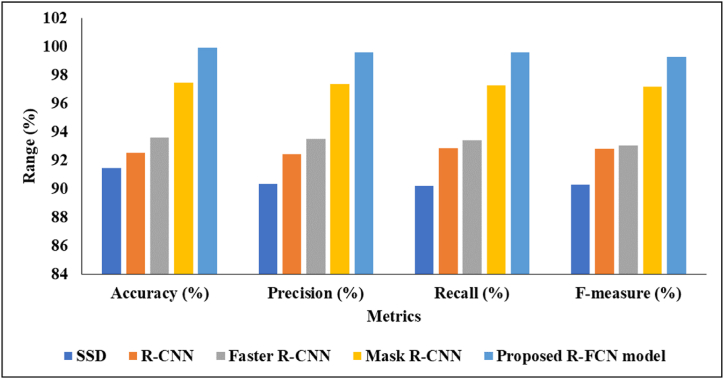
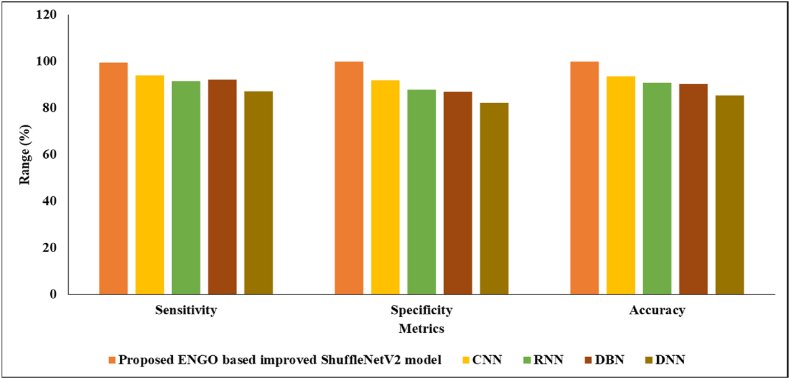
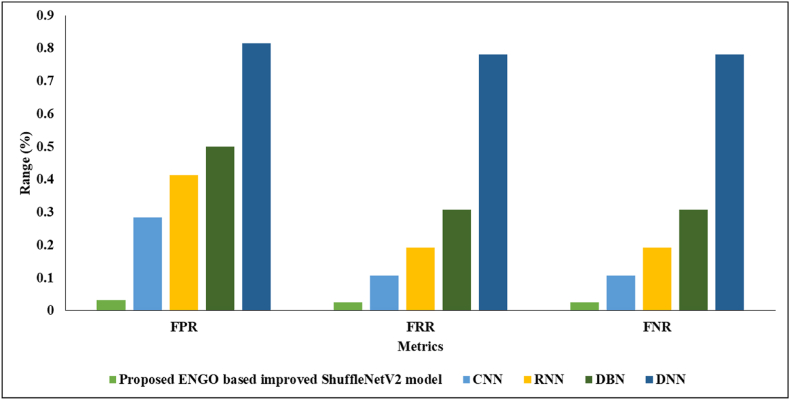
Underwater cameras are crucial in marine ecology, but their data management needs automatic species identification. This study proposes a two-stage deep learning approach. First, the Unsharp Mask Filter (UMF) preprocesses images. Then, an enhanced region-based fully convolutional network (R-FCN) detects fish using two-order integrals for position-sensitive score maps and precise region of interest (PS-Pr-RoI) pooling for accuracy. The second stage integrates ShuffleNetV2 with the Squeeze and Excitation (SE) module, forming the Improved ShuffleNetV2 model, enhancing classification focus. Hyperparameters are optimized with the Enhanced Northern Goshawk Optimization Algorithm (ENGO). The improved R-FCN model achieves 99.94 % accuracy, 99.58 % precision and recall, and a 99.27 % F-measure on the Fish4knowledge dataset. Similarly, the ENGO-based ShuffleNetV2 model, evaluated on the same dataset, shows 99.93 % accuracy, 99.19 % precision, 98.29 % recall, and a 98.71 % F-measure, highlighting its superior classification accuracy.
水下相机在海洋生态学中至关重要,但其数据管理需要自动物种识别。本研究提出了一种两阶段深度学习方法。首先,非锐化掩模滤波器(UMF)对图像进行预处理。然后,一个增强的基于区域的全卷积网络(R-FCN)使用用于位置敏感得分图的二阶积分和用于提高准确性的精确感兴趣区域(PS-Pr-RoI)池化来检测鱼类。第二阶段将ShuffleNetV2与挤压与激励(SE)模块集成,形成改进的ShuffleNetV2模型,增强分类聚焦。使用增强的苍鹰优化算法(ENGO)对超参数进行优化。改进的R-FCN模型在Fish4knowledge数据集上实现了99.94%的准确率、99.58%的精确率和召回率以及99.27%的F值。同样,在同一数据集上评估的基于ENGO的ShuffleNetV2模型显示出99.93%的准确率、99.19%的精确率、98.29%的召回率和98.71%的F值,突出了其卓越的分类准确率。